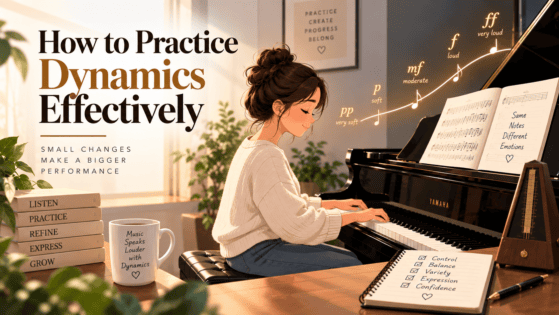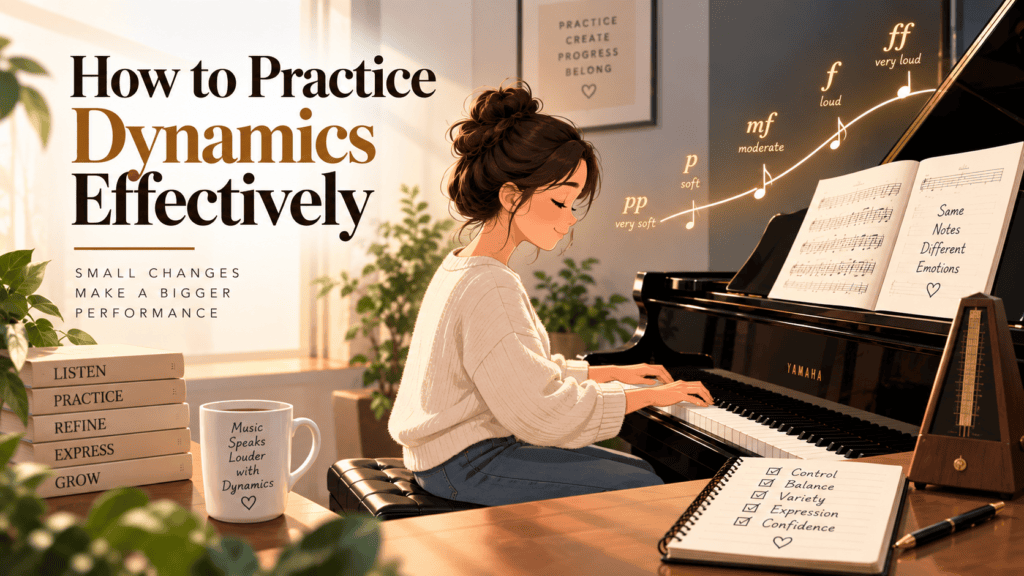
How to Practice Dynamics Effectively
Practice piano dynamics is an important part of developing expressive and musical piano playing. Learning the correct notes and rhythms is only the beginning. A piece can sound completely different depending on how softly or strongly the notes are played, where the music grows louder, where it becomes quieter, and which melodic lines receive emphasis.
Many students understand dynamic markings such as piano, forte, crescendo, and diminuendo but find it difficult to produce them consistently. The solution is not simply to play louder or softer. Effective dynamic practice involves listening carefully, controlling touch, balancing the hands, understanding the musical phrase, and deliberately practising changes in volume.
Dynamics should therefore become part of regular piano practice rather than something added just before a performance.
What Are Dynamics in Piano Music?
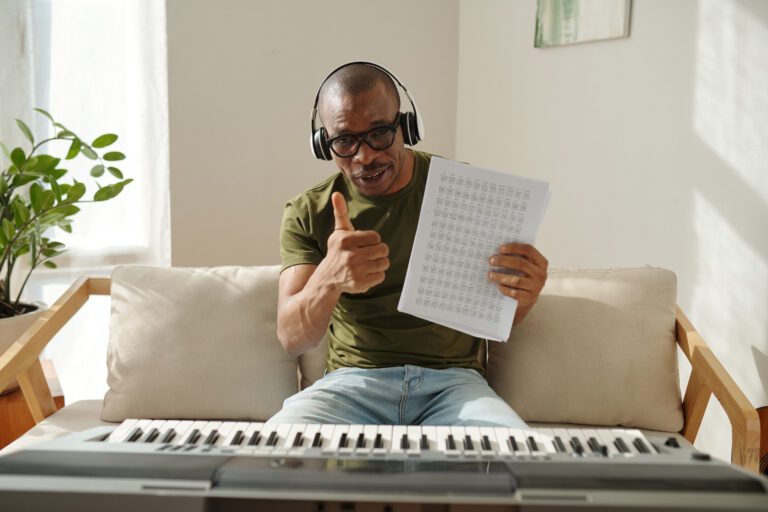
Dynamics describe the relative loudness and softness of music.
Common markings include:
- pp – pianissimo: very soft
- p – piano: soft
- mp – mezzo piano: moderately soft
- mf – mezzo forte: moderately loud
- f – forte: loud
- ff – fortissimo: very loud
- crescendo: gradually becoming louder
- diminuendo: gradually becoming softer
- sfz – sforzando: a sudden strong emphasis
These markings provide a general musical direction rather than an exact volume level.
For example, piano does not simply mean playing as quietly as possible. It means creating a softer sound that still has clarity, control, and musical intention.
Start by Listening to the Difference
Before trying to control dynamics, students need to hear them.
Play a simple phrase several times. First play it softly, then moderately, and then strongly. Listen carefully to the difference in tone and intensity.
Do not focus only on how much pressure you are using. Listen to the sound produced by the piano.
You can also record yourself playing the same phrase at different dynamic levels. Listening back can reveal whether the difference between soft and loud playing is actually clear.
This kind of active listening makes practice piano dynamics more purposeful because students learn to connect physical movement with the resulting sound.
Practise Dynamics Separately
One effective method is to temporarily remove some of the complexity from the music.
Choose a simple passage and practise it only for dynamic control.
Play the entire passage softly.
Then play it moderately.
Then play it loudly.
After that, create a gradual crescendo from beginning to end.
This exercise helps students understand how their touch affects sound.
Once the dynamic control becomes more comfortable, return to the original music and apply the appropriate dynamics.
Learn to Play Softly Without Losing Control
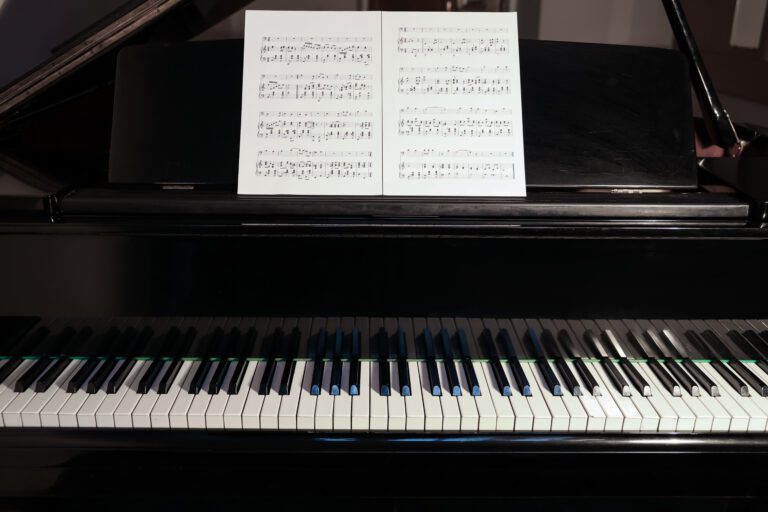
Playing softly can be more difficult than playing loudly.
When students try to play quietly, they sometimes become hesitant or allow the notes to lose clarity. The fingers may become too passive, or the rhythm may become uneven.
The goal is controlled softness.
Try playing a simple five-finger pattern quietly while maintaining an even rhythm and clear articulation. The sound should remain intentional rather than weak.
Gradually experiment with different levels of softness.
This develops control and makes it easier to follow softer dynamic markings in repertoire.
Practise Loud Playing Without Excessive Force
Playing loudly does not mean hitting the keys as hard as possible.
Excessive force can create tension and produce a harsh sound. It can also make it difficult to control the next phrase.
Instead, practise producing a strong, resonant sound while keeping the body comfortable.
The movement should remain controlled. The shoulders, wrists, and arms should not become unnecessarily tense.
Effective practice piano dynamics is about controlling intensity rather than simply increasing physical force.
Balance the Melody and Accompaniment
Dynamic control becomes more complicated when both hands are playing different musical roles.
Often, the right hand carries the melody while the left hand provides accompaniment. The melody needs to remain prominent without making the accompaniment unnecessarily loud.
Practise the hands separately first.
Play the melody and listen to its shape.
Then play the accompaniment and listen to its pattern.
Finally, put them together while deliberately keeping the melody more prominent.
This is one of the most useful exercises for developing dynamic independence.
Practise Crescendos Slowly
A crescendo is not simply a sudden increase in volume.
It is a gradual change.
Choose a short phrase and begin softly. Increase the intensity little by little until you reach the intended dynamic level.
Try counting the phrase while listening to the gradual change.
Ask yourself:
Is the increase noticeable?
Does it happen too quickly?
Does the phrase reach its strongest point too early?
Does the sound remain controlled?
Practising these questions helps students develop more intentional dynamic shaping.
Practise Diminuendos With the Same Care
The opposite is equally important.
A diminuendo requires the pianist to gradually reduce intensity without allowing the music to lose direction.
Choose a phrase and gradually decrease the volume while maintaining rhythm and tone.
The final notes should not simply disappear because the fingers stop supporting them. The pianist should remain in control until the end of the phrase.
This is particularly useful when practising endings, transitions, and lyrical passages.
Use a Metronome While Working on Dynamics
A metronome is usually associated with rhythm and tempo, but it can also support dynamic practice.
Play a phrase at a steady tempo while gradually changing the intensity.
This helps ensure that the crescendo or diminuendo does not accidentally cause the tempo to speed up or slow down.
Students often become excited while playing louder and unconsciously accelerate. Likewise, they may slow down when making a passage softer.
The metronome can help separate dynamic changes from unintended tempo changes.
Exaggerate Dynamics During Practice

Sometimes it helps to exaggerate dynamic differences while practising.
If the final performance requires a subtle crescendo, practise a more obvious crescendo first.
If a melody needs to stand slightly above the accompaniment, temporarily make the difference more pronounced.
Exaggeration makes the dynamic relationship easier to hear and feel.
Once the control is established, reduce the exaggeration until the performance sounds natural.
This technique can be especially useful when students struggle to hear small dynamic differences.
Think About Musical Phrases
Dynamics should not be treated as isolated instructions.
Music has direction.
A phrase may gradually build toward an important note and then relax. Another phrase may begin softly and become more intense. Understanding where the musical idea is going makes dynamic decisions more natural.
Instead of thinking, “I need to play this measure louder,” ask:
“Where is this phrase heading?”
“What is the musical high point?”
“Where does the phrase relax?”
“What should the listener notice?”
These questions turn dynamics into musical expression rather than mechanical volume changes.
Practise One Hand at a Time
Hand independence is essential for dynamic control.
Try playing the right-hand melody while keeping the left hand extremely soft. Then reverse the exercise if the left hand contains the main musical line.
This teaches each hand to operate at a different dynamic level.
You can also practise the accompaniment alone at a very soft dynamic. Then add the melody while keeping the accompaniment at the same quiet level.
With repetition, students become more comfortable controlling different dynamic levels simultaneously.
Use Your Ear More Than Your Eyes

The score tells you what the composer has requested, but your ears tell you whether you are actually achieving it.
After playing a phrase, ask yourself what you heard.
Was the melody clear?
Was the crescendo gradual?
Did the ending become too quiet?
Did the accompaniment overpower the melody?
Did the loud section sound powerful or simply forceful?
This type of self-evaluation is essential for effective dynamic practice.
Record Your Practice
Recording yourself is one of the easiest ways to evaluate dynamics objectively.
While playing, you may feel that you are making a significant dynamic change. When you listen to the recording, however, the difference may sound much smaller than expected.
Record short sections rather than always recording the entire piece.
Listen specifically for:
- Melody and accompaniment balance
- Crescendos
- Diminuendos
- Accents
- Sudden dynamic changes
- Phrase endings
- Overall contrast
Then practise the areas that need adjustment.
Don’t Confuse Dynamics With Emotion Alone
Dynamics contribute strongly to musical expression, but they should still be controlled.
A passionate section does not require uncontrolled force. A quiet section does not need to sound lifeless.
Good dynamic playing combines emotion with technique.
The pianist needs enough control to produce the intended sound consistently while allowing the music to communicate naturally.
This balance develops through thoughtful practice rather than simply trying to “feel” the music more strongly.
Practise Dynamic Changes in Short Sections
When working on a difficult piece, avoid trying to perfect all the dynamics at once.
Choose four or eight measures.
Identify every dynamic marking.
Decide where the phrase grows, where it relaxes, and which notes need emphasis.
Practise that section until the dynamic shape feels natural.
Then move to the next section.
This makes the process manageable and allows students to focus on musical details without becoming overwhelmed.
Pay Attention to Accents
Accents are another important part of dynamic control.
An accent does not always mean playing a note dramatically louder. It means giving the note additional emphasis in relation to the surrounding notes.
Practise short patterns with and without accents.
Listen to how the emphasis changes the musical character.
Then apply the appropriate accents to repertoire.
Learning to control small changes in emphasis can make a performance much more expressive.
Avoid Making Every Section Loud
A common beginner mistake is to play too much of the piece loudly.
If everything is forte, nothing feels especially strong.
Musical contrast is created through differences.
Soft sections make louder sections more meaningful. Quiet endings create space after intense passages. Subtle dynamic changes can make a melody feel more expressive.
Effective practice piano dynamics therefore involves learning when not to play loudly.
Space and restraint are part of dynamic control.
Dynamics and Different Piano Touches

Different types of touch can influence the character of a dynamic.
A lighter touch may create a softer and more delicate sound, while a deeper and more energetic movement can support a stronger sound.
However, students should avoid thinking of dynamics as simply “soft touch equals quiet” and “hard touch equals loud.”
The result depends on technique, speed of movement, the instrument, articulation, and the musical context.
Teachers can help students experiment with different touches and learn which approaches work best for particular repertoire.
A Simple Daily Dynamic Practice Routine
You can include dynamic work in a short section of your normal practice routine.
Start with five minutes of simple scales or five-finger patterns, experimenting with different dynamic levels.
Then choose one phrase from your current piece and practise it softly, moderately, and loudly.
Next, practise any crescendos and diminuendos slowly.
After that, work on melody-and-accompaniment balance.
Finally, play the phrase normally and listen to whether the dynamics now feel more natural.
This does not require a separate hour of practice. A few focused minutes each day can gradually improve control.
Final Thoughts
Practice piano dynamics is essential for turning accurate playing into expressive playing. Learning notes and rhythms gives you the foundation, but dynamics help communicate the character, direction, emotion, and structure of the music.
The most effective approach is to practise dynamics deliberately. Listen carefully, exaggerate contrasts when necessary, work on short passages, balance the hands, control crescendos and diminuendos, and record yourself regularly.
With consistent practice, dynamic control becomes less conscious and more natural. Instead of simply reacting to markings on the page, pianists begin to understand how musical phrases breathe, build, relax, and communicate.
At The Mystic Keys, students can develop these skills through personalised online piano lessons with guidance suited to their level and musical goals. With the right technique and regular practice, students can learn not only to play the correct notes but also to make those notes expressive and meaningful.
If you want to develop stronger control, musical expression, and confidence at the piano, Piano Lessons Online can provide structured guidance and personalised feedback throughout your learning journey.
For more information and exciting resources about learning music, visit our website at The Mystic Keys. For more music content and exciting offers follow us on
Facebook, Instagram, YouTube, LinkedIn, Twitter, Pinterest, and Threads.