
Better Sight-Reading | Improve Your Piano Sight-Reading Skills
Sight-reading is one of the most valuable skills a pianist can develop. Whether you are a beginner learning your first pieces, an intermediate player preparing for an exam, or an advanced pianist working toward confident performances, the ability to read and play unfamiliar music can make a remarkable difference.
Unlike memorising a piece, sight-reading requires you to understand and respond to music in real time. You look at a score, recognise the notes, rhythm, dynamics, articulation, and musical patterns, and then translate all of that information into sound—without stopping every few seconds to figure things out.
For many piano students, sight-reading can initially feel intimidating. A new piece may seem filled with unfamiliar notes, complicated rhythms, key signatures, accidentals, and musical markings. However, strong sight-reading is not simply a talent that some pianists are born with. It is a skill that can be developed through consistent practice and the right approach.
With regular training, you can become faster at recognising patterns, more comfortable reading ahead, and better at maintaining a steady pulse even when you make a mistake. More importantly, improving your sight-reading can make learning new music easier and more enjoyable.
So, how can you become a better piano sight-reader? Let’s explore the techniques, habits, and practice strategies that can help you build greater confidence at the keyboard.

What Is Better Sight-Reading for Piano?
Piano sight-reading is the ability to play a piece of music that you have not previously practised or memorised. Instead of spending days learning the notes before playing the piece, you are expected to interpret the written score and perform it as accurately and musically as possible on your first attempt.
This process involves much more than simply identifying individual notes. Your brain needs to process several elements at once, including pitch, rhythm, key signatures, time signatures, dynamics, articulation, phrasing, and musical structure. At the same time, your hands must respond accurately while your eyes continue moving through the score.
That is why sight-reading can feel challenging even for pianists who play technically difficult pieces from memory. Memorisation allows you to rely on familiarity and muscle memory, whereas sight-reading demands continuous visual and mental attention.
The good news is that you do not need to consciously analyse every single symbol once your skills improve. With practice, your brain begins to recognise common musical patterns automatically. This allows you to read groups of notes, rhythmic figures, chords, scales, and familiar harmonic movements rather than processing every note individually.

Why Is Sight-Reading Important for Pianists?
Good sight-reading can transform the way you learn and experience music. When you can comfortably approach an unfamiliar score, you are no longer dependent on a teacher, recording, tutorial, or extensive preparation before discovering how a piece sounds.
For students, this skill is particularly useful when learning new repertoire. Instead of spending a long time figuring out the notes before practising musically, you can begin understanding the structure and character of a piece much sooner. As a result, practice sessions often become more efficient.
Sight-reading is also extremely useful for piano exams. Many examination systems include a sight-reading component because it tests whether a student can apply their musical knowledge in real time. Rather than relying entirely on memorisation, students need to demonstrate that they can interpret unfamiliar music with reasonable accuracy, rhythm, and musical expression.
Beyond examinations, sight-reading develops overall musical independence. A pianist who reads confidently can explore new compositions, accompany other musicians, participate in ensembles, play from lead sheets, and experiment with music that they have never encountered before.
Perhaps most importantly, strong sight-reading reduces the fear associated with unfamiliar music. Instead of thinking, “I have never played this before,” you begin to think, “Let me see what I can make of this.”

Better Sight-Reading Starts Before You Play
One of the biggest mistakes pianists make when sight-reading is immediately placing their hands on the keyboard and starting to play. Although this may seem like the fastest approach, it often creates unnecessary mistakes.
Before playing a single note, take a few moments to scan the score. Look at the key signature, time signature, tempo marking, dynamics, repeats, rests, accidentals, and any obvious changes in rhythm or texture.
Pay particular attention to the opening measures and any sections that visually appear more complicated. You do not need to analyse the entire piece in detail. The goal is simply to give your brain a quick preview of what is coming.
For example, if you notice that the piece is in 3/4 time, you already know that the music will generally have three beats per measure. Seeing a key signature with several sharps or flats tells you which notes are likely to appear regularly. A repeated chord pattern or scale passage may also become easier to recognise once you have identified it visually.
This short preparation can make a significant difference because you are no longer approaching the score completely blindly.

Look for Patterns Instead of Individual Notes
One of the most effective ways to improve piano sight-reading is to stop thinking about every note as an isolated object.
Imagine seeing a passage containing five or six notes moving stepwise. A beginner may read each note separately: “C… D… E… F… G.” An experienced reader is more likely to recognise the passage as a scale or a familiar melodic pattern.
The same principle applies to chords. Instead of reading three or four notes individually, learn to recognise common chord shapes and intervals. When you see a familiar triad, for instance, your brain can identify the overall shape rather than calculating each note independently.
This approach dramatically reduces the amount of mental processing required.
Patterns can include scales, arpeggios, broken chords, intervals, repeated rhythmic figures, chord progressions, sequences, and common accompaniment patterns. The more musical patterns you encounter during practice, the faster your brain becomes at recognising them.
Over time, sight-reading becomes less about decoding individual symbols and more about recognising musical language.

Develop Strong Note-Reading Skills
Strong sight-reading begins with reliable note recognition. If you have to stop and think about the name of every note, maintaining rhythm and musical flow becomes extremely difficult.
Rather than relying exclusively on memorised phrases such as “Every Good Boy Deserves…” or other mnemonic devices, gradually learn to recognise notes by their position, interval relationships, and visual patterns.
Middle C is an important reference point, but it should not become the only note you use to navigate the keyboard. You should gradually become comfortable identifying notes across both staves without having to count lines and spaces every time.
Interval recognition is especially useful. Instead of asking yourself what each note is called, you can learn to recognise whether the next note is a second, third, fourth, fifth, or another interval away. This makes reading melodies considerably faster.
As your skills develop, try looking at groups of notes rather than focusing on one note at a time. Your eyes will gradually learn to absorb more information in a single glance.

Better Sight-Reading by Learning to Read Ahead
One of the clearest differences between beginners and confident sight-readers is where they are looking.
A beginner often looks directly at the note being played. By the time the note is pressed, the eyes are already searching for what comes next. This can create a constant cycle of catching up, which makes the music feel rushed, hesitant, or disconnected.
Strong sight-readers train themselves to look slightly ahead.
Your eyes should ideally be gathering information about upcoming notes while your hands are playing the current passage. This creates a small mental buffer between what you see and what you play.
At first, reading ahead may feel uncomfortable. You may even make more mistakes because your eyes are moving faster than your hands can respond. With consistent practice, however, the gap becomes more natural.
A simple exercise is to choose an easy piece and consciously look one beat or one small musical group ahead of what your hands are playing. Once that becomes comfortable, gradually increase the distance.
The objective is not to rush your eyes. Instead, you are teaching your brain to anticipate the music rather than constantly reacting to it.

Better Sight-Reading with a Steady Pulse
Rhythm is often more important than perfect notes when sight-reading.
A common mistake is to stop whenever a wrong note is played. Although correcting the note may seem logical, frequent stopping destroys the musical pulse and makes it difficult to develop fluent reading.
Instead, aim to keep moving.
If you miss a note during sight-reading, continue with the rhythm whenever possible. The purpose of practice is not to produce a flawless performance of an unfamiliar piece. You are training your ability to process information and keep the music moving forward.
Using a metronome can be extremely helpful. Start at a tempo that feels comfortable enough for you to maintain a steady pulse. The speed should allow you to read the score without becoming overwhelmed.
As your confidence improves, increase the tempo gradually. A slower, steady performance is far more useful for developing sight-reading skills than a faster attempt filled with stops and corrections.
Learn to Prioritise Accuracy
Sight-reading does not necessarily mean playing every note perfectly.
When you encounter unfamiliar music, some elements naturally deserve greater attention than others. Maintaining the rhythm, identifying the key, following the overall melodic direction, and preserving the musical flow can often be more valuable than stopping to correct one missed note.
This does not mean accuracy is unimportant. Instead, it means learning how to manage mistakes intelligently.
Suppose your right hand misses a note while the left hand continues correctly. Stopping both hands may create a bigger disruption than simply continuing. If you lose your place entirely, recovering becomes even harder.
Therefore, practise recovering from mistakes rather than expecting yourself never to make them.
A confident sight-reader is not someone who never makes mistakes. A confident sight-reader knows how to keep going when mistakes happen.

Better Sight-Reading Through Daily Practice
Consistency is one of the most important factors in improving sight-reading.
You do not necessarily need an hour of sight-reading practice every day. In fact, a focused ten to fifteen minutes can be highly effective when done consistently.
The key is to use new music regularly. If you repeatedly practise the same piece, you eventually begin relying on memory and familiarity. While that is useful for learning repertoire, it does not provide the same challenge as genuine sight-reading.
Choose music that is slightly easier than your current performance level. This is important because sight-reading practice should give your brain enough space to process the score.
For instance, if you can comfortably perform Grade 4 repertoire, you might begin sight-reading pieces around Grade 2 or Grade 3 level. Once those become comfortable, you can gradually increase the difficulty.
The easier the material feels, the more attention you can give to reading ahead, rhythm, phrasing, and musical expression.

Choose the Right Level of Difficulty
One of the most common problems in sight-reading practice is choosing music that is too difficult.
It can be tempting to challenge yourself with a piece that is technically impressive. However, if you spend most of the session stopping to work out complicated notes, the exercise becomes more like regular repertoire practice.
Effective sight-reading material should challenge your reading without overwhelming your technique.
An appropriately difficult piece should allow you to maintain a steady pulse while making occasional mistakes. You should be able to continue playing even when you encounter something unfamiliar.
As your reading improves, gradually introduce more challenging material. The progression should feel manageable rather than frustrating.
Remember that sight-reading practice is not a competition to see how difficult a piece you can attempt. The goal is to improve the speed and accuracy with which you process unfamiliar music.

Better Sight-Reading with Both Hands
Practising hands separately can be helpful when developing basic note-reading skills. It allows you to focus on one staff at a time and become familiar with melodic movement, rhythms, and fingering patterns.
However, sight-reading ultimately requires both hands to work together.
Once you are comfortable with the individual parts, practise reading both staves simultaneously. The piano score is designed to communicate information across both hands, and your brain needs to learn how those parts interact.
Start with simple pieces where the left hand uses straightforward accompaniment patterns. Gradually move toward music with more independent movement between the hands.
This will help you develop the ability to process multiple layers of information at once.

Improve Your Rhythm Reading
Many piano students focus heavily on pitch while neglecting rhythm. Yet a pianist can play the correct notes and still struggle to sight-read effectively if the rhythm constantly breaks down.
Spend time reading rhythms away from the piano. Clap simple rhythmic patterns while counting aloud. Tap the beat with your hand or use a metronome while speaking the rhythm.
Once basic rhythms become comfortable, practise more complex combinations involving rests, syncopation, dotted rhythms, ties, triplets, and changing note values.
Reading rhythm separately can reduce the amount of information your brain needs to process when you eventually combine it with pitch.
As a result, unfamiliar scores become less intimidating because rhythmic patterns begin to feel familiar rather than mysterious.

Understand Key Signatures and Scales
A strong understanding of scales and key signatures can make sight-reading considerably easier.
When you recognise the key of a piece, you already have an idea of which notes are likely to appear and how the music may move harmonically. This allows you to anticipate certain patterns rather than treating every accidental as a surprise.
Practising scales in different keys can therefore support your sight-reading development.
You should also become familiar with common chord progressions and harmonic movements. Many pieces use recurring patterns, and recognising these patterns can help you predict what is likely to happen next.
For example, if you understand common chord relationships, a passage of broken chords may become much easier to interpret. Instead of seeing a random collection of notes, you begin to recognise the underlying harmony.
Music theory and sight-reading are therefore closely connected. The more you understand the language of music, the easier it becomes to read it.

Better Sight-Reading with Musical Phrasing
Sight-reading should not become an exercise in simply hitting the correct keys.
Even when you are playing a piece for the first time, try to notice musical phrases, dynamics, articulation, accents, and changes in character. These markings provide important information about how the composer intended the music to sound.
Of course, you cannot always interpret every detail perfectly during a first reading. Nevertheless, developing the habit of noticing expressive markings will help you become a more musical reader.
Look for obvious dynamic changes such as crescendo, diminuendo, forte, and piano. Notice slurs, staccatos, accents, and rests. Observe where phrases seem to begin and end.
This approach helps transform sight-reading from a mechanical exercise into a musical experience.

Better Sight-Reading with a Metronome
A metronome can become one of your most useful sight-reading practice tools when used correctly.
Rather than setting an ambitious tempo immediately, choose a speed that allows you to maintain a consistent pulse. If you repeatedly lose your place, slow the tempo down.
The metronome should support your reading rather than create pressure.
Once you can comfortably play through a piece at a slower speed, increase the tempo gradually. This process teaches your brain to process musical information more quickly while maintaining rhythmic stability.
Occasionally, it is also useful to practise without a metronome so that you can focus on phrasing and musical flow. Combining both approaches creates a more balanced practice routine.

Do Not Stop When You Make a Mistake
This may be one of the hardest habits for piano students to develop.
When you practise a familiar piece, stopping to correct a mistake can be useful. During sight-reading, however, stopping repeatedly can prevent you from developing fluency.
Instead, treat mistakes as part of the process.
If you play a wrong note, keep your eyes moving and continue with the next musical idea. When you lose your place, use the rhythm, harmonic structure, or a familiar reference point to find your way back.
Learning to recover quickly is an essential part of becoming a confident sight-reader.
Eventually, you will discover that one small mistake does not have to derail the entire performance.

Try Sight-Reading Different Types of Music
Reading the same style of music repeatedly can limit your development.
Classical piano pieces are excellent for developing traditional notation skills, but they are not the only useful material. Try reading simple hymns, pop arrangements, lead sheets, accompaniment patterns, duets, folk songs, and other styles.
Different musical styles expose you to different rhythmic, harmonic, and structural patterns.
For example, playing chord-based arrangements can improve your ability to recognise harmonic shapes. Reading melodies can strengthen interval recognition. Ensemble music can teach you to maintain your part while responding to the broader musical texture.
Variety keeps your practice interesting while also making your reading skills more adaptable.

Make Sight-Reading Part of Your Regular Piano Routine
Sight-reading should not feel like an occasional task that you only practise before an examination.
Instead, incorporate it into your normal piano routine.
You might spend a few minutes warming up with scales, followed by a short sight-reading exercise before moving on to your main repertoire. Even a small amount of regular exposure can produce noticeable improvement over time.
Another effective approach is to keep a collection of easy-to-moderate pieces specifically for sight-reading. Once you have played a piece, set it aside and choose something new the next day.
The important thing is to avoid turning every sight-reading session into a long practice session for the same piece.
Fresh material keeps your brain engaged and ensures that you are genuinely reading rather than relying on memory.
A Simple Sight-Reading Practice Routine
If you are unsure how to structure your practice, try creating a short routine that gradually develops the skills you need.
Begin by selecting a piece that is comfortably below your maximum playing level. Spend around thirty seconds scanning the score. Identify the key signature, time signature, tempo, dynamics, repeated patterns, and any sections that may require extra attention.
Next, establish a comfortable tempo. Before starting, silently look through the opening measures and imagine how the rhythm moves.
Then begin playing without stopping. Focus on keeping a steady pulse and reading ahead. If you make a mistake, continue whenever possible instead of returning to the beginning.
After finishing, take a moment to identify what caused difficulty. Perhaps the rhythm was challenging, the left-hand pattern was unfamiliar, or you struggled to recognise certain intervals.
Use that observation to guide your next practice session.
This simple routine encourages you to focus on the process of reading rather than judging yourself based on perfection.

Common Sight-Reading Mistakes to Avoid
Many students unintentionally make sight-reading more difficult by using habits that work against fluency.
One common mistake is looking down at the hands too frequently. While checking hand position occasionally is natural, constantly watching the keyboard takes your attention away from the score.
Another problem is trying to play every piece at the original performance tempo. A faster tempo does not automatically mean better sight-reading. If the speed causes you to lose rhythm and accuracy, it is working against your progress.
Stopping after every mistake can also create a habit of hesitation. Instead, train yourself to continue and recover.
Finally, avoid practising only pieces that you already know. Familiar music may improve your performance skills, but it does not provide enough opportunity for genuine sight-reading development.
How Long Does It Take to Improve Sight-Reading?
There is no single timeline for improving sight-reading because progress depends on your current level, practice habits, musical background, and consistency.
Some students notice improvements within a few weeks of regular practice, particularly in note recognition and rhythm. Others may need several months to develop greater fluency and confidence.
The most important factor is consistency.
Ten focused minutes every day can be more effective than one long sight-reading session once a week. Frequent exposure teaches your brain to process notation more naturally.
Progress may also feel gradual at first. You might not suddenly notice a dramatic improvement from one day to the next. However, after several weeks of consistent practice, you may realise that unfamiliar pieces no longer look quite as intimidating.
That growing sense of familiarity is an important sign that your reading skills are developing.
Better Sight-Reading for Piano Exams
For students preparing for piano examinations, sight-reading deserves special attention.
Exam sight-reading often requires you to examine an unfamiliar score briefly before playing. You may need to identify the key signature, time signature, tempo, dynamics, articulation, and challenging passages before beginning.
Practising under similar conditions can make the actual exam experience much less stressful.
Instead of immediately playing, train yourself to use the preparation time efficiently. Scan the score from beginning to end, identify potential difficulties, establish the pulse, and mentally prepare the opening.
During the performance, prioritise continuity. If you make a mistake, keep going and recover as quickly as possible.
Exam preparation should therefore involve more than simply practising difficult pieces. Regular exposure to unfamiliar music can help you develop the confidence needed to approach the sight-reading test calmly.
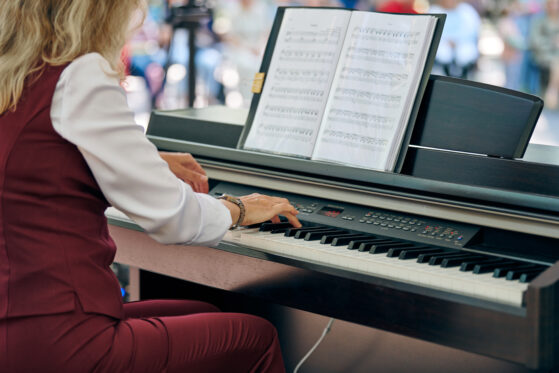
Build Confidence Through Consistent Practice
Confidence in sight-reading does not come from waiting until you feel ready. It develops because you repeatedly expose yourself to unfamiliar music and discover that you can handle it.
Every new piece gives your brain another opportunity to recognise patterns, process rhythms, anticipate musical movement, and coordinate both hands.
Some days will feel easier than others. A piece that looks simple may unexpectedly contain a difficult rhythm, while another that initially appears complicated may turn out to be surprisingly manageable.
That is completely normal.
Instead of judging your progress by the number of mistakes you make, pay attention to how quickly you recover, how far ahead you can read, and how comfortably you can maintain the pulse.
These are meaningful indicators of progress.

Final Thoughts | Become a More Confident Piano Sight-Reader
Improving piano sight-reading is a gradual process, but it is one of the most rewarding skills you can develop as a pianist. With consistent practice, you can learn to approach unfamiliar music with greater confidence and ease.
Start by choosing appropriate-level music, studying the score briefly, recognising patterns, strengthening your rhythm, and training your eyes to read ahead. The Mystic Keys offers personalised Piano Lessons Online to help students develop these skills with structured guidance and support.
Most importantly, keep playing when mistakes happen. Sight-reading is not about playing every note perfectly; it is about understanding and responding to music in real time. With regular practice, unfamiliar scores become easier to navigate and your confidence continues to grow.
Whether you are preparing for an exam, learning new repertoire, or simply becoming a more independent pianist, better sight-reading can make your musical journey smoother. With consistent practice and engaging Piano Lessons Online, you can steadily take your skills to the next level with The Mystic Keys.
For more information and exciting resources about learning music, visit our website at The Mystic Keys. For more music content and exciting offers follow us on
Facebook, Instagram, YouTube, LinkedIn, Twitter, Pinterest, and Threads.