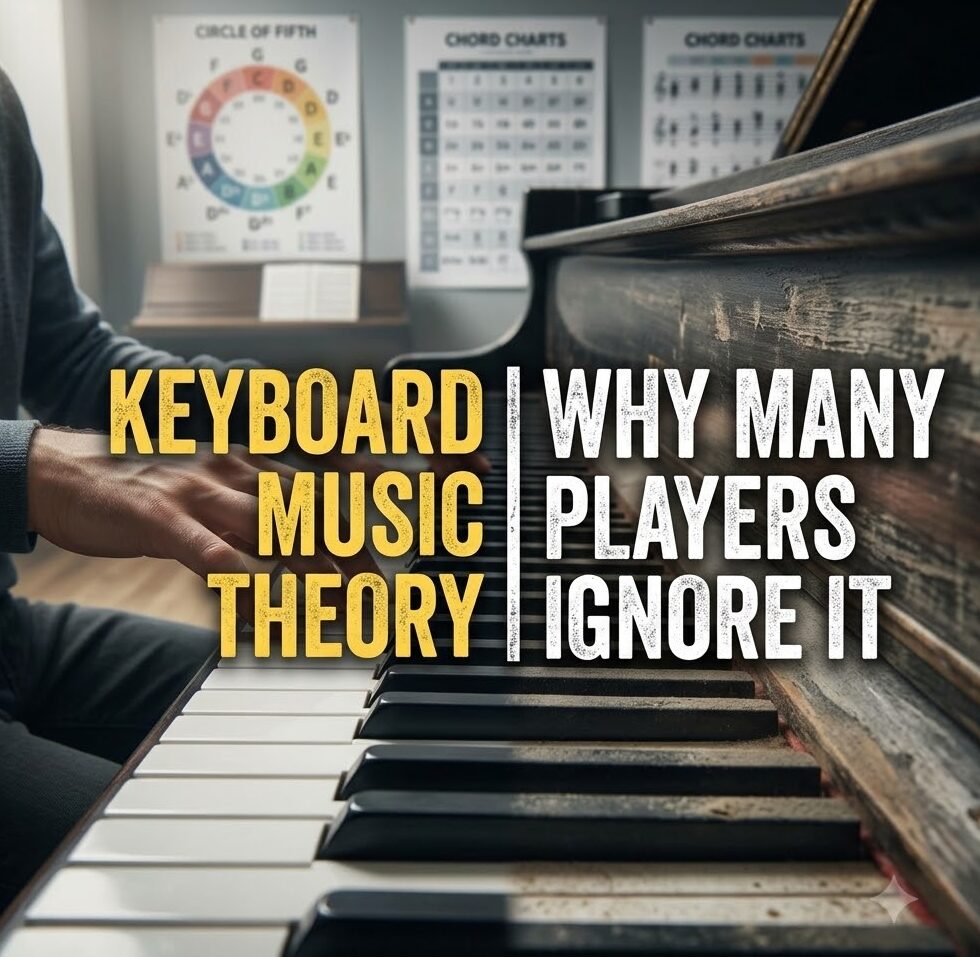
Keyboard Music Theory | Why Many Players Ignore It
Walk into any music classroom, browse keyboard tutorials online, or observe hobbyists practicing at home, and you will notice an interesting pattern. Many keyboard players spend countless hours learning songs, mastering finger movements, and improving speed, yet surprisingly few invest the same effort in understanding music theory.
This is not because theory lacks importance. In fact, music theory serves as the language that explains everything happening beneath the keys. It reveals why certain notes sound pleasing together, how chords create emotion, and what gives songs their structure. Despite these advantages, many keyboard players continue to treat theory as optional rather than essential.
The question is not whether music theory is useful. The real question is why so many keyboard players choose to ignore it. Understanding the reasons behind this trend can help musicians recognize what they might be missing and how theory can transform their musical journey.

The Popular Belief That Theory Is Only for Professionals
One of the biggest reasons keyboard players avoid music theory is the assumption that it is meant only for advanced musicians. Beginners often see theory as something reserved for composers, music teachers, or conservatory students.
This perception usually develops because theory is introduced through technical terminology. Terms such as intervals, chord inversions, harmonic progressions, and modal scales can seem intimidating to someone who simply wants to play their favorite songs. As a result, many learners conclude that theory is an unnecessary complication rather than a practical tool.
Unfortunately, this belief creates a barrier that prevents musicians from discovering how accessible theory can actually be. The reality is that even a basic understanding of scales, chords, and key signatures can significantly improve a player’s confidence and musical awareness. Instead of being reserved for professionals, theory is valuable for anyone who wants to understand what they are playing.

The Appeal of Instant Results Over Keyboard Music Theory
Modern learning culture often emphasizes quick achievements. Keyboard players can now find thousands of tutorials that promise to teach a popular song within minutes. While these resources are helpful, they sometimes encourage a shortcut mentality.
Learning theory requires patience because its benefits are not always immediate. A player can memorize a song and perform it relatively quickly, whereas understanding the theory behind that song may take additional study. Consequently, many learners prioritize visible progress over deeper knowledge.
At first, this approach seems effective. Songs get learned, performances improve, and motivation remains high. However, limitations begin to appear when musicians attempt to play unfamiliar pieces, transpose music, or improvise. Without theoretical understanding, every new song feels like starting from scratch.
Theory may not provide instant gratification, but it offers long-term efficiency. The time invested today often saves countless hours in the future.

The Misconception That Keyboard Music Theory Restricts Creativity
Another common reason players avoid music theory is the fear that it will make their music sound mechanical or overly academic. Some musicians believe creativity should come entirely from emotion and instinct.
This misconception has existed for generations. Stories about famous musicians succeeding without formal theory training have reinforced the idea that knowledge somehow limits artistic expression. As a result, some keyboard players deliberately distance themselves from theory in an effort to preserve originality.
In reality, theory does not dictate creativity; it supports it. Understanding musical concepts gives players more choices, not fewer. Rather than restricting imagination, theory provides a framework that helps musicians explore ideas with greater confidence.
Consider language as an example. Learning grammar does not prevent someone from writing creatively. Instead, it allows them to communicate more effectively. Music theory functions in much the same way. It equips keyboard players with the tools needed to express their ideas more clearly and creatively.

Dependence on Visual Learning Methods
Technology has dramatically changed the way people learn keyboard. Visual tutorials, animated note displays, and imitation-based lessons have become incredibly popular because they make learning feel easy and accessible.
Many players can perform impressive pieces simply by following visual cues. While this method can produce quick results, it often bypasses deeper musical understanding. Learners become skilled at copying patterns without knowing why those patterns work.
Over time, this dependence can create challenges. A musician may be able to reproduce songs accurately yet struggle to identify chords, recognize key changes, or create original arrangements. The absence of theoretical knowledge becomes increasingly noticeable as musical goals become more ambitious.
Visual learning tools are valuable resources, but they work best when combined with theoretical understanding. Together, they create a stronger and more complete learning experience.

Fear of Complexity in Learning Keyboard Music Theory
For many keyboard players, music theory appears overwhelming before they even begin studying it. Thick textbooks, complex diagrams, and unfamiliar terminology can make the subject seem far more difficult than it actually is.
This fear often causes learners to avoid theory altogether. Rather than exploring the basics, they assume the entire subject will be confusing and frustrating. Consequently, they miss opportunities to develop skills that are surprisingly straightforward when taught gradually.
The truth is that foundational theory concepts are quite manageable. Learning major scales, understanding chord construction, and recognizing common progressions can provide immediate practical benefits. These topics do not require advanced mathematical thinking or years of study.
Once players experience how theory applies directly to the music they enjoy, much of the intimidation disappears. What initially seemed complicated begins to feel logical and useful.

Why Keyboard Players Eventually Return to Theory
Interestingly, many musicians who ignore theory in the early stages eventually return to it later. As their skills develop, they encounter situations that cannot be solved through memorization alone.
Improvisation is often one of the first challenges. Creating music spontaneously requires an understanding of scales, chord relationships, and harmonic movement. Similarly, accompanying singers, playing with bands, and arranging songs become much easier when theoretical concepts are understood.
At this point, theory stops feeling like an academic requirement and starts feeling like a practical necessity. Players realize that understanding music allows them to adapt more quickly, learn more efficiently, and communicate more effectively with other musicians.
What once seemed optional gradually becomes essential.

The Hidden Advantages of Learning Keyboard Music Theory
The benefits of music theory extend far beyond passing exams or understanding terminology. Theory helps keyboard players recognize patterns, which dramatically accelerates learning. Instead of viewing each song as a completely separate challenge, musicians begin noticing familiar structures that appear repeatedly across different styles and genres.
Furthermore, theory improves memory. When players understand the relationships between notes and chords, they rely less on pure memorization and more on logical understanding. This often leads to greater confidence during performances.
Another important advantage is musical independence. Rather than depending entirely on tutorials or sheet music, theory enables musicians to analyze songs, create arrangements, and develop original ideas. The keyboard becomes more than an instrument for reproduction; it becomes a tool for expression and exploration.

Finding the Right Balance
Despite its importance, theory should not replace practical playing. Music is ultimately meant to be heard, felt, and experienced. Focusing exclusively on theory without spending time at the keyboard can be just as limiting as ignoring theory altogether.
The most successful musicians typically combine both approaches. They learn songs, practice technique, and perform regularly while also studying the concepts that explain what they are playing. This balance creates a stronger foundation and leads to more consistent growth.
When theory and practice work together, progress becomes more meaningful. Every new piece of knowledge has a practical application, and every performance deepens theoretical understanding.

Conclusion
Many keyboard players ignore music theory because they see it as complicated, unnecessary, restrictive, or disconnected from real-world playing. The popularity of quick tutorials and imitation-based learning has only strengthened these perceptions. However, these beliefs often prevent musicians from unlocking their full potential.
Music theory is not a collection of abstract rules designed to make music more difficult. Instead, it is a guide that helps players understand the logic behind the sounds they create. It transforms random notes into meaningful patterns and turns memorized songs into opportunities for deeper musical expression.
Ultimately, keyboard players do not need to choose between playing music and studying theory. The strongest musicians embrace both. When technical skill is supported by theoretical knowledge, the keyboard becomes far more than a collection of keys—it becomes a language through which creativity can flourish without limits. At The Mystic Keys, our Piano Lessons Online are designed to help students bridge the gap between practical playing and theoretical understanding, creating a stronger foundation for long-term musical growth.
For more information and exciting resources about learning music, visit our website at The Mystic Keys. For more music content and exciting offers follow us on
Facebook, Instagram, YouTube, LinkedIn, Twitter, Pinterest, and Threads.