Count Beats Correctly While Playing Piano
Learning to count beats correctly is one of the most powerful skills you can develop as a pianist. It quietly shapes everything—from how steady your rhythm feels to how confidently you perform in front of others. While many beginners focus heavily on notes and finger placement, rhythm often becomes the invisible thread that holds the entire performance together. Once that thread is weak or inconsistent, even the most beautiful melody can feel unstable.
Understanding how to count properly doesn’t just improve timing; it also builds musical awareness. As you grow more comfortable with counting, you begin to feel music in structured time rather than guessing your way through it. That shift changes everything about how you play.
Why Count Beats Matters More Than You Think
At first glance, counting might feel mechanical or even restrictive. However, it actually gives music its natural flow and emotional shape. Without a steady sense of beat, notes can become disconnected, and phrases lose their direction.
When you count consistently, you are essentially building a rhythm map in your mind. This map guides your fingers even when the passage becomes complex or fast. Over time, your reliance on counting decreases, but the internal sense of rhythm remains strong.
Interestingly, many advanced pianists still rely on mental counting when learning new pieces. This shows that counting is not just for beginners—it is a lifelong tool for musical precision.

Understanding the Pulse Before the Notes
Before diving into counting patterns, it helps to understand the idea of a steady pulse. The pulse is the underlying heartbeat of any piece of music. It continues whether you play a note or not.
While practicing, try tapping your foot or gently nodding your head to the beat. This physical connection reinforces timing in a way that purely mental counting sometimes cannot achieve. As this becomes more natural, your body begins to synchronize with the rhythm automatically.
From here, counting becomes less about effort and more about alignment with that internal pulse. Instead of forcing numbers, you start placing them naturally over a stable foundation.
Starting Simple: Counting in 4/4 Time
Most beginner piano pieces are written in 4/4 time, which is often called “common time.” This simply means there are four beats in every measure.
Instead of rushing through notes, you can calmly count:
“One – two – three – four” and repeat consistently.
While practicing, it helps to say the numbers out loud. This might feel unusual at first, but vocal counting strengthens timing far more effectively than silent thinking. Once comfortable, you can reduce the volume of your voice and eventually count internally.
Gradually, you begin to notice how each note fits into a specific beat rather than floating randomly in time.

Subdividing Count Beats for Better Control
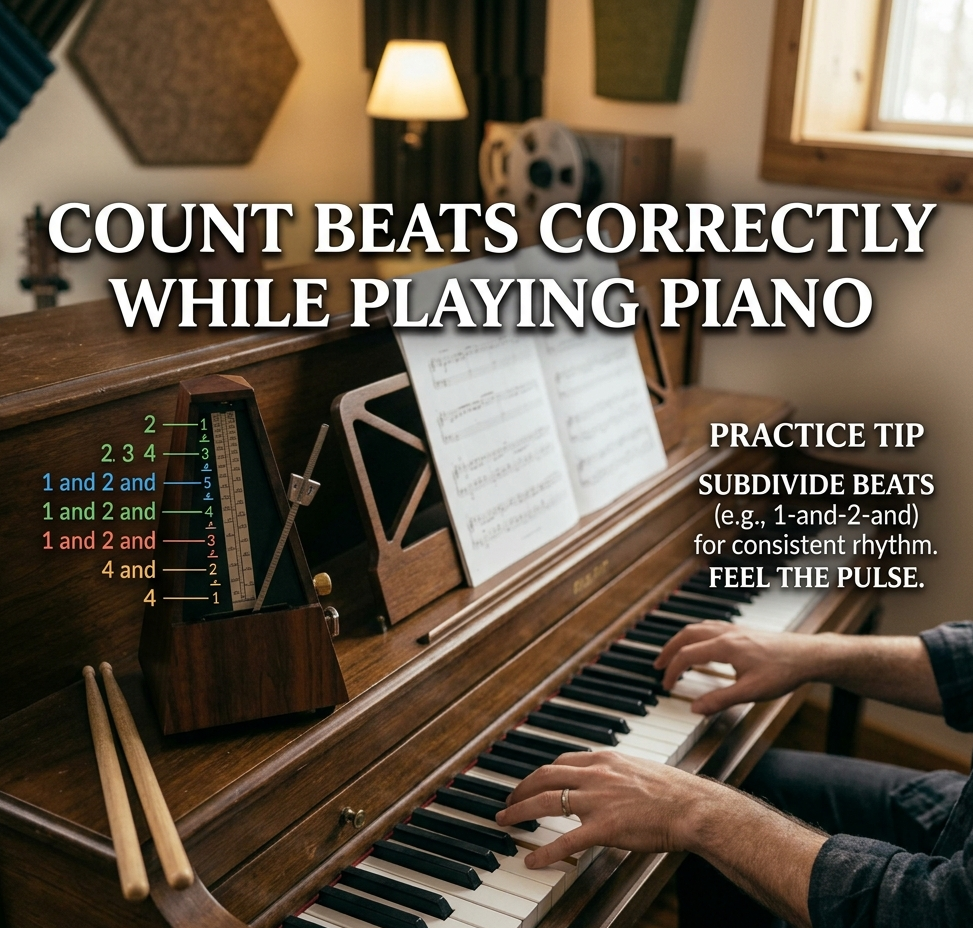
As pieces become more advanced, counting only whole beats is no longer enough. This is where subdivision becomes essential. Subdividing means breaking each beat into smaller parts, such as “1 and 2 and 3 and 4 and.”
At first, this can feel like extra mental effort. However, it quickly becomes a natural habit with practice. Subdivision helps you place faster notes more accurately and prevents rushing or dragging.
While practicing slowly, you might notice that subdivision reveals hidden rhythmic patterns that were not obvious before. This deeper awareness makes your playing cleaner and more controlled, especially in faster passages.

Using a Metronome to Strengthen Count Beats
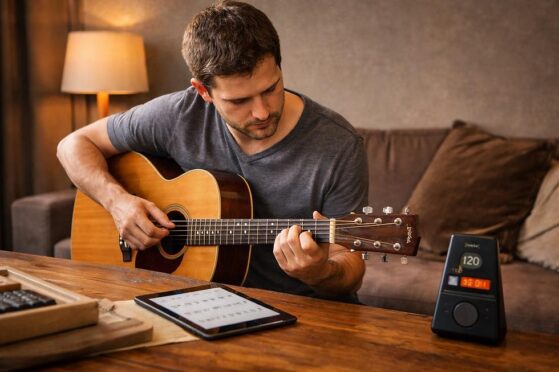
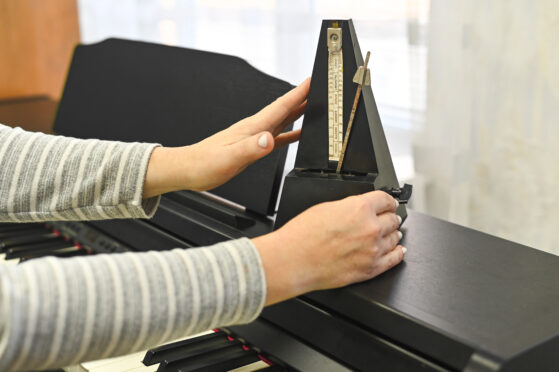
A metronome is one of the most effective tools for developing rhythm, but it should be used wisely. Rather than depending on it all the time, treat it as a guide that checks your internal timing.
Start by setting a slow tempo where you can comfortably count along. As you play, focus on locking your beats with the click instead of chasing it. Over time, you will notice that your internal sense of timing begins to match the metronome naturally.
Once that happens, you can occasionally turn it off and test how steady your internal pulse really is. This balance between guided practice and independent control is what builds strong rhythmic confidence.
Feeling Rhythm Through Musical Phrases
As your counting improves, it becomes important to move beyond mechanical numbers and start feeling musical phrases. Music is not just a sequence of beats; it is a flow of ideas shaped by rhythm.
While counting remains the backbone, your attention gradually shifts toward expression. Certain beats feel stronger, while others feel lighter. This natural rise and fall gives music its emotional character.
At this stage, counting supports expression rather than restricting it. You are no longer just counting time—you are shaping sound within time.
Common Mistakes in Count Beats Practice
One of the most common challenges is speeding up during difficult passages. This usually happens when counting becomes inconsistent or is completely abandoned under pressure. Slowing down practice and reintroducing counting often solves this issue quickly.
Another frequent mistake is counting too loudly or rigidly during performance. While vocal counting is helpful in practice, it should become internal and natural over time. Otherwise, it can interfere with musical expression.
A third issue arises when students skip subdivision altogether. This often leads to uneven rhythm in faster sections. Revisiting slow, subdivided practice can restore clarity and control.
Building a Strong Internal Rhythm
Eventually, the goal is not to count forever, but to develop an internal sense of rhythm so strong that counting happens automatically in your mind. This internalization allows you to focus more on emotion, dynamics, and interpretation.
As this skill develops, you may notice that even unfamiliar pieces become easier to approach. Your brain starts recognizing rhythmic patterns more quickly, and your fingers respond with greater confidence.
With consistent practice, rhythm stops feeling like a separate task and becomes a natural part of your playing identity.
Final Thoughts on Count Beats
Counting beats correctly while playing piano is not just a beginner exercise—it is a foundational musical skill that influences every level of performance. While it may seem technical at first, it gradually transforms into something intuitive and deeply musical.
As you continue practicing, patience plays a key role. Each small improvement in timing adds up over time, shaping a more confident and expressive pianist. In the end, strong rhythm does more than keep you in time—it brings your entire performance to life.
This is exactly why structured guidance matters so much in your musical journey. With consistent support from platforms like The Mystic Keys – Piano Lessons Online, learners can build strong rhythmic foundations while developing real musical confidence step by step.
For more information and exciting resources about learning music, visit our website at The Mystic Keys. For more music content and exciting offers follow us on
Facebook, Instagram, YouTube, LinkedIn, Twitter, Pinterest, and Threads.