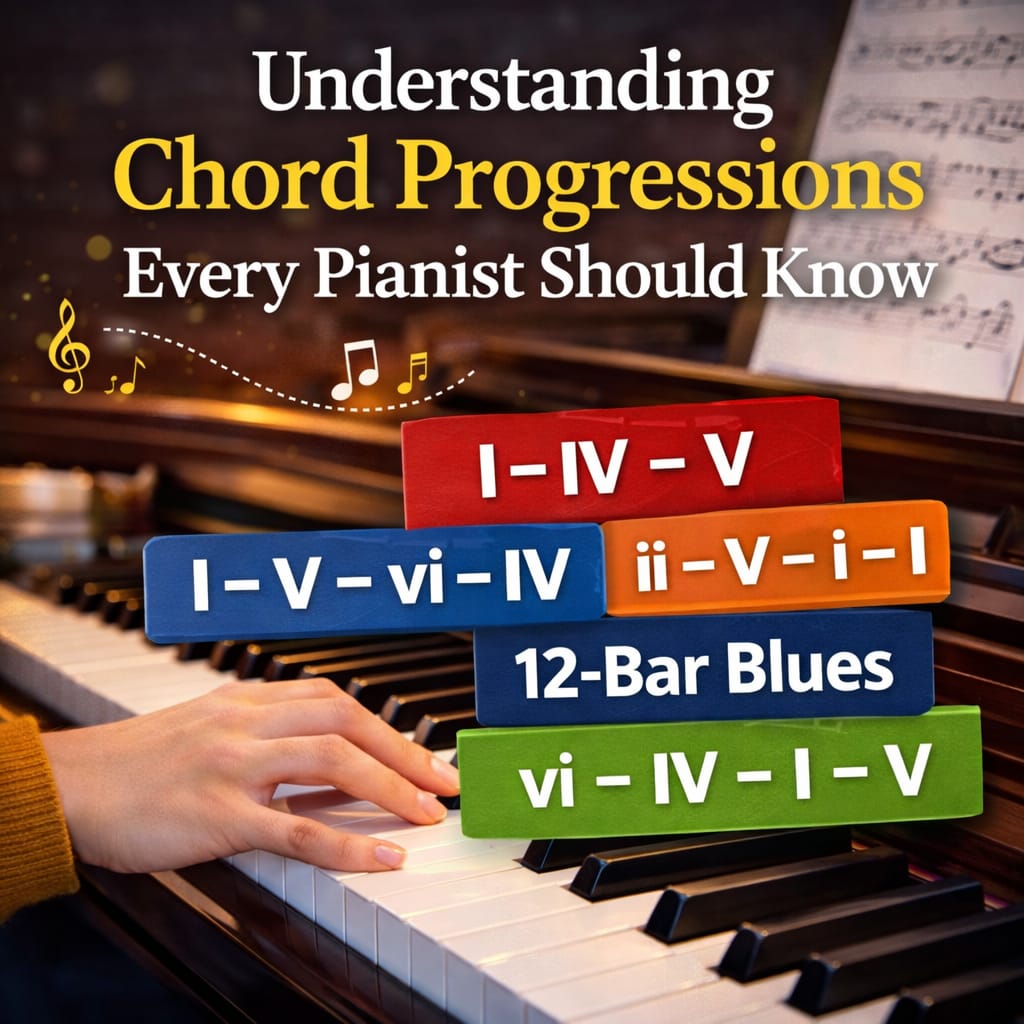
Understanding Chord Progressions Every Pianist Should Know
Chord progressions for pianists are one of the most important concepts to understand when learning piano. A chord progression is a sequence of chords played in a particular order, creating harmony and structure in music. When pianists learn common chord progressions, they can recognize patterns in songs, play accompaniment more easily, and develop stronger musical skills.
Understanding chord progressions for pianists also helps musicians improvise, compose music, and interpret songs with greater confidence. Many popular songs share similar chord patterns, which means that learning just a few essential progressions can open the door to playing hundreds of pieces.
What Is a Chord Progression?

A chord progression is a sequence of chords played one after another in a piece of music. These chords create the harmonic framework that supports the melody.
For example, a simple progression in the key of C major might include:
C – F – G – C
Each chord creates tension and resolution, giving the music direction and emotional impact.
Learning these patterns helps pianists understand how music is structured.
Why Chord Progressions Are Important for Pianists
Understanding chord progressions offers many benefits for piano players.
1. Makes Learning Songs Easier
Many songs use similar chord patterns. Once you recognize these patterns, learning new songs becomes much faster.
2. Improves Musical Understanding
Chord progressions help you understand how harmony works in music. This knowledge makes it easier to analyze songs and play them confidently.
3. Helps with Improvisation
When you know common progressions, you can improvise melodies or accompaniments more easily while playing.
4. Supports Songwriting
Most songwriters rely on chord progressions when creating music. Learning these patterns can help you compose your own pieces.
Common Chord Progressions Every Pianist Should Know

Here are some essential chord progressions that appear frequently in many styles of music.
1. The I – IV – V Progression
One of the most common chord progressions in music is the I – IV – V progression.
In the key of C major, this progression is:
C – F – G
This progression is widely used in:
- Pop music
- Rock music
- Blues music
- Folk songs
It creates a strong sense of movement and resolution.
2. The I – V – vi – IV Progression
This progression is extremely popular in modern pop music.
In the key of C major, the chords are:
C – G – Am – F
Many famous songs use this progression because it creates a balanced emotional flow.
This progression is often used in:
- Pop ballads
- Contemporary music
- Worship music

3. The ii – V – I Progression
The ii – V – I progression is one of the most important chord progressions in jazz music.
In the key of C major, it looks like:
Dm – G – C
This progression creates strong harmonic resolution and is widely used in jazz standards.
Learning this progression helps pianists develop a deeper understanding of harmony.
4. The 12-Bar Blues Progression
The 12-bar blues progression is a fundamental structure used in blues and jazz.
A simplified version in C major includes:
C – C – C – C
F – F – C – C
G – F – C – G
This progression is excellent for practicing rhythm, improvisation, and musical expression.

5. The vi – IV – I – V Progression
Another popular progression used in modern music is:
Am – F – C – G
This pattern appears in many pop songs and creates a smooth emotional flow.
Learning this progression helps pianists play a wide variety of contemporary music.
Tips for Practicing Chord Progressions
Learning chord progressions takes time and regular practice. Here are some helpful tips.
Practice in Different Keys
Once you learn a progression in one key, try playing it in other keys. This strengthens your keyboard awareness.
Practice Smooth Transitions
Focus on moving smoothly between chords. Efficient hand movement makes your playing sound more professional.
Use a Metronome
Practicing with a steady rhythm helps improve timing and consistency.
Experiment with Patterns
Try playing chords in different rhythms or broken chord patterns to create interesting accompaniments.

How Piano Lessons Help You Understand Chord Progressions
Working with an experienced teacher can greatly improve your understanding of harmony and chord progressions.
A teacher can guide you through:
- Proper chord voicings
- Smooth chord transitions
- Musical interpretation
- Improvisation techniques
Structured lessons make it easier to apply chord progressions in real musical situations.

Final Thoughts
Understanding chord progressions is an essential skill for every pianist. These patterns form the harmonic backbone of most music and allow players to learn songs faster, improvise more confidently, and even create their own compositions.
By practicing common progressions regularly and exploring them in different keys, pianists can develop a deeper understanding of music and become more versatile musicians.
Over time, chord progressions will become a natural part of your playing, helping you perform with greater creativity and expression.

About The Mystic Keys
The Mystic Keys is an online music academy dedicated to helping students build strong musical foundations through personalized instruction. The academy offers one-on-one online lessons for Piano Lessons Online, guitar, vocals, drums, Hindustani music, and more. instruments.
Students receive guidance from experienced instructors along with recorded lessons and customized practice materials. This structured approach helps learners improve technique, musical understanding, and confidence.
The academy also prepares students for internationally recognized music certifications such as Trinity College London, helping students achieve important milestones in their musical journey.
For more information and exciting resources about learning music, visit our website at The Mystic Keys. For more music content and exciting offers follow us on
Facebook, Instagram, YouTube, LinkedIn, Twitter, Pinterest, and Threads.