Understanding Sharps and Flats on the Piano
Sharps and flats on the piano are among the first music theory concepts that every beginner encounters while learning the instrument. When students first look at a piano keyboard, they often notice the pattern of white and black keys repeating across the instrument. While the white keys represent the natural notes of the musical alphabet, the black keys introduce the important concept of sharps and flats. Understanding sharps and flats on the piano helps musicians play in different keys, read sheet music correctly, and develop a deeper understanding of how music works. Once you learn how these notes function on the keyboard, the piano becomes far easier to navigate and much more enjoyable to play.

The Layout of the Piano Keyboard
Before understanding sharps and flats, it’s important to look at how the piano keyboard is organized.
A standard piano contains 88 keys, arranged in a repeating pattern of:
7 white keys
5 black keys
The black keys are grouped in sets of:
Two black keys
Three black keys
This pattern repeats across the entire keyboard.
The white keys represent the natural notes of the musical alphabet:
C – D – E – F – G – A – B
After B, the sequence repeats again starting from C.
The black keys are where sharps and flats come into play.
What Is a Sharp?
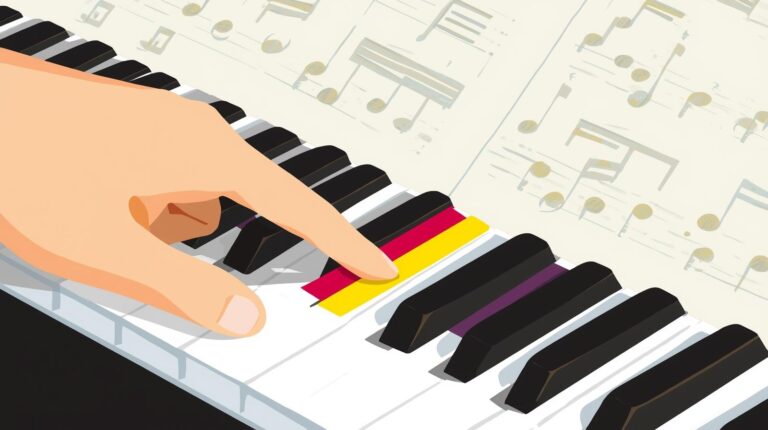
A sharp (#) means that a note is raised by one half step (also called a semitone).
A half step is the smallest distance between two notes on the piano.
When you sharpen a note, you move one key to the right on the keyboard.
Example
If you start on C and move one key to the right, you land on the black key between C and D.
This note is called:
C♯ (C sharp)
So:
C → C♯
Another example:
F → F♯
G → G♯
Each sharp raises the pitch slightly, making the sound higher.
What Is a Flat?
A flat (♭) means that a note is lowered by one half step.
When you flatten a note, you move one key to the left on the keyboard.
Example
If you start on D and move one key to the left, you land on the same black key between C and D.
This note is called:
D♭ (D flat)
So:
D → D♭
Another example:
B → B♭
A → A♭
Flats lower the pitch slightly, making the sound deeper.
Why the Same Key Can Have Two Names
One interesting thing about piano notes is that the same black key can have two different names.
For example:
The black key between C and D can be called:
C♯ (C sharp)
or
D♭ (D flat)
Both refer to the same key on the piano, but the name depends on the musical context or key signature.
This concept is called enharmonic equivalence.
Other examples include:
F♯ = G♭
G♯ = A♭
A♯ = B♭
Understanding this concept helps musicians read music more easily and play in different keys.
Why Sharps and Flats Are Important
Sharps and flats are essential because they allow musicians to play music in different keys and tonalities.
Without them, music would sound very limited and repetitive.
They help musicians:
* Play songs in different keys
* Create emotional expression in music
* Build scales and chords
* Perform classical and modern compositions accurately
Many famous pieces of music rely heavily on sharps and flats to create their distinctive sound.
Sharps and Flats in Musical Scales
Scales are the foundation of music, and sharps and flats are often included to maintain the correct pattern of tones and semitones.
For example:
The C Major Scale
C – D – E – F – G – A – B – C
This scale contains no sharps or flats.
But other scales do.
The G Major Scale
G – A – B – C – D – E – F♯ – G
Notice the F sharp.
The F Major Scale
F – G – A – B♭ – C – D – E – F
Here we see B flat.
These sharps and flats maintain the correct musical spacing between notes.
Key Signatures and Sharps/Flats
In written music, sharps and flats often appear in something called a key signature.
A key signature is placed at the beginning of a staff and tells musicians which notes should be automatically played as sharps or flats throughout the piece.
For example:
* G Major has one sharp (F♯)
* D Major has two sharps (F♯ and C♯)
* F Major has one flat (B♭)
This system helps musicians read music quickly without seeing accidentals on every note.
Accidentals: Temporary Sharps and Flats
Sometimes composers want a note to be sharpened or flattened temporarily.
In this case, they add an accidental symbol before the note.
Accidentals include:
♯ Sharp
♭ Flat
♮ Natural
The natural symbol cancels a sharp or flat and returns the note to its original pitch.
These symbols affect the note only within the measure unless repeated.
How to Identify Sharps and Flats Quickly on the Piano
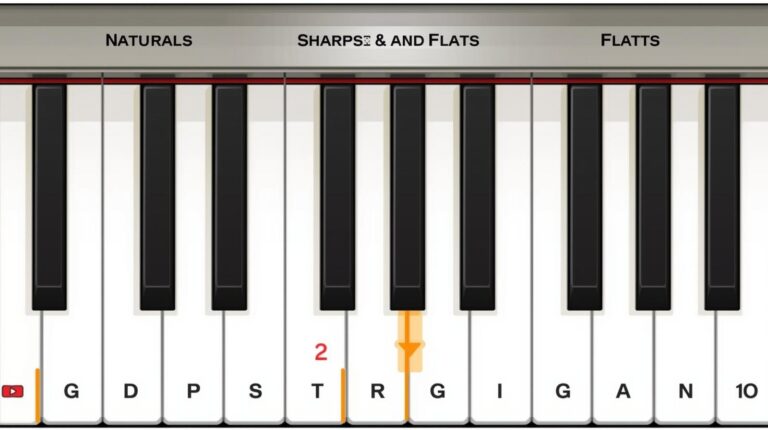
One of the easiest ways to recognize sharps and flats is by using the black key groups.
Two Black Keys
C♯ / D♭
D♯ / E♭
Three Black Keys
F♯ / G♭
G♯ / A♭
A♯ / B♭
By memorizing these groups, beginners can identify notes instantly.
Practice Exercises for Beginners
Here are a few simple exercises to help you understand sharps and flats on the piano.
Exercise 1: Find All the Sharps
Play the following notes:
C♯
F♯
G♯
Notice how each note moves one step to the right.
Exercise 2: Find All the Flats
Play:
D♭
G♭
B♭
Notice how each note moves one step to the left.
Exercise 3: Say the Notes Out Loud
While playing, say the name of each note.
This builds both muscle memory and theory understanding.
Common Beginner Mistakes
Many beginners make small mistakes when learning sharps and flats.
Here are a few to avoid.
Confusing Direction
Sharps go right.
Flats go left.
Ignoring Key Signatures
Always check the key signature before playing a piece.
Forgetting Enharmonic Notes
Remember:
C♯ = D♭
F♯ = G♭
How The Mystic Keys Helps Students Understand Music Theory
At The Mystic Keys, we believe music theory should never feel confusing or overwhelming.
That’s why our teachers break down concepts like sharps, flats, scales, and key signatures step by step during our one-on-one online music lessons.
Students receive:
* Personalized instruction
* Recorded sessions for revision
* Practice notes and exercises
* Guidance from highly experienced teachers
Whether a student is learning piano, keyboard, or music theory, our goal is to make complex musical concepts simple, practical, and enjoyable.
With the right guidance, even beginners quickly become confident in reading music and understanding the piano keyboard.
About The Mystic Keys
The Mystic Keys is a professional online music academy offering personalized music lessons in Piano Lessons Online, guitar, vocals, drums, Hindustani music, and more.
Our teachers are highly trained musicians who provide flexible one-on-one Zoom sessions along with structured lesson plans, recordings, and performance guidance.
Students can also prepare for internationally recognized certifications such as Trinity College London exams.
Our mission is simple: help every student grow into a confident and expressive musician.
Final Thoughts
Sharps and flats are a fundamental part of understanding music. While they may seem complicated at first, they quickly become second nature with regular practice and clear guidance.
By learning how these notes work on the piano, students gain a deeper understanding of scales, chords, and musical expression.
Once you master sharps and flats, the piano keyboard becomes far less mysterious and far more exciting.
Every note suddenly feels like part of a larger musical language — one that allows you to explore endless melodies, harmonies, and creative possibilities.
For more information and exciting resources about learning music, visit our website at The Mystic Keys. For more music content and exciting offers follow us on
Facebook, Instagram, YouTube, LinkedIn, Twitter, Pinterest, and Threads.