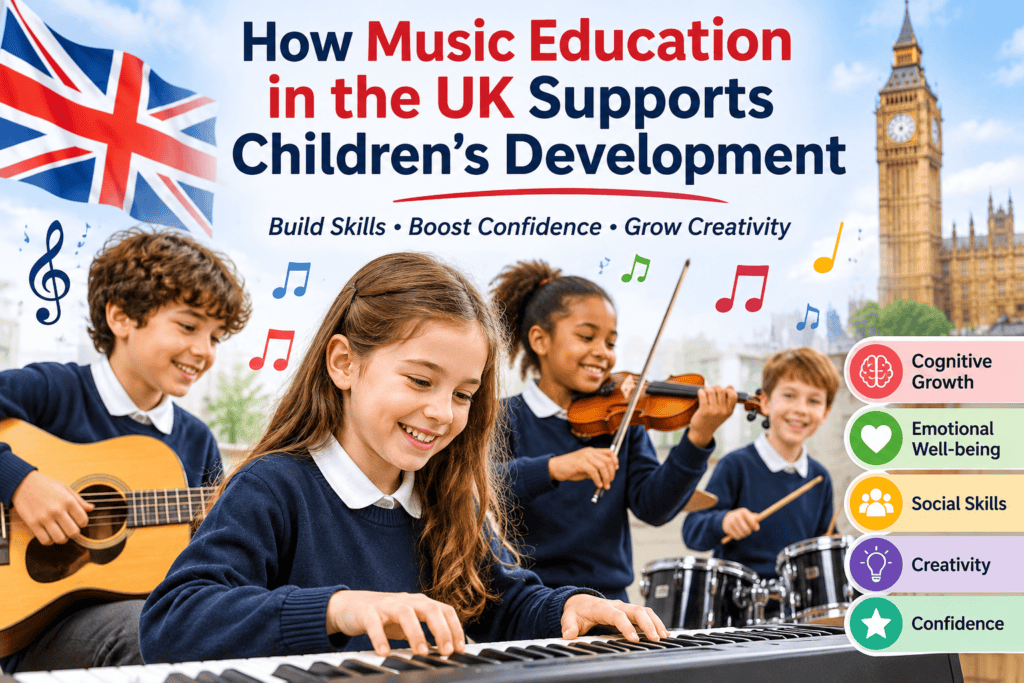
Music Education in the UK
How Music Education Supports Children's Development in the UK
Introduction
A child’s development involves much more than academic learning. Alongside reading, writing, and mathematics, creative activities play an important role in building confidence, communication skills, emotional awareness, and independent thinking. Music education in the UK provides children with opportunities to explore their creativity while developing valuable skills that can support them both inside and outside the classroom.
From learning to play an instrument to participating in school choirs and music groups, musical experiences encourage children to listen, experiment, collaborate, and express themselves. Whether a child is interested in piano, guitar, violin, drums, or singing, music can become a meaningful part of their educational journey.
Understanding how music education supports children’s development can help parents make informed decisions about introducing music lessons at an early age.

Why Music Education in the UK Matters for Children’s Development
Music is an important part of creative education in the UK. Schools and music organisations provide children with opportunities to develop musical knowledge, explore different instruments, and participate in group performances.
Music education is not simply about teaching children how to play songs. It introduces them to rhythm, melody, harmony, listening, and creative expression while encouraging patience and regular practice.
Through structured music lessons, children can develop skills that complement their academic education. These experiences also give them opportunities to discover their interests, build confidence, and enjoy learning in a different environment.
1. Music Education Supports Cognitive Development
Learning music involves several mental processes. Children need to listen carefully, recognise patterns, remember musical sequences, and coordinate their movements while playing an instrument or singing.
These activities provide opportunities to exercise different cognitive skills.
For example, learning a piano piece requires children to remember notes, follow rhythms, read musical notation, and coordinate both hands. Similarly, playing drums involves recognising rhythmic patterns and maintaining consistent timing.
Music education can encourage the development of:
Memory: Remembering melodies, rhythms, lyrics, and musical instructions.
Concentration: Paying attention to notes, timing, and performance details.
Pattern recognition: Identifying repeated musical sequences and structures.
Problem-solving: Working through challenging passages and correcting mistakes.
Coordination: Connecting listening, reading, and physical movements.
These skills are useful in many learning situations, although music lessons should complement rather than replace other forms of education.
2. Music Lessons Help Improve Children’s Concentration
Children often need to manage several activities throughout the school day. Developing the ability to focus on one task at a time can help them become more organised and attentive learners.
Music lessons provide regular opportunities to practise concentration.
When learning an instrument, children must listen to instructions, follow musical patterns, maintain tempo, and notice errors. They gradually learn to pay attention to small details while working towards a larger goal.
For instance, a beginner guitarist may need to concentrate on finger placement, chord transitions, and strumming patterns simultaneously. With practice, these actions become more familiar and controlled.
Regular music practice can encourage children to:
Follow instructions carefully.
Complete tasks step by step.
Pay attention to details.
Remain focused while learning something challenging.
Develop patience through repetition.
These habits can also support their approach to schoolwork and other activities.
3. Music Education in the UK Encourages Emotional Expression
Children do not always find it easy to communicate their emotions through words. Music gives them another way to express feelings, explore different moods, and develop emotional awareness.
A cheerful melody, a gentle piano arrangement, or an energetic drum rhythm can communicate emotions in ways that children can understand and explore.
Through music education, children learn to recognise changes in musical expression, including tempo, dynamics, and tone. They can also experiment with creating their own musical ideas.
Learning to sing or play an instrument may provide a positive creative outlet after a demanding school day.
Music can help children:
Express emotions creatively.
Explore different moods through sound.
Develop confidence in sharing their ideas.
Appreciate different musical styles and expressions.
Find enjoyment and personal satisfaction through learning.
Every child responds to music differently, but creative musical experiences can provide valuable opportunities for emotional development.
4. Music Education Builds Confidence and Self-Esteem
Learning a new skill takes time, and music is no exception. Children may initially struggle with difficult notes, unfamiliar rhythms, or complicated finger movements. However, achieving small musical goals can help them recognise their own progress.
For example, a child who initially struggles to play a simple piano melody may eventually perform it independently after regular practice.
These achievements can strengthen their confidence and encourage them to take on new challenges.
Music education helps children build confidence by giving them opportunities to:
Learn new skills at their own pace.
Overcome challenges through practice.
Perform songs they have learned.
Recognise the value of persistence.
Participating in a school concert, choir performance, or music recital can also help children become more comfortable performing in front of an audience.
5. Learning Music Develops Social Skills and Teamwork
Music is often a shared experience. Children who participate in choirs, bands, orchestras, or group music activities learn how to work with others towards a common goal.
Playing in a group requires listening, cooperation, timing, and mutual understanding.
For example, children participating in a school orchestra must follow the conductor, maintain their individual parts, and coordinate with other musicians. Choir members must listen to different vocal sections to create balanced harmonies.
These experiences encourage important social skills, including:
Active listening.
Cooperation and teamwork.
Respect for other people’s contributions.
Communication and coordination.
Responsibility towards a group.
Group music activities can also help children develop friendships with others who share similar interests.
6. Music Education in the UK Encourages Creativity and Imagination
Children naturally enjoy exploring new ideas, and music provides an environment where they can experiment without always needing a single correct answer.
Learning familiar songs is only one part of musical education. Children can also explore improvisation, songwriting, rhythm creation, and musical storytelling.
For example, a child learning piano might experiment with different melodies over a simple chord progression. A young drummer may create original rhythms using different combinations of beats.
These activities encourage children to think creatively and explore different possibilities.
Music education supports creativity through:
Creating original melodies and rhythms.
Experimenting with musical styles.
Developing songwriting skills.
Interpreting music in individual ways.
Encouraging creativity helps children become more comfortable expressing their ideas and exploring their imagination.
7. Learning an Instrument Develops Discipline and Patience
Musical progress does not happen overnight. Children need regular practice to develop their skills, improve their technique, and become comfortable with new musical concepts.
This process teaches them that improvement often comes through consistent effort.
For example, mastering a guitar chord may require repeated practice to achieve clean finger placement and smooth transitions. Similarly, learning a violin piece involves developing posture, bow control, and accurate intonation over time.
As children progress, they begin to understand the importance of:
Setting achievable goals.
Following a regular practice routine.
Repeating challenging exercises.
Learning from mistakes.
Remaining patient when progress feels slow.
These habits can help children develop a more responsible approach to learning and personal development.
8. Music Education Introduces Children to Different Cultures
The UK is home to children from many cultural backgrounds, making cultural awareness an important part of education.
Music provides an enjoyable way to explore different traditions, languages, instruments, and musical styles.
Through musical activities, children can discover classical compositions, jazz, folk music, Western pop, Hindustani classical music, Carnatic music, and many other traditions.
Exploring different musical styles helps children understand how music reflects cultural identities, histories, and traditions.
It can encourage them to:
Appreciate music from different parts of the world.
Explore unfamiliar instruments and sounds.
Understand different musical traditions.
Develop respect for cultural diversity.
Become more open to new creative experiences.
This exposure can make music learning more engaging while broadening children’s understanding of the world.

9. How Music Education in the UK Complements Academic Learning
Music and academic subjects may appear very different, but they share certain learning processes.
For example, reading musical notation involves recognising symbols and understanding sequences. Rhythm introduces children to patterns, counting, and timing. Learning lyrics can involve language, pronunciation, and memory.
Music activities can therefore provide opportunities to reinforce skills that children also use in academic settings.
Some useful connections include:
Music and mathematics: Counting beats, recognising patterns, understanding rhythm, and exploring musical fractions.
Music and language: Learning lyrics, pronunciation, listening skills, and interpreting musical expression.
Music and reading: Following musical notation, recognising symbols, and understanding written instructions.
Music and physical coordination: Developing controlled movements through playing instruments and performing.
Music education should not be viewed as a shortcut to higher academic achievement. Instead, it offers a different and enjoyable way for children to practise a range of learning skills.
10. Music Lessons Provide Opportunities Beyond the Classroom
Music education does not have to take place only at school. Private music lessons, community programmes, online classes, and local music groups can give children additional opportunities to explore their interests.
In the UK, families can explore school music activities, local music services, community choirs, instrumental programmes, and private tuition.
These opportunities can help children receive more individual attention and work towards musical goals that suit their interests and abilities.
Depending on the child’s age and preferences, parents may consider:
Piano or keyboard lessons.
Acoustic or electric guitar lessons.
Singing and vocal training.
Violin lessons.
Drum lessons.
Group music and choir activities.
Choosing an appropriate learning environment can make music education more enjoyable and sustainable.
11. How Parents Can Encourage Music Education at Home
Parents play an important role in helping children develop a positive relationship with music. Children are more likely to enjoy learning when they receive encouragement without feeling pressured to achieve immediate results.
Parents do not need to be musicians themselves to support their child’s musical development.
Here are some practical ways to encourage music learning at home:
Introduce different types of music: Play different genres and allow children to discover the sounds they enjoy.
Let children explore instruments: Give them opportunities to try different instruments before choosing one.
Create a regular practice routine: Set aside a manageable amount of time for music practice without interfering with schoolwork or rest.
Celebrate small achievements: Recognise improvements in technique, confidence, and consistency.
Encourage musical creativity: Let children sing, experiment with rhythms, and create their own melodies.
Avoid unnecessary pressure: Focus on enjoyment and gradual progress instead of expecting perfection.
A supportive environment can help children develop a lasting interest in music.
12. Choosing the Right Music Lessons for Children in the UK
Every child has different interests, learning preferences, and abilities. Choosing the right music lessons involves considering these individual needs rather than selecting an instrument based only on popularity.
Parents should consider the following factors:
Age and readiness: Choose an instrument and learning approach appropriate for the child’s development and physical comfort.
Musical interests: Consider whether the child enjoys singing, percussion, keyboard instruments, or string instruments.
Teacher experience: Look for qualified, experienced teachers who can work with children.
Lesson structure: Choose lessons that provide clear guidance, achievable goals, and opportunities for regular feedback.
Scheduling flexibility: Ensure lessons fit comfortably around school, homework, and other commitments.
Learning environment: Consider whether in-person or online lessons better suit the child’s needs.
The best music lessons are those that encourage children to enjoy the learning process while developing their abilities at a comfortable pace.
How The Mystic Keys Supports Children’s Musical Development
At The Mystic Keys, children can explore their musical interests through structured online lessons designed to support different ages and skill levels.
With guidance from internationally certified teachers, students can develop their abilities in piano and keyboard, guitar, violin, drums, and vocal training. Lessons focus on building musical foundations, improving technique, developing confidence, and encouraging creative expression.
Online learning also gives families greater flexibility when organising lessons around school hours and other commitments.
Whether a child is taking their first musical steps or developing existing skills, The Mystic Keys aims to make music education engaging, accessible, and rewarding.

Conclusion
Music education plays a valuable role in children’s overall development by encouraging creativity, concentration, confidence, discipline, and social interaction. In the UK, children can explore music through schools, community programmes, and private lessons, giving them opportunities to develop skills beyond traditional academic learning. With the right guidance and encouragement, learning music can become a rewarding experience that supports their growth throughout childhood and beyond.
For more information and exciting resources about learning music, visit our website at The Mystic Keys. For more music content and exciting offers follow us on
Facebook, Instagram, YouTube, LinkedIn, Twitter, Pinterest, and Threads,