

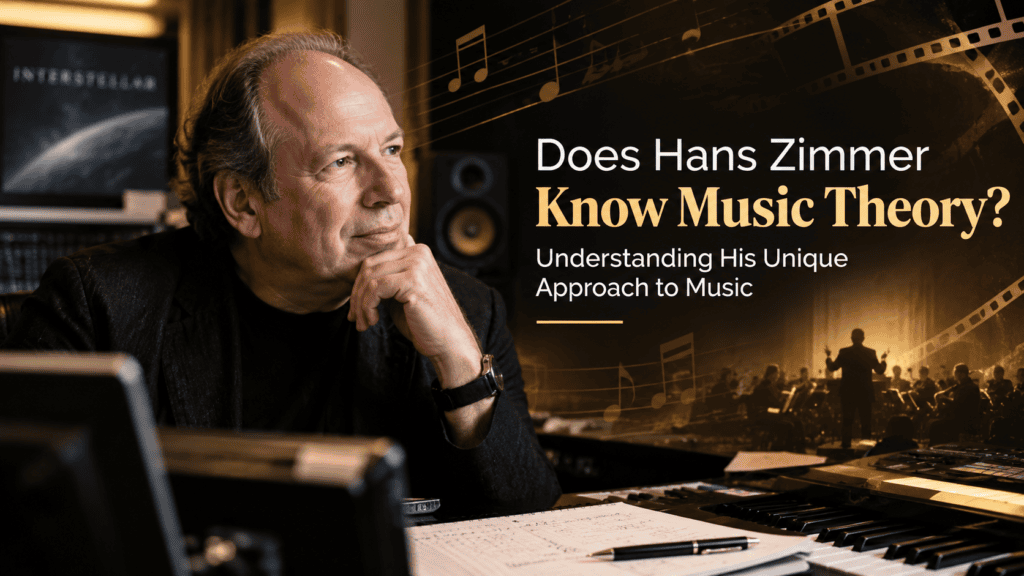
Does Hans Zimmer Know Music Theory?
Does Hans Zimmer Know Music Theory?
Does Hans Zimmer know music theory? The answer is more complicated than a simple yes or no. Hans Zimmer did not follow the traditional path of studying music at a conservatory or university. He has repeatedly described himself as largely self-taught and has said that his formal piano training lasted only about two weeks. However, his career demonstrates an extensive practical understanding of composition, orchestration, harmony, sound design, rhythm, and musical structure.
Zimmer developed his musical skills through listening, experimentation, working with other musicians, technology, and practical experience in studios. His approach shows that formal music education and practical musical knowledge are not always the same thing.
Did Hans Zimmer Have Formal Music Training?
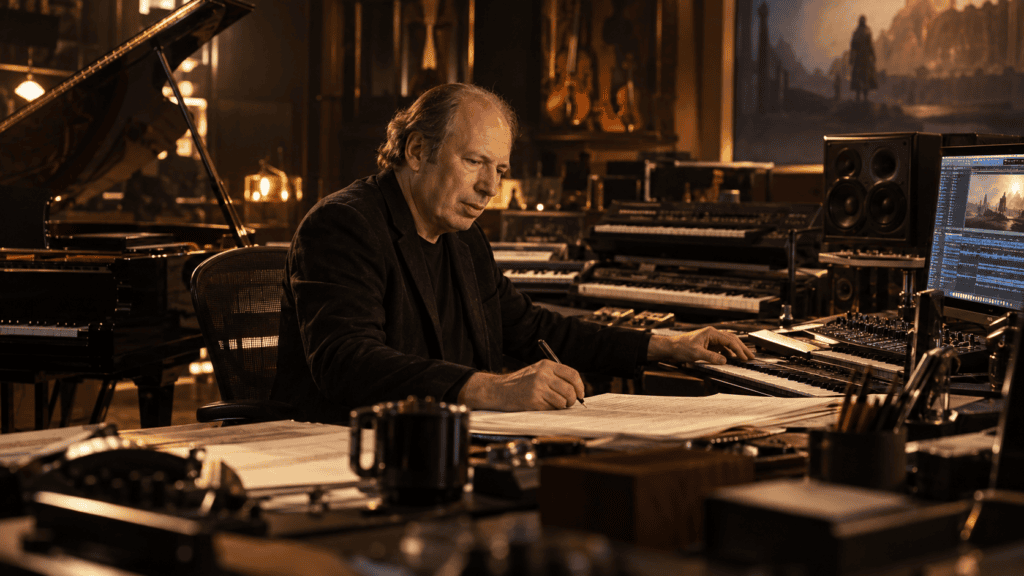
One of the most interesting parts of the answer to “Does Hans Zimmer know music theory?” is Zimmer’s unusual educational background.
As a child, Zimmer took piano lessons, but according to his own accounts, they lasted only around two weeks. He disliked the traditional approach of practicing scales and playing other people’s compositions.
Zimmer later described himself as self-taught. In a 2013 AMA, he said his formal training consisted of two weeks of piano lessons and that he learned music largely on his own.
This does not mean that Zimmer had no understanding of music. Instead, he developed that understanding through a very different route.
Does Hans Zimmer Know Music Theory Without Formal Education?
Does Hans Zimmer know music theory even though he did not receive traditional music education? His career suggests that he developed substantial practical musical knowledge, although he has also openly said that he does not approach music through traditional notation in the way many formally trained composers do.
In a 1997 interview with the Los Angeles Times, Zimmer said he did not pay much attention to written music and described himself as someone who did not read music. He emphasized that he heard musical ideas in his head and used technology to turn those ideas into music.
Later, Zimmer explained that working with early computers and sequencers became part of his musical education. He described entering musical information into early electronic systems and learning through the process of making those systems work.
This is an important distinction: music theory can be learned formally through books, classes, and notation, but musicians can also develop practical knowledge through listening, playing, composing, arranging, and experimentation.
How Did Hans Zimmer Learn Music?
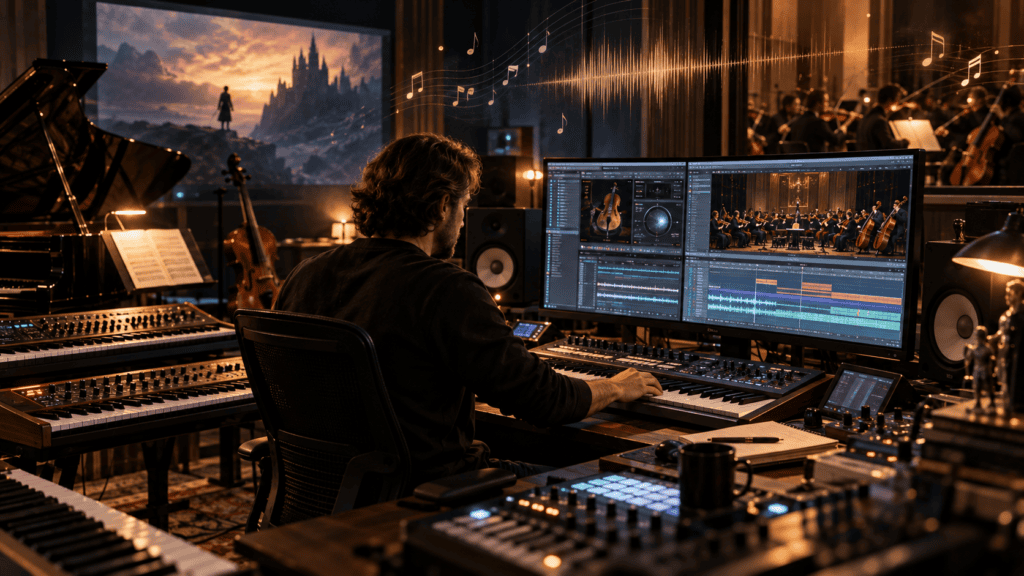
If you’re wondering “Does Hans Zimmer know music theory?”, it helps to understand how he actually learned to make music.
Zimmer’s development involved several important areas:
1. Listening
Zimmer has repeatedly emphasized the importance of listening. In his MasterClass material, he discusses listening as a fundamental skill for musicians and explains that he learned to work with music through his ears rather than through conventional academic training.
2. Playing in Bands
Before becoming one of Hollywood’s best-known film composers, Zimmer worked as a musician and keyboard player. He was involved with bands and became particularly interested in electronic instruments and synthesizers.
3. Synthesizers and Technology
Technology played a major role in Zimmer’s development. He worked as a synthesizer programmer and recording engineer and experimented with early electronic instruments and sequencing technology.
4. Working With Other Composers
A major turning point came when Zimmer worked with film composer Stanley Myers. Zimmer has explained that Myers showed him how to write film cues and introduced him to working with orchestras.
This practical experience helped Zimmer understand how musical ideas could be developed into film scores.
Does Hans Zimmer Use Music Theory in His Compositions?
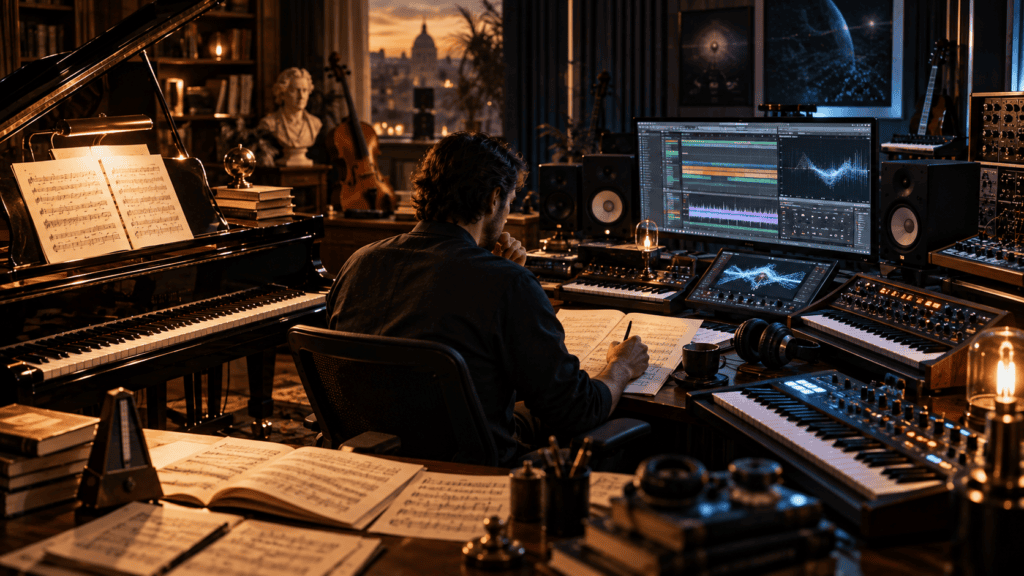
The question “Does Hans Zimmer know music theory?” becomes especially interesting when we look at his film scores.
Zimmer’s music contains many elements that are studied in music theory, including:
- Harmony and chord relationships
- Melody
- Rhythm and pulse
- Repetition and variation
- Dynamics
- Texture
- Orchestration
- Timbre
- Musical motifs
- Layering
- Tension and release
For example, film scoring often requires a composer to understand how music interacts with images, dialogue, editing, pacing, and emotional changes. Zimmer has developed a highly practical approach to these elements.
His scores frequently combine electronic sounds with orchestral instruments, creating textures that have become strongly associated with modern film music.
Hans Zimmer's Approach to Harmony and Musical Structure
Another reason people ask “Does Hans Zimmer know music theory?” is because his music can sound both simple and highly sophisticated.
Zimmer often focuses on a relatively small musical idea and develops it through:
- Repetition
- Layering
- Changes in instrumentation
- Rhythmic development
- Dynamic changes
- Increasing intensity
- Electronic sound design
- Orchestral expansion
This approach can create a strong emotional effect without requiring a composition to constantly introduce new melodies or complicated harmonic changes.
His work demonstrates that musical complexity is not always about using as many chords or notes as possible. Sometimes, sound, timing, repetition, texture, and emotional development can be just as important.
What Can Musicians Learn From Hans Zimmer?
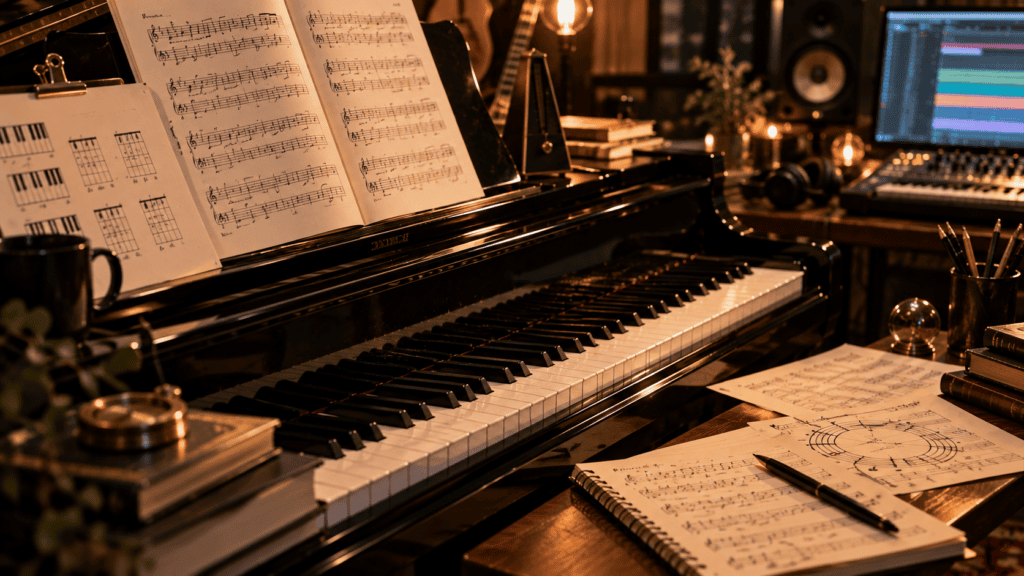
The answer to “Does Hans Zimmer know music theory?” can also teach an important lesson to students and aspiring musicians.
Formal music theory is valuable. Learning scales, chords, harmony, rhythm, notation, and musical structures can give musicians a strong foundation.
But theory is only one part of becoming a musician.
Zimmer’s career demonstrates the importance of developing other skills too:
Learn to Listen
Train your ears to recognize pitch, rhythm, harmony, dynamics, and texture.
Experiment With Sound
Zimmer’s work with synthesizers demonstrates how technology can become part of the creative process.
Understand Musical Emotion
Film composers need to understand how music supports a scene and communicates emotion.
Practice Creating Music
Theory becomes much more useful when you apply it by composing, arranging, playing, and experimenting.
Learn From Other Musicians
Zimmer’s work with Stanley Myers and other musicians played an important role in his development.
Does Hans Zimmer Read Music?
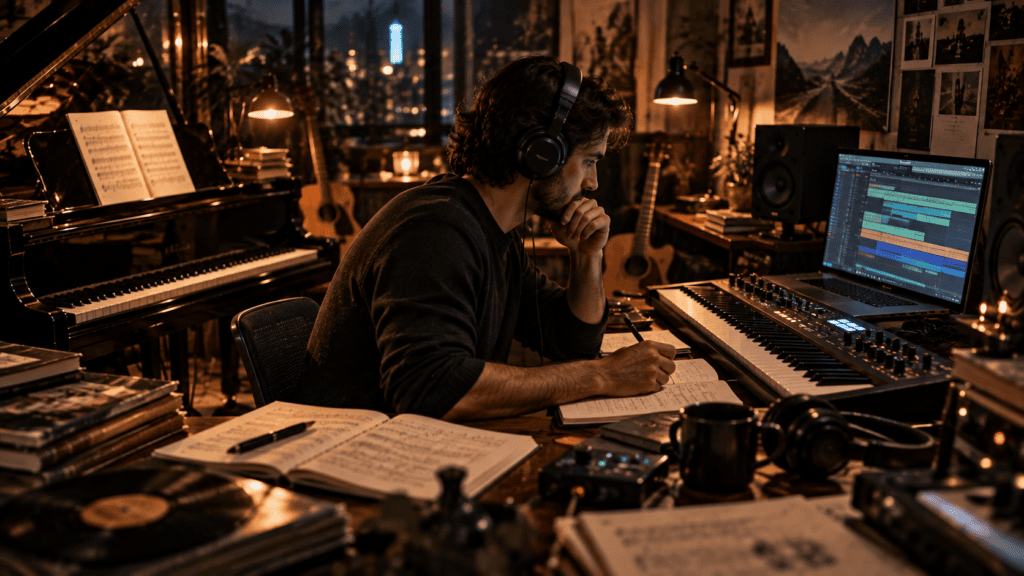
There is some nuance here. Zimmer has publicly said that he does not read music in the conventional way associated with formally trained composers. In a 2014 AMA, he said he could not read music and emphasized the importance of listening.
At the same time, Zimmer has demonstrated the ability to work with orchestras and create complex orchestral arrangements. In his MasterClass material, he discusses being able to orchestrate and use pen and paper despite not attending music school.
Therefore, it is more accurate to say that Zimmer’s relationship with notation and formal theory is unconventional rather than simply saying that he has no musical knowledge.
So, Does Hans Zimmer Know Music Theory?
Does Hans Zimmer know music theory? There is no strong basis for describing him as a traditionally trained music-theory specialist. Zimmer himself has emphasized that he did not receive formal musical education and learned primarily through experience, listening, technology, collaboration, and practical composition.
However, his music demonstrates a deep practical understanding of many concepts that music theory describes. His ability to work with orchestras, develop motifs, construct musical textures, manipulate harmony and rhythm, and synchronize music with film shows extensive musical knowledge.
So, rather than thinking of Hans Zimmer as someone who simply does or does not know music theory, it is more useful to understand him as a composer who developed his musical language through a highly unconventional, largely practical and technology-driven education.
What Hans Zimmer's Story Teaches About Music Education
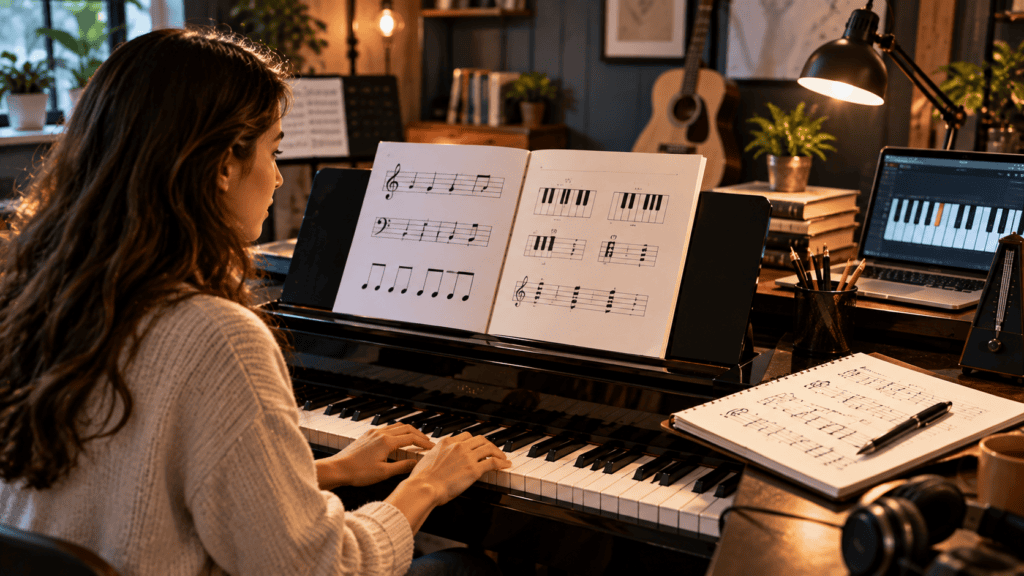
Hans Zimmer’s career does not mean that music theory or formal lessons are unnecessary.
Instead, his story shows that there are multiple ways to develop musical ability.
A student learning piano, guitar, vocals, or another instrument can benefit from both formal music theory and practical musical experience. Theory can help musicians understand why music works, while listening and practice help them develop musical instincts.
The strongest approach can combine both.
Learn Music Theory and Apply It Through Practice
Understanding “Does Hans Zimmer know music theory?” gives us a fascinating look at the difference between formal education and practical musical knowledge.
Hans Zimmer did not follow the traditional conservatory route. His musical development came through listening, experimentation, technology, bands, studio work, collaboration, and film scoring.
His story is a useful reminder that musicians can develop in different ways. Formal music theory can provide structure and understanding, while regular practice, listening, creativity, and real musical experience help turn that knowledge into music.
If you want to develop your own musical skills, learning the fundamentals of music theory, harmony, rhythm, ear training, and practical performance can give you a strong foundation for creating music of your own.
Suggested TMK CTA
At The Mystic Keys, students can learn music through structured lessons that combine musical concepts with practical playing and performance. Whether you are a beginner or an experienced musician, developing both your technical skills and musical understanding can help you become a more confident musician.
Start learning music with The Mystic Keys today.
Intersted in learning music with us? Register now
For more information and exciting resources about learning music, visit our website at The Mystic Keys. For more music content and exciting offers follow us on
Facebook, Instagram, YouTube, LinkedIn, Twitter, Pinterest, and Threads.