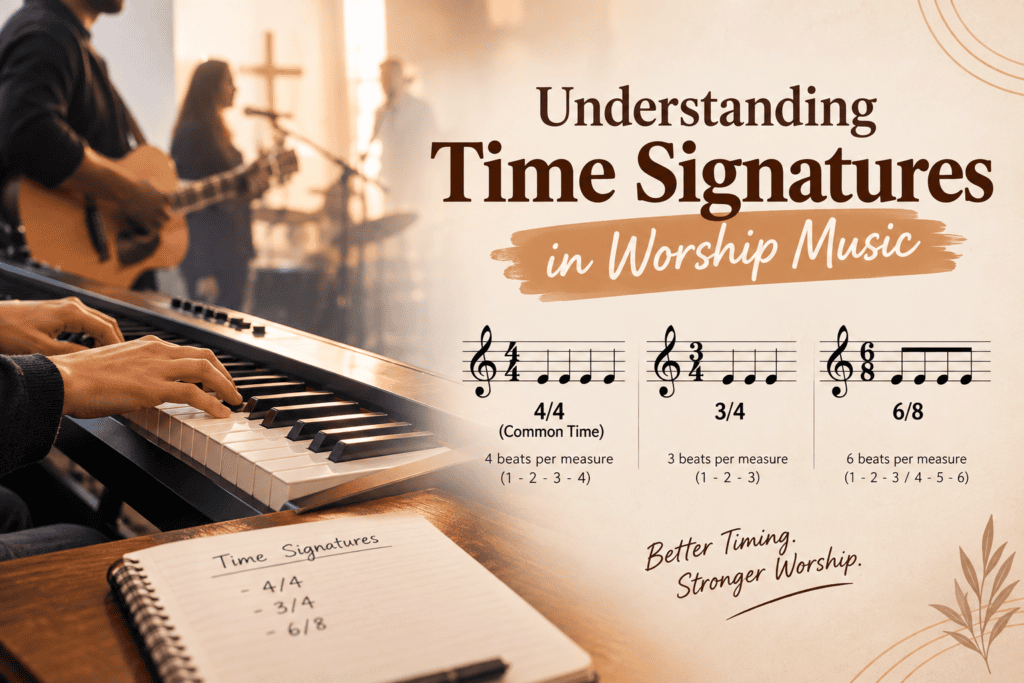
Understanding time signatures in worship music is essential for musicians who want to play confidently and stay in sync during worship. Time signatures guide the rhythm and structure of a song, helping musicians know how many beats are in each measure and how the music flows.
Whether you are a pianist, guitarist, or vocalist, mastering time signatures improves your overall performance.
What Are Time Signatures in Worship Music?
To begin understanding time signatures in worship songs, you need to know what a time signature is.
A time signature is written at the beginning of a piece of music and looks like a fraction (for example, 4/4 or 3/4). It tells you:
How many beats are in each measure
What type of note gets one beat
This helps musicians stay together rhythmically.
Common Time Signatures in Worship Songs
Most worship songs use simple and consistent time signatures.
Understanding time signatures in worship music helps musicians:
Stay in rhythm with the band
Follow the worship leader easily
Transition smoothly between sections
Support the congregation
Without proper timing, even simple songs can feel disorganized.
How Musicians Apply Time Signatures
Different instruments interpret time signatures differently.
Piano: Focuses on chord rhythm and flow
Guitar: Uses strumming patterns based on beats
Drums: Establish the groove and tempo
All instruments must stay aligned with the time signature.
Counting Beats Effectively
Counting is the key to mastering rhythm.
Tips:
Count out loud while practicing
Use a metronome
Break down complex sections
Feel the pulse naturally
This builds strong timing skills.
Time Signatures in Worship Music and Transitions
Transitions between songs are common in worship.
Understanding time signatures in worship music helps you:
Move between songs smoothly
Adjust tempo easily
Maintain flow during worship
This keeps the atmosphere consistent.
Common Mistakes to Avoid
❌ Losing count of beats ❌ Rushing or dragging tempo ❌ Ignoring the drummer or leader ❌ Not practicing with a metronome
Avoiding these improves timing and confidence.
Tips to Master Time Signatures
Practice regularly with rhythm exercises
Listen carefully to worship songs
Play along with recordings
Focus on consistency
These habits will strengthen your rhythm skills.
How The Mystic Keys Helps Students
At The Mystic Keys, we teach time signatures in worship music through:
Practical rhythm training
Live playing techniques
Ensemble coordination
Personalized guidance
This helps students perform confidently in worship settings.
Visit our page, Worship Music Online to explore more about our worship music courses.
Conclusion
Understanding time signatures in worship music is a key step toward becoming a better musician. With practice and awareness, you can stay in rhythm, play confidently, and contribute to a smooth worship experience.
👉 Strong rhythm creates strong worship.
For more information and exciting resources about learning music, visit our website at The Mystic Keys. For more music content and exciting offers follow us on
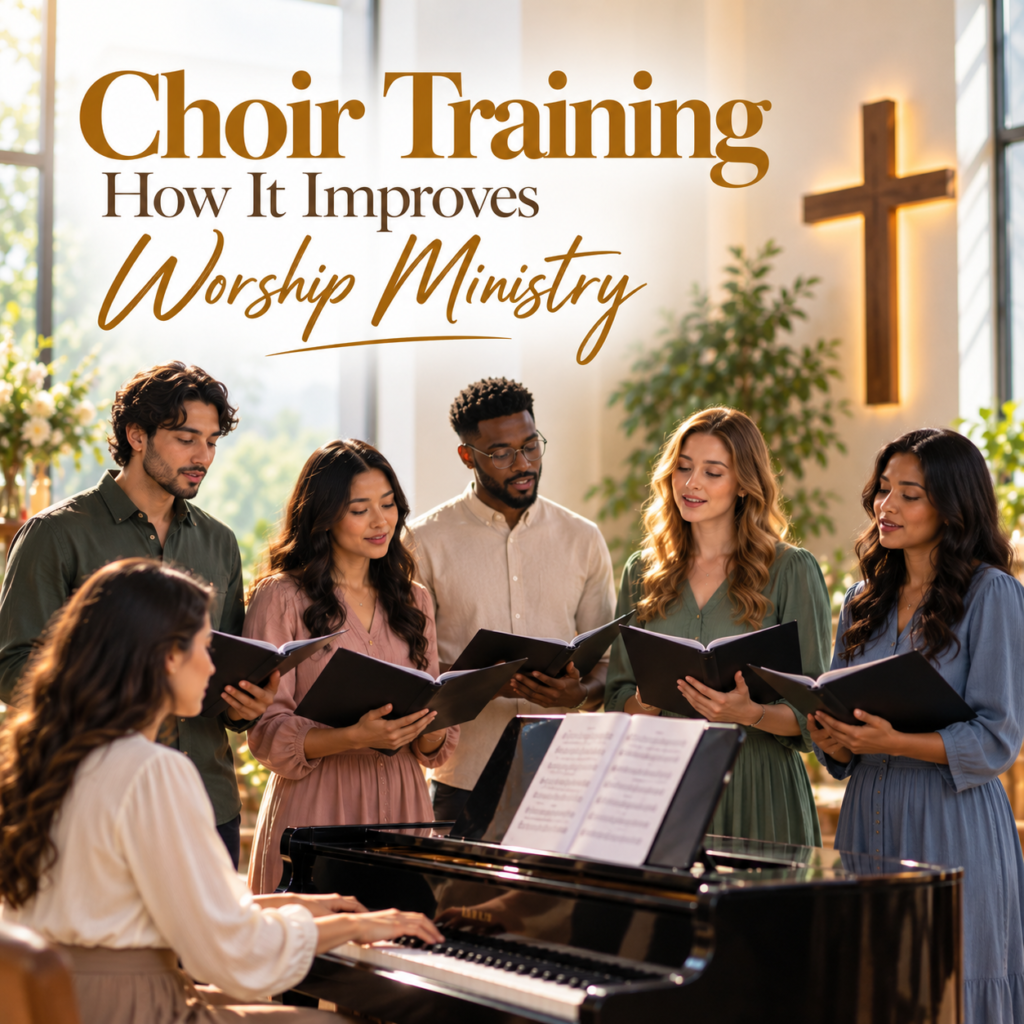
A worship choir is more than a group of people singing together. It is a team that blends individual voices into one musical expression, supports congregational singing, and helps create an atmosphere where people can engage more deeply with worship. While enthusiasm and a love for music are important, effective choir ministry also requires preparation, coordination, musical awareness, and consistent training.
This is where choir training becomes valuable. Structured training helps singers develop their voices while learning how to listen, blend, follow direction, understand musical dynamics, and work together as an ensemble. When these skills come together, the choir becomes more confident, cohesive, and musically prepared to serve within a worship setting.
Choir Training for Stronger Vocal Foundations
Every singer has a different voice, range, tone, and level of experience. In a choir, these differences can be beautiful, but without proper guidance, they can also make it difficult to achieve a balanced sound. Choir training helps singers understand the fundamentals of healthy and controlled singing.
Through regular vocal exercises, members can work on breathing, pitch, tone production, articulation, vocal control, and range. These techniques allow singers to use their voices more effectively without unnecessary strain.
As individual voices become more controlled, the overall sound of the choir begins to improve. Instead of several voices competing for attention, singers learn how their voices can contribute to a unified musical expression.
Learning to Sing as One
One of the most important skills in a choir is the ability to blend. A powerful choir sound does not necessarily come from every singer having a powerful individual voice. It comes from understanding how different voices fit together.
Training teaches singers to listen carefully to one another and adjust their volume, tone, pronunciation, and phrasing accordingly. This creates greater consistency across sections and helps the choir sound like a single musical unit.
Listening is especially important in worship ministry because singers need to respond to what is happening around them. The choir may need to become softer during a reflective passage, build gradually toward a powerful section, or leave space for the congregation and instruments. Developing this awareness allows the choir to support the worship rather than simply perform the song.
Improving Pitch, Harmony and Musical Accuracy
Worship songs often include harmonies, layered vocal parts, repeated sections, and changes in dynamics. Without adequate preparation, these elements can become difficult to manage, particularly when several vocal sections are singing different notes simultaneously.
Choir training gives singers the opportunity to understand harmony and become more comfortable with their individual parts. Instead of relying entirely on the strongest voice nearby, members gradually develop the ability to identify and maintain their own vocal lines.
This improves pitch accuracy and creates a more stable harmonic foundation. With practice, singers become better equipped to enter at the right moment, sustain their notes, follow musical cues, and transition smoothly between sections.
Choir Training for Developing Better Listening Skills
A strong choir is built on listening as much as singing. Members need to hear the voices around them, recognize the musical direction, and respond to the instrumental accompaniment.
Training can develop active listening by encouraging singers to pay attention to rhythm, pitch, dynamics, timing, and phrasing. This becomes particularly useful when the choir is working with a worship leader, pianist, guitarist, drummer, or other musicians.
Once singers learn to listen before reacting, the entire ensemble becomes more responsive. The choir can follow changes more naturally and maintain musical unity even when arrangements become more complex.
Choir Training for Greater Unity Within the Choir
A choir may include people with very different musical backgrounds. Some members may have years of singing experience, while others may be relatively new. Regular training creates a shared foundation that helps bring these different levels together.
Working through vocal exercises, harmonies, arrangements, and rehearsals also encourages members to understand the importance of teamwork. Everyone has a role, and the quality of the final sound depends on how those roles work together.
This sense of unity extends beyond music. A choir that rehearses with patience, communicates well, and supports its members can develop a stronger sense of togetherness. That connection can positively influence how the group serves within the wider worship ministry.
Strengthening Confidence and Stage Presence
Confidence is another important part of effective choir ministry. Singers who are uncertain about their notes, entrances, or vocal parts may hesitate during a worship service. Proper preparation can reduce that uncertainty.
When singers know their material and understand the arrangement, they can focus more on expressing the music rather than worrying about what comes next. Repeated practice also helps members become comfortable with microphones, movement, musical cues, and performing as part of an ensemble.
The goal is not to turn worship into a performance. Instead, confidence allows singers to participate with greater freedom, focus, and musical stability.
Choir Training for Understanding Dynamics and Expression
Singing every section at the same volume can make even a beautiful worship song feel flat. Effective choir training teaches singers how dynamics can shape the emotional and musical direction of a song.
A gentle verse may require controlled and softer vocals, while a chorus may call for greater energy. Some sections may benefit from fewer voices, allowing another musical element to come forward. Understanding these changes helps the choir create contrast and expression.
Consequently, singers learn that good choir singing is not simply about singing the correct notes. It is also about understanding when to lead, when to support, when to build, and when to create space.
Preparing for Different Worship Settings
Every worship environment is different. A choir may sing with a full band, acoustic instruments, a keyboard, or minimal accompaniment. Songs may also vary in style, language, tempo, and arrangement.
Consistent training gives singers the flexibility to adapt to these situations. They become more familiar with different musical structures and learn how to respond to changes without losing their vocal or ensemble control.
This adaptability can be especially valuable for worship ministries that regularly introduce new songs or work with changing musical arrangements. Instead of starting from scratch each time, trained singers have a stronger musical foundation to build upon.
Choir Training for More Effective Rehearsals
Good choir training can also transform the rehearsal process. When singers understand rhythm, harmony, notation, vocal technique, and musical terminology, rehearsals can become more focused and productive.
Rather than spending most of the time correcting basic vocal or timing issues, the group can concentrate on interpretation, dynamics, transitions, and the overall arrangement. Over time, this can help the choir prepare songs more efficiently.
Regular training also encourages consistency. A choir that develops a routine of warming up, learning parts, listening to one another, and rehearsing with intention is more likely to approach each worship session with preparation and purpose.
Supporting the Larger Worship Team
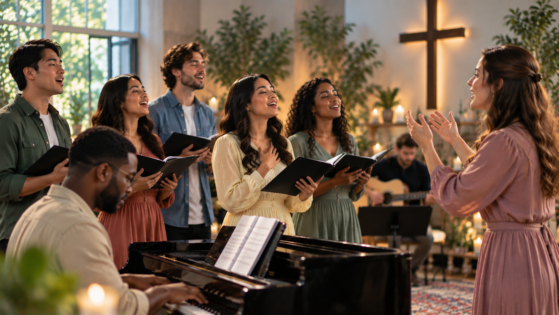
A choir does not function separately from the rest of the worship ministry. It works alongside worship leaders, instrumentalists, sound teams, and the congregation. Strong training helps singers understand this relationship.
For example, the choir may reinforce a melody, provide harmony behind a worship leader, respond to a musical phrase, or strengthen a particular section of a song. Knowing when to contribute and when to step back allows the choir to complement the wider arrangement.
This creates a more balanced worship experience where every musical element has space to serve its purpose.
Continuous Learning Makes a Difference
Choir development does not happen through a single workshop or a few rehearsals. Like any musical skill, it grows through consistent practice and guidance. Even experienced singers can benefit from revisiting vocal technique, harmony, listening skills, and ensemble work.
A structured learning environment can help singers identify areas for improvement while giving them opportunities to strengthen existing abilities. Over time, small improvements in individual technique can lead to noticeable changes in the sound and confidence of the entire choir.
For worship ministries, this ongoing approach can make training a meaningful part of musical development rather than something that happens only before a special event.
Choir Training with The Mystic Keys
As an online music academy, The Mystic Keys offers flexible, personalized music learning designed to help students develop their musical skills through one-on-one online lessons. Training with the right guidance can help singers build stronger vocal foundations, improve musical understanding, and develop greater confidence in their abilities.
For those interested in worship music, focused learning can also complement choir participation by strengthening skills such as vocal technique, harmony, listening, musical expression, and overall musicianship.
Because every singer has different strengths and areas for development, personalized instruction can provide a more focused approach to learning. With consistent practice and the right guidance, singers can continue growing both individually and as members of a worship team.
Bringing Music, Preparation and Purpose Together
A well-trained choir is not simply a collection of singers who know the same songs. It is a team that understands how to listen, blend, communicate, respond, and contribute to a shared musical direction.
Choir training strengthens the technical side of singing while also encouraging discipline, teamwork, confidence, and musical awareness. These qualities can make rehearsals more productive and help the choir support the worship ministry with greater consistency. For singers looking to strengthen their musical foundation beyond choir practice, Worship Piano & Singing Lessons Online can also help develop vocal technique, musical understanding, harmony, and confidence.
Ultimately, the purpose of training is not to make every voice sound identical. It is to help different voices work together with understanding and intention. When preparation meets unity, a choir can become a strong musical part of worship—supporting the song, the worship team, and the congregation through every note. At The Mystic Keys, an online music academy, personalized lessons can support singers and musicians as they continue developing their skills and musical confidence.
For more information and exciting resources about learning music, visit our website at The Mystic Keys. For more music content and exciting offers follow us on