How Choir Members Can Improve Their Listening Skills
Introduction
Learning how choir members can improve their listening skills is essential for creating a balanced and harmonious choir sound. Singing in a choir is not just about your own voice—it’s about blending, adjusting, and responding to others.
Strong listening skills help choir members stay in tune, maintain rhythm, and sing as one unified group
Why Listening Matters in a Choir
To master how choir members can improve their listening skills, singers need to shift their focus from individual performance to group awareness.
This helps singers perform confidently in a choir.
👉 Explore more music courses at The Mystic Keys to start your piano journey with the right foundation.
Conclusion
Understanding how choir members can improve their listening skills is key to creating a unified and powerful choir sound. By focusing on awareness, blending, and timing, singers can contribute effectively to the group.
👉 Great choirs are built on great listening.
For more information and exciting resources about learning music, visit our website at The Mystic Keys. For more music content and exciting offers follow us on
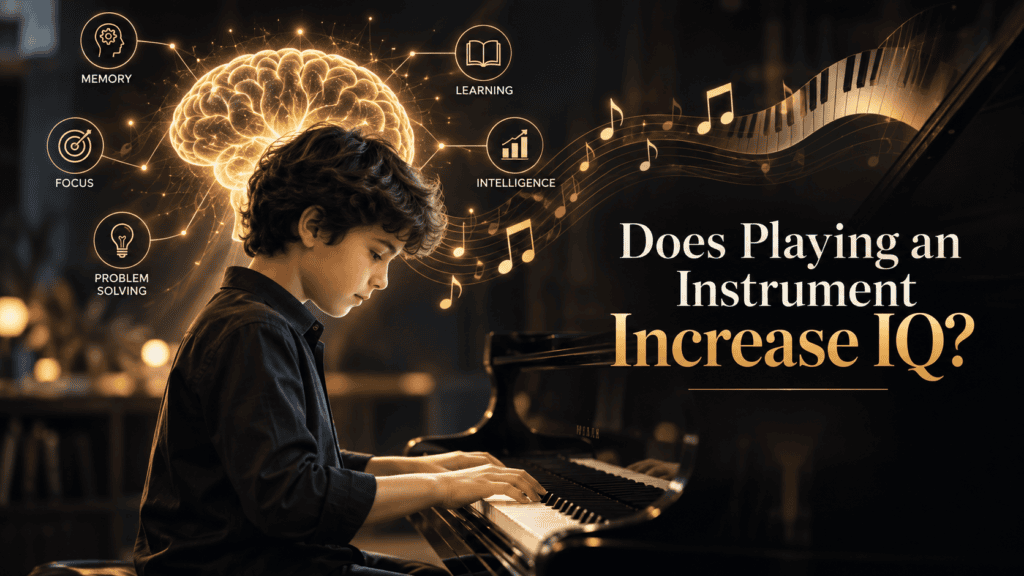
Have you ever wondered, does playing an instrument increase IQ? Do people who play the piano, guitar, violin, or another instrument have a higher IQ?
Learning an instrument involves much more than producing sounds. Musicians constantly read information, remember patterns, coordinate their hands, listen carefully, and make decisions while playing. Because of this, researchers have studied the relationship between musical training and cognitive abilities.
While playing an instrument does not automatically make someone highly intelligent, learning music can help develop several mental skills that are important for learning and everyday life.
The connection between musical training and intelligence is more nuanced than a simple yes or no.
Does Playing an Instrument Increase IQ?
IQ, or intelligence quotient, is a score designed to measure certain cognitive abilities. Depending on the test, these can include areas such as:
IQ is only one way of looking at cognitive ability. Intelligence is complex, and skills such as creativity, emotional understanding, communication, and musical ability are not fully represented by a single IQ score.
How Does Playing an Instrument Affect the Brain?
When you play an instrument, your brain processes several types of information simultaneously.
This combination creates a demanding mental activity that engages different cognitive processes.
Does Playing an Instrument Improve Memory?
Research has found associations between musical training and certain cognitive abilities, but that does not necessarily mean that learning an instrument directly increases IQ.
People who choose to study music may already have characteristics that influence cognitive performance. For example, motivation, educational background, family environment, and opportunities for learning can all play a role.
Some studies have reported small improvements in cognitive abilities following musical training, while other research suggests that the benefits may be specific to certain skills rather than producing a broad increase in general intelligence.
Therefore, it is more accurate to say that musical training can support cognitive development, rather than claiming that every musician will have a higher IQ.
Does Playing an Instrument Improve Focus?
Memory is an important part of learning an instrument.
Musicians often need to remember:
Notes and chords
Melodies
Rhythmic patterns
Musical structures
Finger positions
Songs and performances
Regular practice can challenge working memory and long-term memory. For children, these activities can complement other forms of learning and help them develop better strategies for remembering information.
Playing Music Requires Focus and Attention
Playing an instrument requires concentration.
Imagine learning a new piano piece. You may need to concentrate on the notes with one hand while coordinating the other hand, following rhythm, listening to your sound, and keeping track of where you are in the music.
Over time, this type of practice can encourage sustained attention and careful listening.
These skills can also be useful outside music, particularly when students need to concentrate on challenging tasks.
Can Playing an Instrument Improve Problem-Solving Skills?
Learning an instrument involves solving problems constantly.
A student might ask:
Why does this chord sound wrong?
How can I play this difficult section more smoothly?
Why am I losing the rhythm?
How can I improve my timing?
Which fingering makes this passage easier?
Instead of simply memorizing information, musicians learn to identify problems, experiment with solutions, and evaluate the results.
This makes music practice an excellent environment for developing practical problem-solving habits.
Music and Hand-Eye Coordination
Instrumental performance also involves physical coordination.
A guitarist coordinates both hands while following rhythm and listening to the sound. A pianist may coordinate both hands independently. A drummer coordinates multiple limbs while maintaining timing.
This combination of movement, listening, and visual information creates a strong connection between cognitive processing and physical coordination.
Can Music Make Children Smarter?
Music education can provide children with valuable cognitive, academic, and social experiences. However, parents should be careful about viewing music lessons only as a way to increase IQ.
The strongest reason to introduce children to music is that it gives them an opportunity to develop discipline, concentration, creativity, listening skills, coordination, and confidence while learning something they can enjoy for years.
Music should be seen as an important part of a child’s overall development—not simply an IQ-boosting activity.
Does the Instrument Matter?
Different instruments can challenge the brain in different ways.
Piano: Reading two musical lines, coordinating both hands, and understanding harmony.
Guitar: Combining chord shapes, melody, rhythm, and hand coordination.
Drums: Developing rhythm, timing, coordination, and independent limb movement.
The most important factor is not necessarily which instrument someone chooses. Consistent practice, active learning, and genuine engagement with music are more important.
The Importance of Consistent Practice
Simply owning an instrument does not provide cognitive benefits.
Learning happens through active participation and regular practice. A student who practices thoughtfully, receives feedback, and gradually tackles new challenges is more likely to develop useful musical and cognitive skills.
Even a short, focused practice session can be more valuable than spending a long time playing without concentration.
Is Playing an Instrument About More Than IQ?
The question “Does playing an instrument increase IQ?” is interesting, but IQ should not be the main reason to learn music.
Music can teach students how to:
Stay patient when something is difficult
Practice consistently
Listen carefully
Work toward long-term goals
Handle mistakes
Express emotions creatively
Perform with confidence
Collaborate with others
These abilities can be valuable in school, work, and everyday life.
Learn an Instrument With The Mystic Keys
At The Mystic Keys, students can learn music through personalized online lessons designed around their age, level, goals, and musical interests.
Whether you’re interested in piano, guitar, keyboard, vocals, violin, drums, or music theory, structured guidance and consistent practice can help you develop both musical ability and confidence.
The goal isn’t simply to play more notes. It’s to develop musicians who can listen, think, practice, create, and perform.
So, does playing an instrument increase IQ?
There isn’t enough evidence to say that learning an instrument automatically makes someone more intelligent or guarantees a higher IQ score. However, musical training can engage important cognitive skills such as memory, attention, coordination, listening, and problem-solving.
That makes learning an instrument valuable far beyond music itself.
Music doesn’t just train your hands—it challenges your brain, develops discipline, and gives you a creative way to learn and express yourself.
Start Learning Music Today
Ready to develop your musical skills? Explore personalized music lessons with The Mystic Keys and find an instrument that matches your interests and goals.
Intersted in learning music with us? Register now
For more information and exciting resources about learning music, visit our website at The Mystic Keys. For more music content and exciting offers follow us on