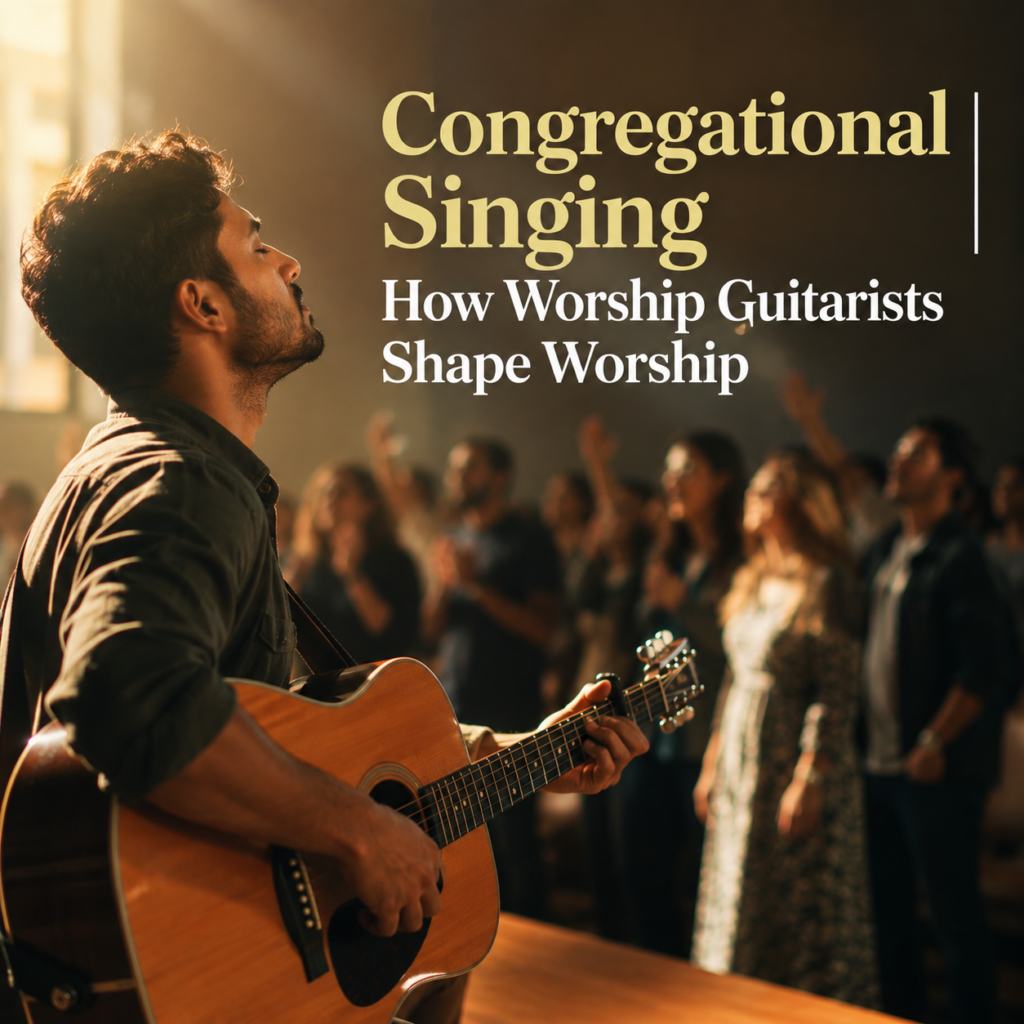
Congregational Singing | How Worship Guitarists Shape Worship
Congregational Singing | How Worship Guitarists Shape Worship
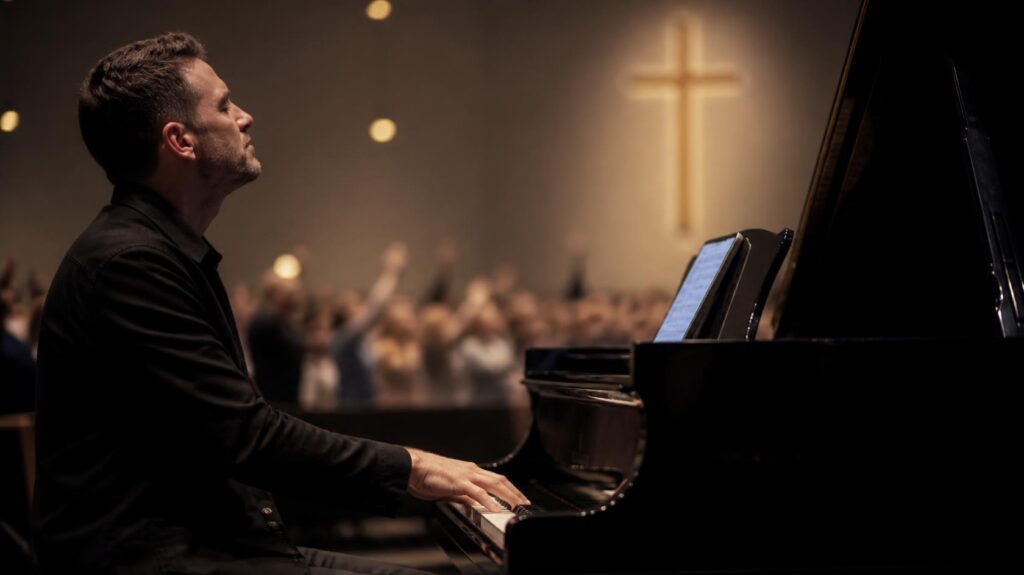
Congregational singing is one of the most powerful expressions of worship. When a church sings together, individual voices become one collective sound, creating a sense of unity that goes far beyond music. The congregation is not simply listening to a worship team perform a song; everyone is participating in an act of worship.
Within that experience, the worship guitarist has an important and often understated role. A guitarist may not always be the person leading the congregation, yet the instrument can strongly influence how people sing, respond, and connect with the song. Through rhythm, dynamics, chord choices, tone, and sensitivity, a worship guitarist can help create an environment where people feel confident enough to sing freely.
The goal, therefore, is not to make the guitar stand out. Instead, it is to make the worship experience stronger by supporting the congregation and serving the song.
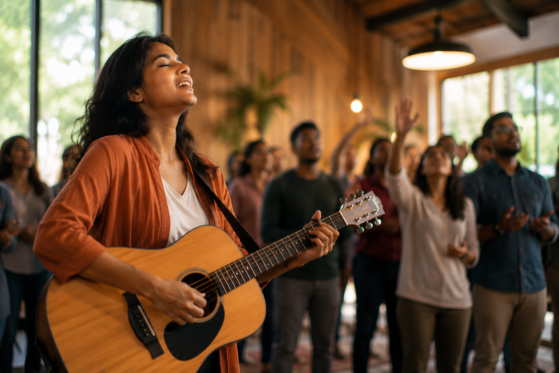
Understanding the Heart of Congregational Singing
Congregational singing is fundamentally different from a concert performance. In a concert, the audience generally listens while the musicians perform. During congregational worship, however, the congregation becomes part of the music itself.
That difference changes the guitarist’s responsibility. Rather than thinking primarily about how impressive a part sounds, a worship guitarist needs to consider whether the congregation can follow the song comfortably. The rhythm should feel natural, the harmonic movement should be clear, and the overall arrangement should leave enough space for people to sing.
A strong worship arrangement makes participation feel easy. When the congregation knows where the melody is going and can comfortably hear and follow the song, more people are likely to join in.
This is why simplicity can sometimes be more powerful than complexity. A carefully chosen chord pattern played with consistency may serve congregational worship far better than an elaborate guitar arrangement that competes for attention.
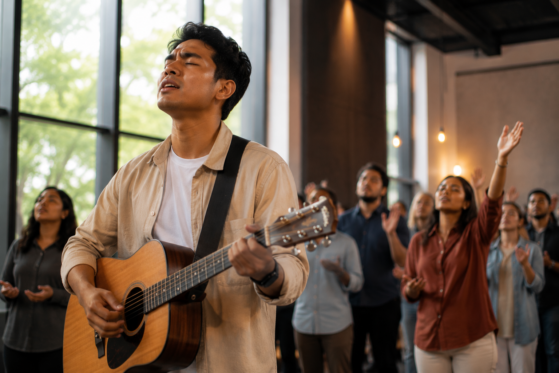
Congregational Singing and the Guitar as a Guide
One of the guitar’s most valuable functions in worship is providing rhythmic and harmonic direction. Even when the congregation does not consciously notice the guitar, its steady pulse can help people stay connected to the song.
A consistent strumming pattern can establish the tempo and give singers a reliable foundation. When the guitarist maintains that pulse with confidence, the congregation can naturally settle into the rhythm.
At the same time, chord changes help communicate the structure of the song. Moving clearly from one chord to another allows singers to anticipate harmonic changes and remain connected to the melody.
For this reason, worship guitarists need to develop more than technical accuracy. They also need to develop musical awareness. Knowing when to play, when to simplify, and when to leave space can make a tremendous difference to the overall worship experience.

Supporting the Melody Without Competing With It
The melody belongs to the congregation. The guitar should support that melody rather than overpower it.
A guitarist who plays too loudly, uses an overly prominent tone, or fills every available space can unintentionally make congregational singing more difficult. People may begin listening to the instrument instead of focusing on the words and melody.
On the other hand, a supportive guitar part can make the melody feel more accessible. Gentle rhythmic patterns can carry a verse, while fuller strumming can help lift a chorus. The guitarist can gradually build the musical energy without taking attention away from the voices.
This balance requires sensitivity. Sometimes the best guitar part is the one that listeners barely notice because it fits so naturally into the entire arrangement.
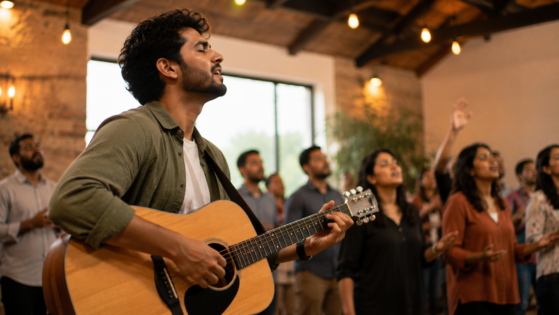
Dynamics: Knowing When to Build and When to Pull Back
Dynamics play a major role in shaping congregational worship. A song does not need to remain at the same volume or intensity from beginning to end. Instead, the guitarist can help create movement by responding to the emotional direction of the song.
During a quiet verse, a softer picking pattern or restrained strumming can create space. As the chorus arrives, a fuller rhythm can provide energy and encourage the congregation to sing with greater confidence.
Later, a bridge might call for another increase in intensity. After that moment, bringing the dynamics down can create contrast and allow the next section to feel fresh.
Such changes do not need to be complicated. Often, simply changing the intensity of the strumming is enough. The important thing is that every dynamic decision serves the message and atmosphere of the song.
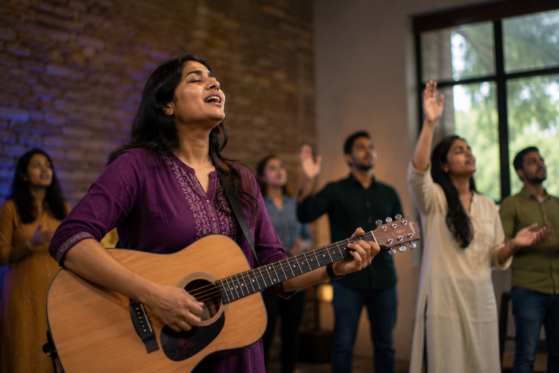
The Importance of Rhythm in Worship Guitar
Rhythm is one of the most noticeable ways a guitarist can influence congregational singing. A strong rhythmic foundation gives the congregation something dependable to follow.
However, consistency does not mean playing mechanically. Good worship rhythm has both stability and sensitivity. The guitarist needs to maintain the pulse while also responding to the other musicians and the natural flow of the song.
For example, a verse may benefit from a lighter pattern with more space between the strokes. When the chorus arrives, stronger downstrokes and a fuller pattern can create a sense of expansion.
Even small rhythmic changes can transform the emotional character of a section. Therefore, developing a strong sense of timing is just as important as learning different chord shapes or strumming patterns.

Creating Space Is Also Part of Playing
One of the most important lessons for a worship guitarist is that silence can be musical.
There may be moments when the guitar needs to become quieter or stop completely. Such pauses give the congregation room to hear itself. They can also create anticipation before the next musical section.
When every moment is filled with chords, riffs, fills, and strumming, the arrangement can begin to feel crowded. By contrast, intentional space allows the important moments to breathe.
A guitarist who understands when not to play demonstrates musical maturity. Instead of constantly adding something, the player listens to what the song already has and decides what is genuinely needed.

Choosing Chords That Serve the Song
Chord selection can also influence the character of congregational worship. Open chords often provide a warm, familiar sound that works beautifully in many worship settings. Barre chords, suspended chords, inversions, and other voicings can add color when used thoughtfully.
However, complexity should never become the main objective.
A chord voicing may sound beautiful in isolation but become distracting when combined with keyboards, vocals, drums, and other instruments. The guitarist needs to consider the entire musical arrangement rather than judging a chord only by how it sounds on its own.
Consequently, choosing the right chord is not simply a technical decision. It is an arrangement decision. The best voicing is the one that complements the song, supports the other instruments, and keeps the congregation engaged.
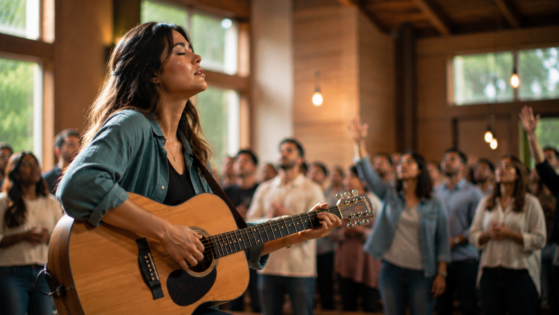
Congregational Singing and the Role of Guitar Tone
Tone is another subtle way guitarists shape the worship environment. A bright, clean tone may work well for rhythmic support, while a warmer tone can create a softer and more reflective atmosphere.
Effects such as delay, reverb, compression, and overdrive can add depth and texture. Nevertheless, these effects need to be used with restraint. A heavily processed guitar sound can easily become distracting if it occupies too much sonic space.
The guitarist should therefore think about tone as part of the arrangement. The question is not simply, “Does this sound good?” A better question is, “Does this sound help the song?”
When the answer is yes, even a relatively simple guitar tone can contribute beautifully to worship.
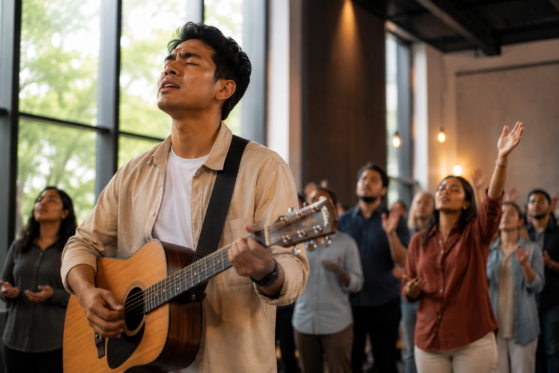
Listening Is More Important Than Playing More
A worship guitarist needs to listen constantly.
Listening means paying attention to the worship leader, vocalists, keyboard, drums, bass, and the congregation itself. It also means noticing changes in energy and responding appropriately rather than following a predetermined guitar part without flexibility.
If the worship leader brings the congregation into a quieter moment, the guitarist may need to reduce the intensity immediately. When the band begins building toward a powerful chorus, the guitar can gradually become fuller.
This kind of responsiveness turns a guitarist from someone simply playing chords into an active musical partner.
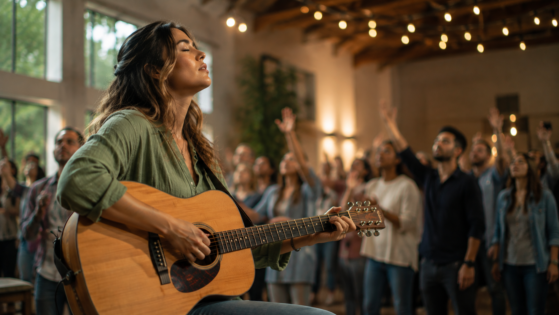
Congregational Singing and Following the Worship Leader
The worship leader usually guides the overall direction of the song, and the guitarist needs to remain attentive to those cues.
A leader may repeat a chorus, extend a bridge, move directly into another song, or create an unplanned moment of reflection. If the guitarist is focused only on following a fixed arrangement, these changes can become difficult to handle.
Preparation is still important, but flexibility is equally valuable. Knowing the song well enough to move beyond a rigid structure allows the guitarist to respond confidently when the moment changes.
In this way, musical preparation and spiritual attentiveness can work together. The better prepared the guitarist is, the more freedom they have to respond naturally.
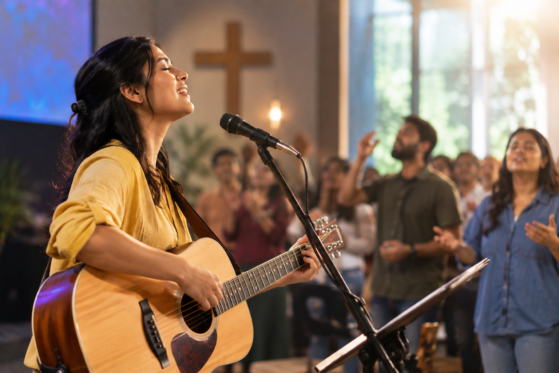
Helping the Congregation Sing With Confidence
A congregation is more likely to sing confidently when the musical environment feels supportive and predictable.
A steady tempo, clear chord progression, appropriate volume, and well-controlled dynamics can all contribute to that confidence. The guitarist does not need to draw attention to these elements; they simply need to make them dependable.
When the music feels uncertain, singers may hesitate. When the musical foundation feels secure, people can focus more fully on the words.
Therefore, one of the guitarist’s greatest contributions may be invisible. The congregation may never realize why a particular worship moment felt so easy and natural, but the guitarist’s consistency may have played an important part.

Congregational Singing and Avoiding the Temptation to Overplay
Technical ability is valuable, but worship guitar is not primarily about demonstrating technical ability.
A guitarist may know advanced scales, complex chord voicings, intricate fingerstyle techniques, or impressive solos. Those skills can certainly be useful. Yet the ability to choose not to use them can be just as important.
Overplaying can compete with vocals and other instruments, especially during congregational sections. Too many fills can distract from the lyrics, while constant rhythmic variation can make the song harder to follow.
Instead, technical skill should serve musical judgment. A guitarist who understands when to simplify can often contribute more effectively than someone who plays constantly.

Building Musical Awareness Through Practice
Effective worship playing begins long before the service. Practice should include more than simply memorizing chord progressions.
Guitarists can practice different strumming intensities, experiment with dynamics, work on smooth chord transitions, and learn to maintain a steady tempo. It is also helpful to practice playing along with recordings while deliberately leaving space.
Another valuable exercise is to play the same song in several different ways. Try a simple pattern for the verse, a fuller rhythm for the chorus, and a restrained approach for a quieter bridge. This helps develop the ability to shape a song rather than simply accompany it from beginning to end.
Over time, these choices become more natural, allowing the guitarist to focus less on technical execution and more on the people and music around them.

The Spiritual Responsibility Behind the Instrument
Worship guitar is ultimately about service.
The guitarist’s role is not to become the center of attention but to contribute to something larger than the individual musician. Every chord, rhythm, pause, and dynamic choice can help create space for the congregation to participate.
That perspective can completely change the way a guitarist approaches worship. Instead of asking, “How can I make this part sound impressive?” the musician can ask, “How can I help people sing?”
That simple shift in perspective encourages humility, attentiveness, and intentionality.

When the Guitar Becomes Part of Something Bigger
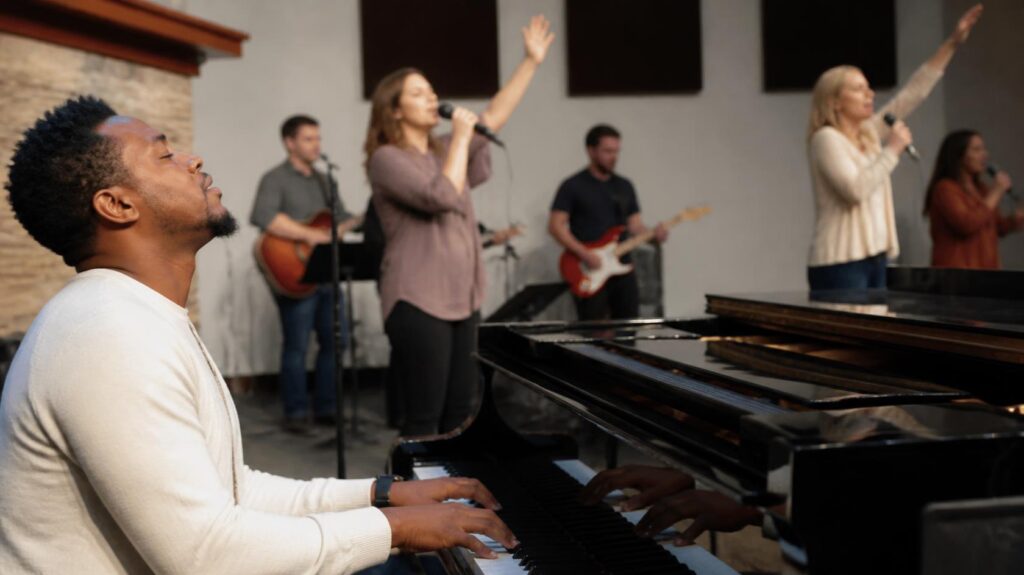
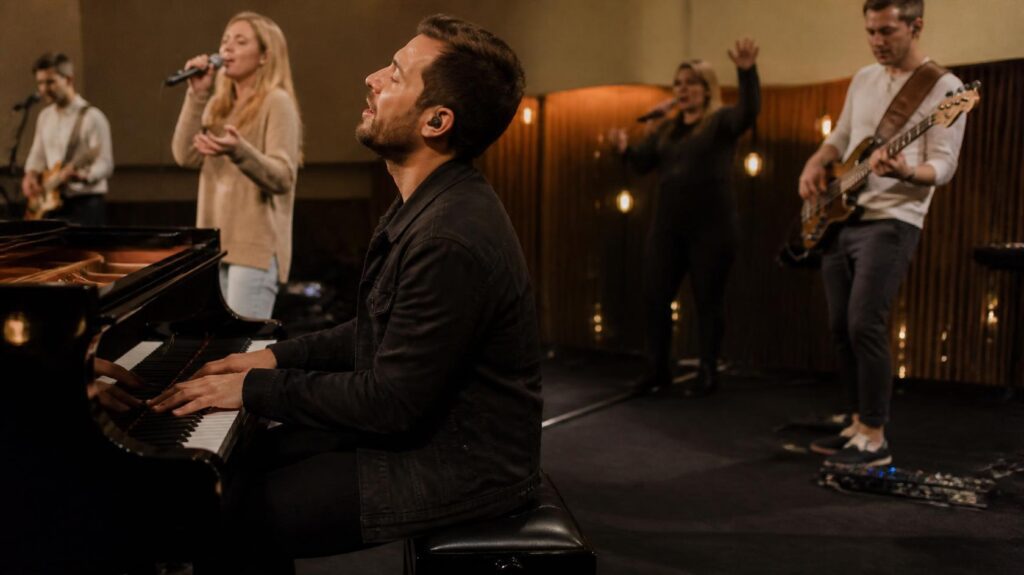
The most meaningful congregational worship happens when individual musical roles come together naturally. The vocals carry the melody, the drums establish energy, the bass provides depth, keyboards add harmonic texture, and the guitar connects these elements through rhythm and color.
No single instrument needs to dominate. Each one contributes to the whole.
In that setting, the worship guitarist becomes part of a larger musical conversation. The instrument can encourage the congregation during a joyful chorus, create intimacy during a reflective verse, and build anticipation before a powerful musical moment.
Ultimately, the guitar is not the destination. It is a tool that helps support the song, the worship team, and most importantly, the congregation.

Conclusion
Congregational singing becomes powerful when people feel invited to participate rather than simply encouraged to listen. Worship guitarists can play a meaningful role in creating that invitation through steady rhythm, thoughtful chord choices, appropriate dynamics, supportive tone, and intentional space. For those looking to develop these skills, The Mystic Keys offers structured musical guidance that can help guitarists build confidence, technique, and a deeper understanding of worship playing.
The strongest worship guitarists understand that great playing is not always about playing more. Sometimes it is about playing less, listening more, and knowing exactly what the song needs at that moment. Through Guitar Lessons Online, aspiring worship guitarists can learn to develop their rhythm, chord transitions, musical expression, and ability to support congregational singing with greater confidence.
When technical skill is combined with musical sensitivity and a heart for serving the congregation, the guitar becomes more than an accompanying instrument. It becomes part of the foundation that helps a room full of individual voices become one collective expression of worship.
For more information and exciting resources about learning music, visit our website at The Mystic Keys. For more music content and exciting offers follow us on
Facebook, Instagram, YouTube, LinkedIn, Twitter, Pinterest, and Threads.