

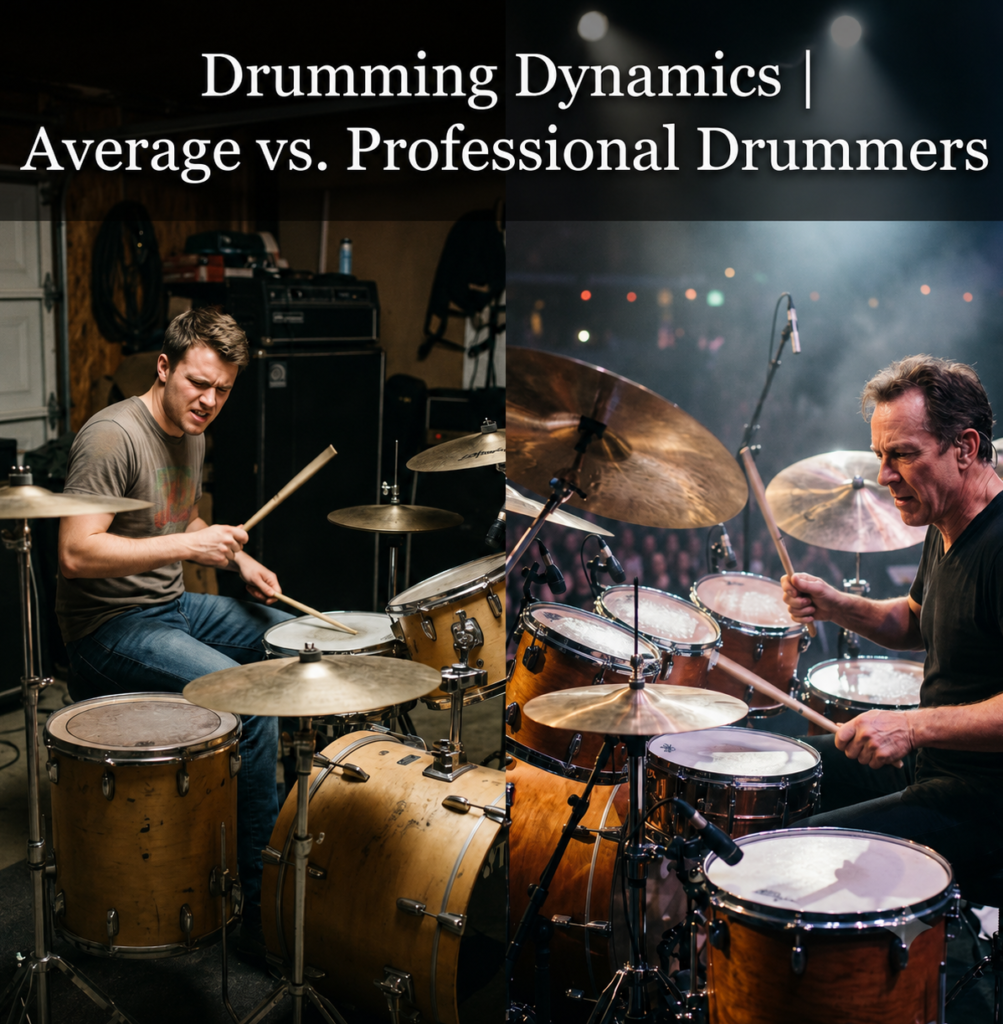
Drumming Dynamics | Average vs. Professional Drummers
Drumming Dynamics | Average vs. Professional Drummers
At first glance, drumming may seem like a straightforward skill. Strike the drums, keep the beat, and stay in time with the music. However, the true essence of Drumming Dynamics goes far beyond simply maintaining rhythm. Anyone who has spent time behind a drum kit quickly realizes that the difference between an average drummer and a professional drummer isn’t measured by how loudly they play or how fast they move their sticks. Instead, it lies in countless subtle details that collectively transform a performance from ordinary to extraordinary.
While average drummers often focus on playing the correct notes, professional drummers concentrate on how every note feels, sounds, and connects with the music. Their performances display consistency, control, precision, and emotional depth that can elevate an entire band. Such mastery doesn’t happen overnight. Rather, it develops through years of deliberate practice, critical listening, and continuous refinement.
Understanding these distinctions offers valuable insights for drummers at every stage of their musical journey. Whether you are just beginning or looking to improve your skills, recognizing what separates professionals from hobbyists provides a clear roadmap for growth.

Drumming Dynamics | Beyond Simply Hitting the Drums
Most average drummers develop enough technique to play common grooves and basic fills. They can perform songs reasonably well, yet their movements often involve unnecessary effort. Grip may become inconsistent, strokes may lack uniformity, and fatigue tends to appear during longer performances.
Professional drummers, on the other hand, treat technique as the foundation of everything they play. Every movement is carefully refined to maximize efficiency while minimizing wasted motion. Their stick control allows them to produce consistent sounds regardless of speed or complexity. Even after playing demanding performances for hours, they maintain relaxed posture and controlled movements.
As experience grows, technique becomes almost invisible. Instead of appearing flashy, professional drummers move naturally, allowing the music to take center stage. Consequently, they conserve energy while delivering performances that remain clean and controlled from beginning to end.

Timing: The Invisible Skill That Changes Everything
Many listeners cannot explain why one drummer sounds better than another. Quite often, the answer lies in timing.
Average drummers generally stay close to the beat but may unintentionally rush during exciting sections or drag during slower passages. These slight inconsistencies can gradually affect the overall feel of a performance, even if individual mistakes are barely noticeable.
Professional drummers possess an exceptional internal clock. Rather than depending entirely on a metronome, they develop a natural sense of pulse that remains steady under virtually any circumstance. Even when performing complex rhythms or spontaneous fills, they maintain unwavering consistency.
Moreover, professionals understand that timing is not always about perfect mathematical precision. Depending on the style, they may intentionally play slightly behind the beat for a relaxed groove or slightly ahead to create excitement. This subtle manipulation of timing gives music its unique personality.

Drumming Dynamics Through Purposeful Control Instead of Volume
One of the most significant differences between average and professional drummers lies in their understanding of dynamics.
Average players often perform at nearly the same volume throughout an entire song. As a result, every section carries similar intensity, making the music feel repetitive and emotionally flat.
Professional drummers recognize that music breathes through contrast. Quiet verses create anticipation, while powerful choruses deliver emotional impact. Soft ghost notes add texture without drawing attention, whereas carefully placed accents provide excitement exactly when needed.
Instead of viewing the drum kit as a collection of instruments to strike as hard as possible, professionals treat it like a complete orchestra capable of producing an enormous range of colors and emotions. Every note serves a specific musical purpose.

Drumming Dynamics in Musical Listening | Supporting the Song First
Many developing drummers naturally focus on their own performance. Their attention remains fixed on executing fills, maintaining patterns, or demonstrating technical ability.
Professional drummers adopt a very different perspective. They constantly listen to every musician around them. The vocalist’s phrasing, the bassist’s groove, the guitarist’s dynamics, and even the subtle nuances of keyboard parts all influence their playing.
Because they prioritize the song over personal recognition, professionals know exactly when to simplify a groove and when to introduce complexity. In many situations, the most impressive decision is choosing not to play additional notes at all.
This musical maturity often separates seasoned professionals from technically gifted drummers who have yet to develop true ensemble awareness.

Drumming Dynamics Under Pressure | The Power of Consistency
Anyone can deliver an excellent performance on a good day. Repeating that level of excellence every single time presents a much greater challenge.
Average drummers frequently experience fluctuations in performance quality. One rehearsal may sound excellent, while the next feels inconsistent due to nerves, fatigue, or changing conditions.
Professional drummers train specifically to eliminate these variables. Through disciplined practice, they develop habits that remain dependable regardless of venue, audience size, or performance pressure. Whether playing before ten people or ten thousand, their execution remains remarkably stable.
Consequently, bands, producers, and musical directors place enormous value on reliability. A consistently strong drummer often receives more professional opportunities than someone capable of brilliance only occasionally.

Practice Habits That Produce Long-Term Growth
The quality of practice often matters far more than the number of hours spent practicing.
Average drummers frequently repeat familiar grooves because they are enjoyable and comfortable. Although repetition has value, improvement eventually slows when practice lacks structure.
Professional drummers approach practice with clear objectives. They identify weaknesses, isolate difficult techniques, and gradually improve them through focused repetition. Recording practice sessions, analyzing mistakes, and working with metronomes become regular parts of their routine.
Furthermore, professionals continuously study different musical genres. Rock, jazz, funk, Latin music, blues, pop, gospel, and progressive styles each introduce new concepts that expand rhythmic vocabulary. This broad musical education allows them to adapt confidently to diverse performance situations.

Drumming Dynamics and Sound Quality | Every Stroke Matters
Many people associate drumming with rhythm alone, yet sound quality plays an equally important role.
Average drummers often produce inconsistent tones because stick placement, striking angle, and rebound vary from note to note. Even if the rhythm is correct, the overall sound may feel uneven.
Professional drummers pay close attention to tone production. Every drum and cymbal receives a carefully controlled strike designed to produce its fullest, richest sound. They understand where each drum resonates best and adjust their technique accordingly.
As a result, professional performances often sound polished before any studio processing is added. The quality originates from the drummer rather than from technology.

Adaptability Across Musical Situations
Musical environments constantly change. One performance may require subtle acoustic accompaniment, while another demands energetic rock drumming. Studio recordings, live concerts, worship settings, theatre productions, and jazz clubs all present unique expectations.
Average drummers sometimes struggle when asked to leave their comfort zone. Techniques that work well in one style may feel awkward in another.
Professional drummers embrace adaptability as an essential skill. They quickly adjust their touch, dynamics, tempo, equipment, and musical choices based on the situation. This flexibility makes them highly sought after because they consistently enhance whatever music they perform.

Professional Mindset Beyond Technical Skill
Technical ability alone does not define professionalism.
Professional drummers arrive prepared, communicate effectively, respect rehearsal schedules, maintain their equipment, and collaborate positively with fellow musicians. Their reputation often grows because of their attitude just as much as their talent.
Average drummers sometimes underestimate these qualities, focusing almost entirely on playing ability. However, long-term careers are built upon reliability, humility, and professionalism as much as musical excellence.
As musicians gain experience, they often discover that opportunities arise through trust and consistency rather than technical skill alone.

The Journey From Average to Professional
Every professional drummer was once a beginner. The distinction between average and exceptional players rarely comes from natural talent alone. Instead, it reflects thousands of small improvements accumulated over months and years of intentional effort.
Progress begins by developing stronger technique, refining timing, improving listening skills, and embracing disciplined practice habits. Along the way, patience becomes just as important as persistence because meaningful improvement happens gradually rather than instantly.
Most importantly, professional drummers never stop learning. Even after decades of experience, they continue exploring new rhythms, techniques, musical styles, and creative ideas. That ongoing curiosity fuels continuous growth.

Conclusion
The difference between an average drummer and a professional drummer extends far beyond speed, flashy fills, or technical complexity. It is revealed through consistency, musical sensitivity, dynamic control, disciplined practice, and an unwavering commitment to serving the music.
Every stroke, every rhythmic choice, and every moment of silence contributes to the overall performance. Professionals understand this responsibility and approach every song with precision and purpose. Meanwhile, average drummers who commit themselves to thoughtful practice and continuous learning steadily bridge the gap. Resources such as Drums Lessons Online can further support this journey by helping drummers strengthen their technique, timing, and overall musicianship.
Ultimately, becoming a professional drummer is not defined by reaching a final destination. It is a lifelong pursuit of excellence, where every rehearsal, performance, and lesson offers another opportunity to grow behind the kit. With the right guidance, dedication, and consistent effort, aspiring drummers can continue refining their craft and unlocking their full potential. At The Mystic Keys, this philosophy lies at the heart of helping students develop not only technical proficiency but also the confidence and musical expression needed to excel as drummers.
For more information and exciting resources about learning music, visit our website at The Mystic Keys. For more music content and exciting offers follow us on
Facebook, Instagram, YouTube, LinkedIn, Twitter, Pinterest, and Threads.