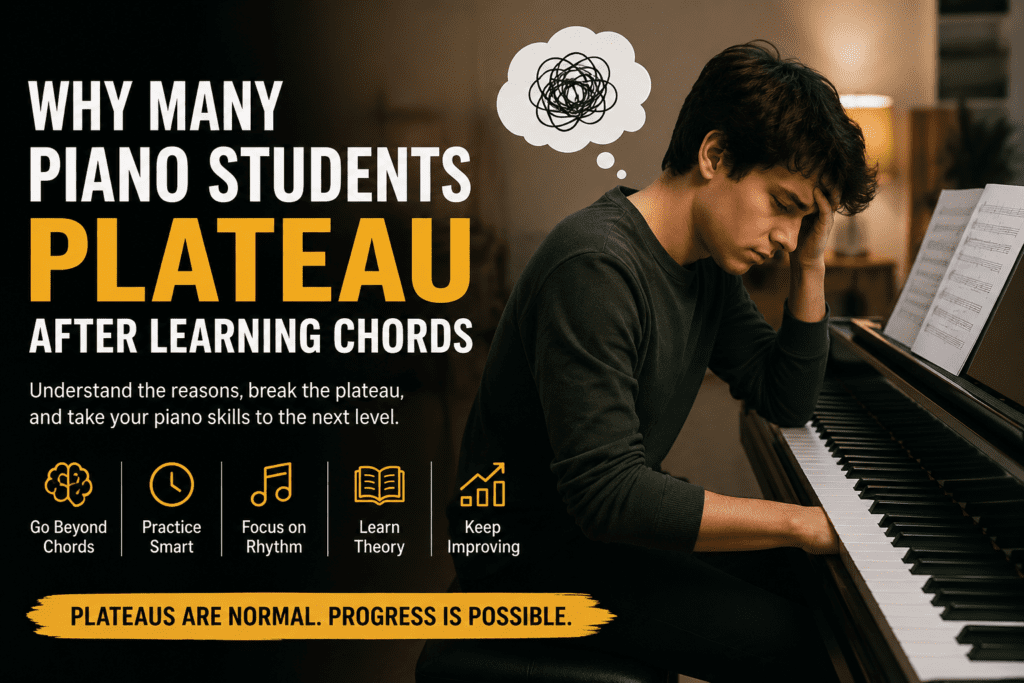
Why Many Piano Students Plateau After Learning Chords
Learning piano is exciting in the beginning. Students quickly pick up basic chords, play a few songs, and feel great progress. But after some time, many learners hit a piano learning plateau—a stage where improvement feels slow or stuck.
This is one of the most common challenges in piano learning. Let’s understand why it happens and how to overcome it.
What Does “Plateau” Mean in Piano Learning?
A plateau is a phase where your progress slows down or feels stuck, even though you are still practicing.
At this stage, students can usually:
Play basic chords
Perform simple songs
Follow chord charts
But they struggle to move beyond this level into more advanced playing.
Why Do Piano Students Plateau After Learning Chords?
Many students practice without a clear plan. They just play songs they already know instead of improving specific skills.
This leads to:
Repetition without growth
No technical improvement
Slow progress over time
3. No Focus on Hand Independence
After chords, the next step is coordination between left and right hands.
But many learners:
Depend heavily on chord shapes
Don’t train finger independence
Struggle with melody playing
4. Ignoring Rhythm and Timing
Even if chords are correct, poor rhythm can make playing sound basic.
Common issues include:
Irregular timing
No metronome practice
Weak sense of groove
5. Lack of Musical Theory Understanding
Students often learn “what to play” but not “why it works.”
Without basic theory:
Chord progressions feel confusing
Improvisation becomes difficult
Growth becomes slow
6. Not Practicing Beyond Comfort Zone
Many learners repeat easy songs because they feel comfortable.
But real improvement comes from:
Slightly difficult songs
New chord positions
Challenging transitions
How to Break the Plateau
Here are simple ways to move forward:
✔ Practice Scales Daily
Scales improve finger strength and speed.
✔ Learn Chord Progressions
Understand how chords connect in songs.
✔ Use a Metronome
Helps improve timing and consistency.
✔ Train Both Hands Separately
Build coordination step by step.
✔ Learn Basic Music Theory
Even simple concepts like keys and intervals help a lot.
✔ Challenge Yourself Weekly
Try one slightly harder song every week.
Plateaus are completely normal in piano learning. They are not a sign of failure—they are a sign that your skills are ready to grow deeper.
If you move beyond just chords and start focusing on technique, rhythm, and theory, your progress will continue smoothly again.
Remember: Every great pianist once struggled at the same stage—you just need the right direction to move forward.
If you feel stuck, you can explore our piano lessons online, where we guide students step by step to overcome plateaus and build strong musical skills with proper structure and support.
Intersted in learning music with us? Register now
For more information and exciting resources about learning music, visit our website at The Mystic Keys. For more music content and exciting offers follow us on