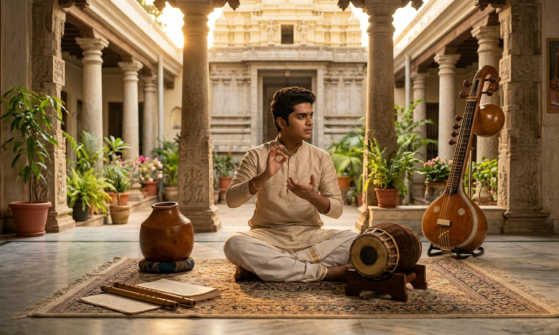
Daily vocal sadhana | How Practice Shapes a Carnatic Vocalist
Carnatic music goes beyond being just a performance tradition; it lives as a discipline that grows quietly inside a practitioner every single day. At its core, daily vocal sadhana drives this growth as a steady, almost meditative practice that refines not only the voice but also the mind’s relationship with sound. A Carnatic vocalist does not treat this as optional training; they build their artistry on this foundation itself.
This journey feels unique because a singer rarely notices dramatic progress in the moment. Yet over weeks and months, the voice responds differently, gamakas flow more naturally, and ragas shift from being scales on paper to living expressions shaped through experience and sound awareness.
The Meaning of Sādhana in Carnatic Music
Sādhana is often translated as “practice,” but in the Carnatic tradition, it carries a deeper sense of disciplined inner work. It is not merely repetition of exercises; it is the steady alignment of breath, voice, and awareness.
Unlike casual singing, sādhana is approached with intention. Each note is allowed to settle, each phrase is explored rather than rushed, and silence between notes becomes just as meaningful as sound itself. Over time, this approach reshapes how a vocalist hears and produces music.
There is also a subtle transformation that happens mentally. The mind learns patience, because progress in Carnatic music is gradual. A single rāga can take years to truly mature in expression, and daily practice becomes the space where that maturity is nurtured.
Daily Vocal Sādhana | Beginning the Day with Voice Awareness
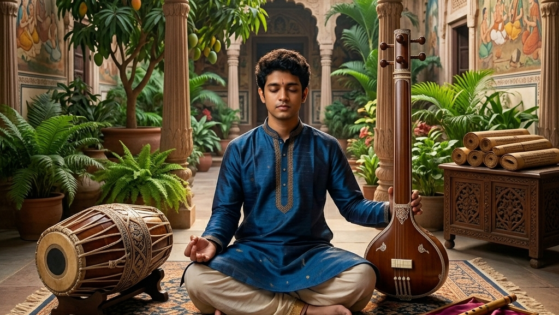
A Carnatic vocalist usually begins daily vocal sādhana not with complex compositions, but with gentle voice awakening. The vocalist focuses the early moments of sādhana less on performance and more on reconnecting with the instrument within.
The singer breathes slowly and lets the voice settle, easing out the stiffness of inactivity. The practitioner explores simple swara exercises in a calm tempo and allows the vocal cords to adjust naturally.
As the practice unfolds, the musician moves from physical preparation into mental focus. Distractions fade away, and attention narrows into sound. This transition happens subtly, yet it sets the tone for everything that follows.
Swara Practice as the Backbone of Discipline
Swara exercises form the structural core of Carnatic vocal training. Though they may appear simple, their repetition builds precision, control, and clarity over time.
Instead of rushing through patterns, a disciplined practice focuses on stability of pitch and smoothness of transitions. Even small variations in speed or emphasis reveal how well the voice is anchored.
As practice deepens, swaras stop feeling mechanical. They begin to function like musical grammar—something that later supports improvisation and raga elaboration. This is where discipline quietly transforms into creativity.
Daily Vocal Sādhana | Raga Exploration and Emotional Depth
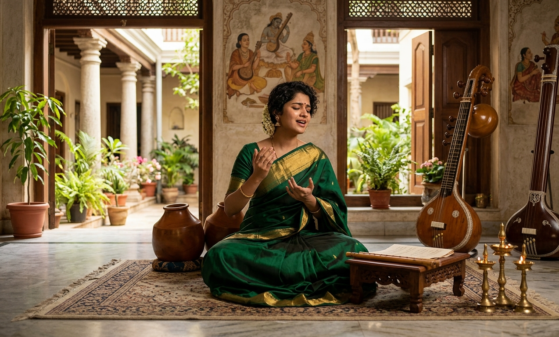
Once the voice is prepared, a vocalist shifts from daily vocal sadhana into rāga practice, and this stage brings the emotional core of the discipline into focus. Instead of approaching it as technical drilling, the singer opens the space for exploration and sensitivity.
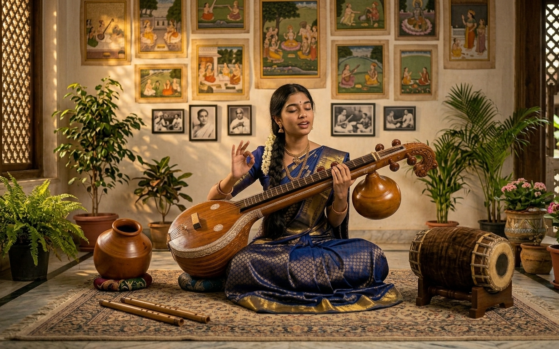
The vocalist takes a single rāga and explores it slowly, phrase by phrase, and allows its character to unfold in real time. Rather than reducing it to a scale, the singer feels its mood, its tension, and its release as each phrase takes shape.
Repetition rarely creates boredom in this process; instead, it builds depth. Each return to the same phrase reveals something new—sometimes a subtle microtonal shift, sometimes a more expressive gamaka. Over time, the vocalist stops treating the rāga as an external structure and starts living it as an internal language.
The Role of Breath and Control in Vocal Growth
Breath is the invisible thread that holds Carnatic singing together. Without controlled breathing, even the most beautiful phrases lose stability and flow.
During daily sadhana, attention gradually shifts toward sustaining notes without strain. This is not achieved forcefully but through consistent awareness of airflow and support.
As control improves, longer phrases become easier, and expression gains fluidity. The singer begins to feel that breath is no longer something managed consciously—it starts to operate as a natural extension of musical thought.
Daily Vocal Sādhana | From Practice to Expression_ The Subtle Shift
With continued practice, there comes a moment in Daily vocal sadhana where technical effort begins to fade during singing. This does not mean discipline is lost; rather, it has been internalized.
At this stage, music starts to feel less like execution and more like expression. The vocalist is no longer thinking about each step but allowing the rāga to guide the movement of sound.
This shift is often gradual and almost unnoticeable. Yet it marks one of the most important transitions in a Carnatic musician’s journey—from learning music to living it.
Daily Vocal Sādhana | Consistency as the Quiet Teacher
Consistency in sadhana matters more than intensity in most cases. A short, focused daily session shapes the voice more effectively than occasional long practice hours shape it.
Over time, the body adapts to routine. The vocal cords respond more readily, and the mind enters practice with less resistance. Even on days of fatigue or distraction, continuity sustains the musical connection and keeps the training alive.
This consistency also adds a psychological layer to the practice. It builds trust between the musician and their own voice and gradually removes hesitation and doubt.
The Inner Transformation of a Vocalist
A vocalist begins practicing daily vocal sadhana as technical training and gradually transforms it into inner refinement. Carnatic sādhana shapes patience, attention, and emotional balance through steady discipline.
A singer who follows daily vocal sadhana develops heightened sensitivity—not only toward music but also toward sound in everyday life. Even silence starts carrying meaning and presence.
With consistent daily vocal sādhana, the voice eventually stops acting as just an instrument. It reflects the musician’s inner state like a mirror, expressing clarity, struggle, growth, and stillness in equal measure.
Conclusion | Where Practice Becomes Identity
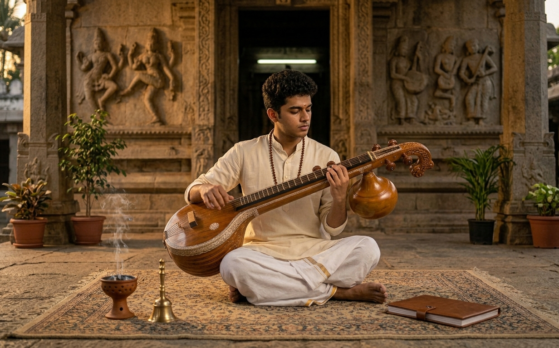
A vocalist lives daily vocal sādhana rather than treating it as a task. This practice shapes a Carnatic vocalist slowly and almost invisibly, until the transformation eventually becomes undeniable.
A trained singer emerges as a musician whose voice carries years of discipline, patience, and listening. In that voice, every note preserves the memory of countless quiet hours of practice, while structured guidance from platforms like The Mystic Keys provides Carnatic Vocal Lessons Online actively shape and support this journey with clarity and direction.
Carnatic music, in this sense, does not aim for a final endpoint; instead, it invites the practitioner to remain in continuous dialogue with sound itself.
For more information and exciting resources about learning music, visit our website at The Mystic Keys. For more music content and exciting offers follow us on