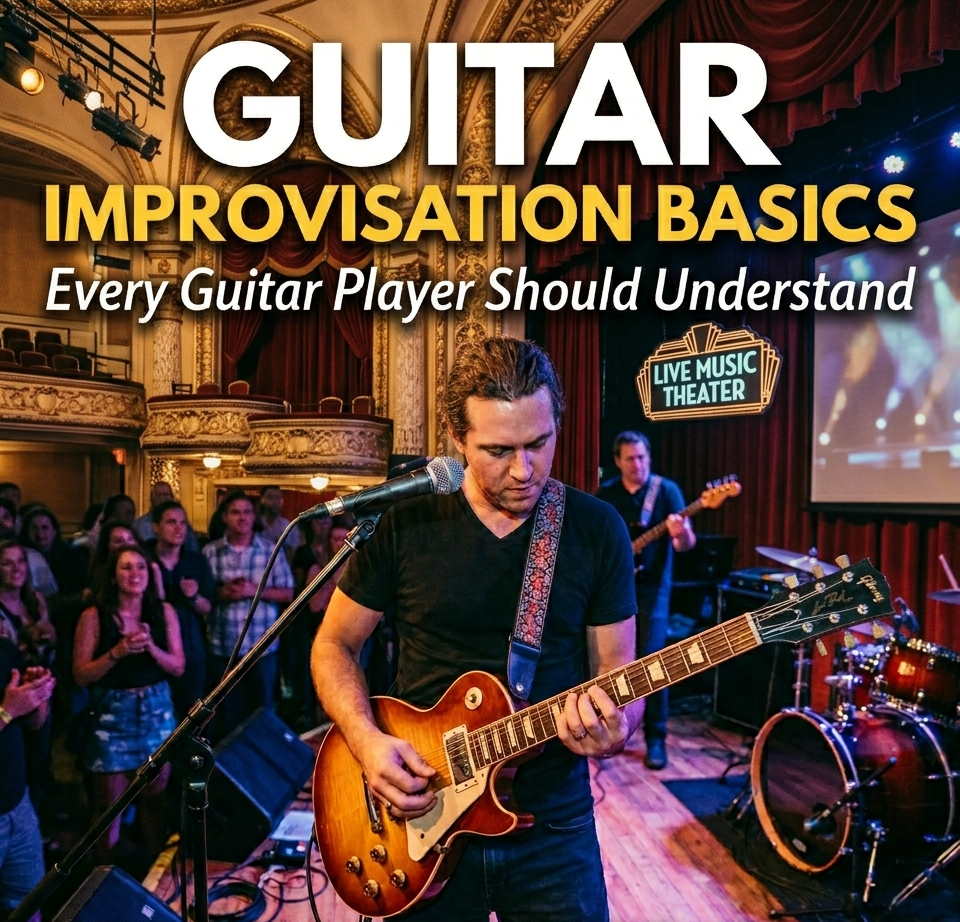
Guitar Improvisation Basics Every Player Should Understand
Guitar Improvisation Basics Every Player Should Understand
Improvisation is often described as the moment when music becomes personal. While exploring Guitar Improvisation Basics, players begin to move beyond simply repeating something already written and start shaping sound in real time. That shift—from playing notes to expressing ideas—is where true musical growth starts
Many players assume improvisation is mysterious or reserved for advanced musicians. In reality, it develops from a handful of foundational concepts that anyone can learn step by step. Once these basics become familiar, spontaneous playing begins to feel natural rather than intimidating.
Understanding these essentials does not remove creativity. Instead, they provide the structure that allows creativity to appear confidently and consistently.

Guitar Improvisation Basics Begin with Listening Before Playing
Improvisation is not simply about fingers moving across the fretboard. At its core, it starts with hearing what is happening in the music and responding to it thoughtfully.
Every backing track, chord progression, or ensemble setting creates a musical environment. That environment suggests which notes will feel stable and which ones will create tension. Strong improvisers learn to notice those relationships instinctively.
Careful listening helps players recognize rhythm patterns, chord changes, and melodic space. Over time, the ear begins guiding the hands instead of the other way around. When that connection develops, improvisation stops feeling random and starts sounding intentional.
Musicians who listen actively also learn when not to play. Silence often carries as much expressive value as sound, especially during melodic improvisation.

Understanding Scales Creates a Reliable Musical Map
Scales function like roadmaps for improvisation. Rather than guessing which notes might work, guitarists rely on familiar patterns that match the harmony underneath.
Major and minor scales form the starting point for most melodic exploration. Pentatonic scales usually come next because they are flexible, expressive, and easy to apply across many musical styles. Blues scales expand that vocabulary further by introducing characteristic tension notes that give phrases personality.
Confidence grows when players begin recognizing scale shapes across multiple fretboard positions. Movement between those shapes allows melodic ideas to travel instead of staying trapped in one location.
Eventually, scales stop feeling like exercises and begin functioning as musical language.

Guitar Improvisation Basics Improve Through Strong Chord Awareness
Many beginners rely entirely on scales while improvising. Although scales are helpful, they become far more powerful when connected directly to chords.
Each chord contains specific notes that define its sound. Highlighting those notes during improvisation makes melodies feel connected to the progression rather than floating above it. Listeners often perceive this connection as maturity in playing.
Strong improvisers learn to notice when chords change and adjust their note choices accordingly. Even small adjustments create a surprisingly large improvement in musical clarity.
Gradually, chord tones become landing points for phrases, giving improvisation a sense of direction and purpose.

Rhythm Shapes Expression More Than Note Choice
Players often spend hours searching for the right notes while overlooking rhythm. Yet rhythm frequently determines whether a phrase sounds confident or uncertain.
Simple notes placed with strong timing can sound more musical than complex passages played without rhythmic awareness. Groove, spacing, and phrasing transform ordinary scale patterns into expressive statements.
Developing rhythmic variation helps improvisation sound conversational instead of repetitive. Short phrases followed by pauses create anticipation. Longer lines add excitement and movement.
When rhythm becomes intentional, even familiar scale shapes begin sounding fresh again.

Phrasing Turns Notes into Musical Sentences
Improvisation resembles speaking a language. Individual notes act like words, while phrasing determines how those words communicate meaning.
Musical phrases often feel strongest when they breathe naturally. Instead of playing continuously, experienced guitarists allow ideas to begin, develop, and resolve within short expressive sections. That structure makes improvisation easier for listeners to follow.
Repetition also strengthens phrasing. Returning briefly to a familiar idea creates recognition and coherence inside a solo. Slight variations on repeated phrases introduce personality without losing clarity.
As phrasing improves, improvisation starts sounding intentional rather than accidental.

Target Notes Help Guide Musical Direction
Improvisation becomes more expressive when guitarists aim for specific notes at important moments. These target notes usually belong to the chords currently being played.
Landing on such notes during strong beats creates stability. Approaching them gradually adds anticipation and motion. Combining both techniques produces solos that feel connected to the harmony rather than separate from it.
Instead of wandering through scale shapes, players begin shaping musical journeys that feel purposeful from beginning to end.
Over time, recognizing target notes becomes automatic.

Guitar Improvisation Basics Gain Expression Through Dynamics
Volume changes influence how listeners experience improvisation. Playing every phrase at the same intensity removes emotional variety from the performance.
Soft passages often create intimacy and space. Louder sections introduce excitement and energy. Alternating between the two creates contrast that keeps improvisation engaging.
Tone adjustments contribute as well. Picking strength, vibrato depth, and note length all shape emotional impact without changing pitch content.
Dynamic awareness transforms simple phrases into expressive musical statements.
Connecting Positions Expands Creative Freedom
Many guitarists learn scale shapes in one position and remain there while improvising. Although that approach works initially, it limits melodic movement across the fretboard.
Connecting multiple positions allows phrases to travel horizontally instead of staying vertical. Movement like this makes solos feel smoother and more natural.
Transitions between positions become easier when players recognize shared notes between shapes. Gradual shifting replaces sudden jumps, resulting in more fluid expression.
Eventually, the fretboard begins to feel like a continuous landscape rather than separate isolated zones.

Guitar Improvisation Basics Encourage Learning from Mistakes
Improvisation naturally includes unexpected moments. Instead of treating those moments as failures, experienced musicians treat them as opportunities.
Unexpected notes sometimes create tension that resolves beautifully when followed by the right choice. Learning to recover quickly builds confidence during live playing situations.
Flexibility matters more than perfection. When players remain relaxed, improvisation becomes adventurous instead of stressful.
Many memorable musical ideas begin as accidents that were explored rather than avoided.

Practice Builds Confidence More Than Speed
Improvisation improves gradually through focused repetition. Short daily sessions usually produce stronger results than occasional long practice periods.
Working with backing tracks helps simulate real musical environments. Repeating the same progression several times encourages experimentation without pressure. Recording practice sessions also provides valuable perspective on progress.
Confidence develops when familiar patterns begin appearing naturally during spontaneous playing. That comfort allows attention to shift from technique toward expression.
Consistency shapes improvisers more effectively than complexity.

Improvisation Is a Conversation, Not a Performance Test
Some players approach improvisation as something they must execute perfectly. That mindset often creates hesitation and self-doubt.
Music becomes far more enjoyable when improvisation feels like interaction rather than evaluation. Responding to rhythm, harmony, and emotional atmosphere turns playing into communication instead of calculation.
Confidence grows naturally once players begin trusting their musical instincts.
Most importantly, improvisation becomes fun again.

Final Thoughts
Improvisation is not a mysterious skill reserved for advanced musicians. Instead, it grows steadily from listening, scale familiarity, chord awareness, rhythmic sensitivity, and expressive phrasing. Through structured guidance—such as the approach followed at The Mystic Keys and other well-designed Guitar Lessons Online—players often discover that improvisation becomes far more approachable when these fundamentals are introduced step by step.
Progress may feel slow at first, yet every small improvement builds a stronger musical voice. With consistent exploration and patience, spontaneous playing gradually becomes one of the most rewarding parts of the guitar journey.
Eventually, improvisation stops feeling like something you try to do and starts feeling like something you naturally do. That moment is where real musical freedom begins—and where a guitarist truly starts sounding like themselves
For more information and exciting resources about learning music, visit our website at The Mystic Keys. For more music content and exciting offers follow us on
Facebook, Instagram, YouTube, LinkedIn, Twitter, Pinterest, and Threads.