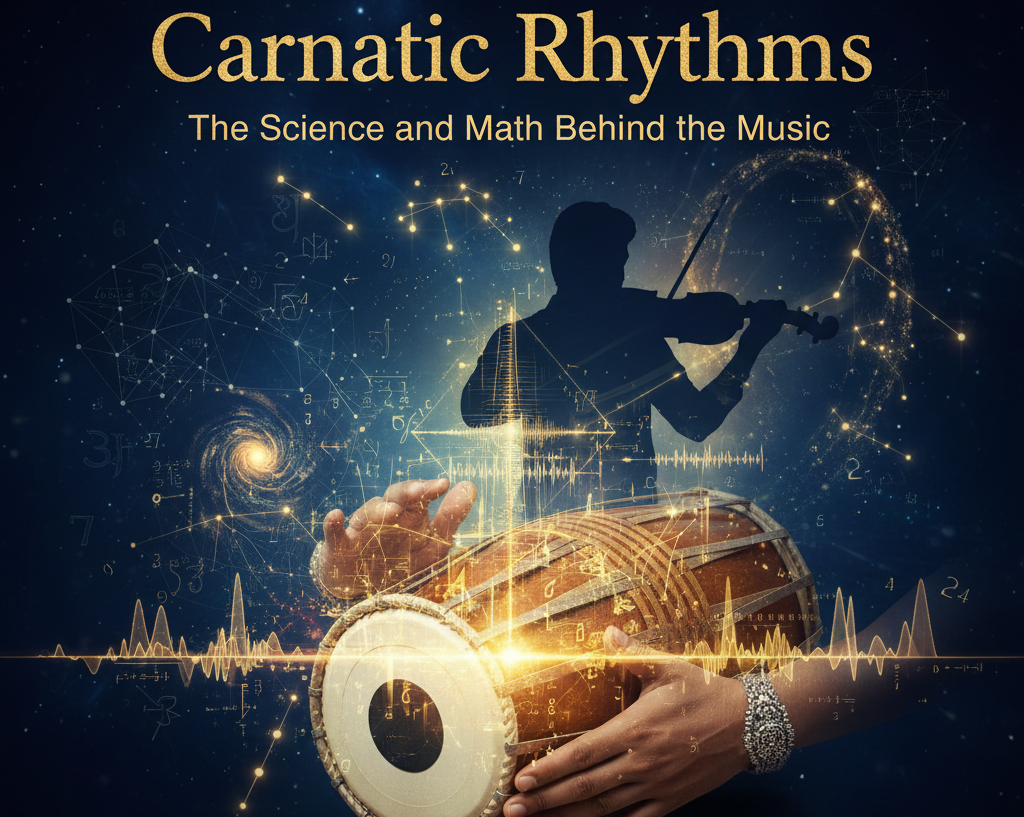
Carnatic Rhythms | The Science and Math Behind the Music
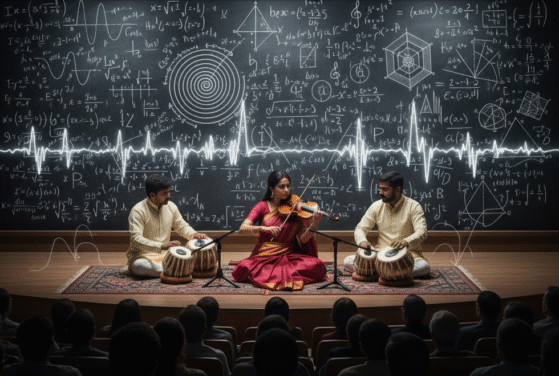
People often experience Carnatic rhythms as instinctive and spiritual, yet its foundation relies on one of the most mathematically refined systems in the world. Beneath its expressive surface, the music follows a precise language of numbers, cycles, and timing. Interestingly, these same principles also reveal how motivation works—not as a sudden burst of inspiration, but as a disciplined, rhythm-driven process shaped by consistency and structure.
Carnatic Rhythms as a Mathematical Framework of Order
Musicians build Carnatic rhythms on tala, a cyclical system that organizes time into clearly defined patterns. They construct each tala using specific counts and subdivisions, forming a repeating structure that anchors the music. While listeners experience this as seamless flow, performers remain constantly aware of the precise numerical relationships beneath the surface.
This mathematical organization stabilizes the music. The brain naturally seeks patterns, and when it recognizes a rhythmic cycle, it feels oriented and in control. Motivation works in the same way. When we structure our efforts—through routines, schedules, and measurable progress—our minds feel secure enough to engage deeply. Chaos drains motivation, but rhythmic order sustains it.
The Neuroscience Behind Listening to Carnatic Rhythms
Listening to Carnatic rhythms engages the brain’s prediction and reward systems. As the tala cycle repeats, the brain actively anticipates rhythmic resolutions. Each correct anticipation strengthens neural connections and triggers dopamine release, sharpening attention and deepening engagement.
Carnatic percussion deliberately delays or reshapes these expectations before resolving precisely on the samam. This resolution delivers intense psychological satisfaction. Motivation operates through the same neurological process. When progress unfolds in predictable stages, the brain remains engaged and committed. The true reward lies not only in achievement, but in the rhythmic anticipation of growth itself.
Korvais in Carnatic Rhythms and the Psychology of Planning
Korvais represent one of the most intricate mathematical aspects of Carnatic rhythms. These rhythmic compositions rely on careful calculation—phrases are repeated, expanded, or compressed so that they land precisely on the samam. A single miscalculation can disrupt the entire structure.
This disciplined planning closely resembles how motivation operates in real life. Long-term motivation requires foresight, adjustment, and an understanding of how small efforts accumulate. Just as a korvai demands alignment between creativity and calculation, sustainable motivation depends on balancing vision with realistic, consistent action.
Laya and the Human Sense of Time
Laya, or tempo, actively shapes how Carnatic rhythms move through time. Musicians train rigorously to absorb tempo so completely that they no longer rely on external counting. This strong internal sense of time helps them maintain precision even while navigating complex improvisations.
Psychologically, humans also perform best when they honor natural pacing. Rushing or forcing effort weakens motivation, while stagnant progress causes it to fade. Carnatic rhythms actively cultivate patience and timing, encouraging steady progress without losing control. True motivation emerges when effort flows in harmony with time rather than working against it.
Discipline, Freedom in Creative Growth
One of the most striking features of this music is that improvisation becomes possible only after the underlying structure is firmly internalized. Creative freedom does not happen by accident; musicians earn it through discipline and repetition.
Motivation follows the same principle. Waiting for inspiration often leads to inconsistency, but when disciplined routines take hold, resistance diminishes and creativity flows naturally. This music shows that structure does not restrict expression—it enables it. Similarly, disciplined habits do not suppress motivation; they sustain it.
Why Carnatic Rhythms Feel Alive, Not Mechanical
Despite their mathematical precision, Carnatic rhythms remain fluid and expressive. Musicians shape emphasis, tone, and timing with subtle variations that add emotional depth to the structure. This balance between precision and expression keeps the rhythm alive rather than mechanical.
Motivation also thrives when emotion works alongside structure. Discipline without meaning drains energy, while emotion without structure creates inconsistency. Carnatic rhythms clearly show how logic and feeling can operate together, producing both stability and vitality.
Conclusion | Carnatic Rhythms as a Blueprint for Motivation
The science and math behind Carnatic rhythms reveal far more than musical sophistication; they show us how the human mind sustains focus and motivation. Rhythm teaches us to recognize progress as cyclical, align effort with time, and use discipline as a path to freedom.
At The Mystic Keys, this understanding shapes the approach to Carnatic Vocal Lessons Online, where students learn not only compositions but also the rhythmic discipline that builds focus, patience, and long-term motivation. Just as musicians resolve Carnatic rhythms through patience and precision, learners develop motivation through consistent, well-timed practice. When we learn to stay in rhythm—whether in music or in life—growth becomes not just possible, but inevitable.
For more information and exciting resources about learning music, visit our website at The Mystic Keys. For more music content and exciting offers follow us on
Set Up Your Guitar for Church Worship | A Complete Guide
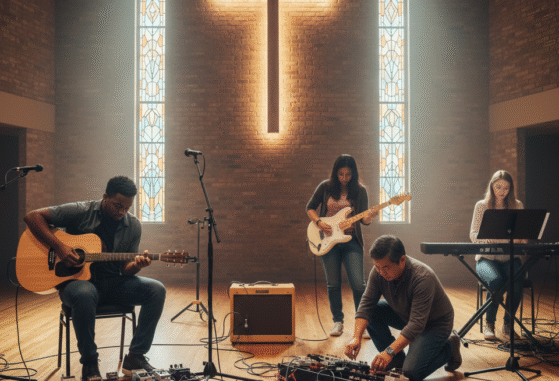
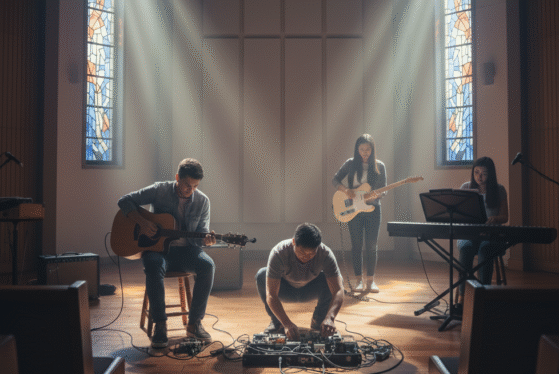
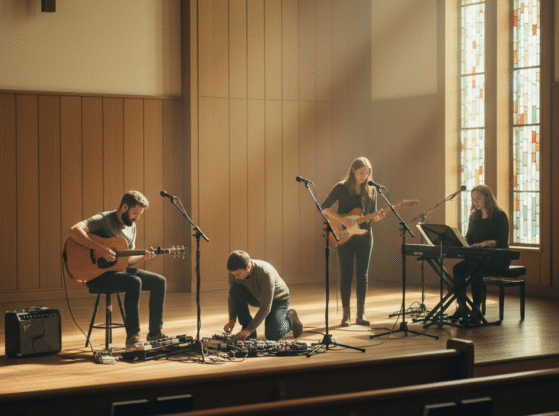
Leading worship on the guitar is a blend of preparation, purpose, and persistence. While the congregation may only see the final performance, what truly shapes a meaningful worship session happens much earlier—when you set up your guitar, prepare your mind, and understand what keeps you motivated to return to your instrument week after week.
This blog explores how thoughtful guitar setup and a clear understanding of motivation work together to create worship that feels effortless, sincere, and spiritually grounded.
Why Worship Begins Before You Set Up Your Guitar
Worship does not start with the first chord—it begins with intention. Before you even plug in or tune up, there’s a mindset shift that needs to happen. When you approach your guitar as a tool for service rather than performance, everything changes.
This perspective fuels motivation in a powerful way. You’re no longer practicing out of obligation; you’re preparing to contribute to a shared spiritual moment. That sense of purposeis often what keeps worship musicians consistent even when energy or time feels limited.
How to Set Up Your Guitar for a Worship-Ready Sound
When you set up your guitar thoughtfully, you remove unnecessary distractions. Tuning accurately is the most basic step, yet it’s also one of the most important. A guitar that’s slightly out of tune can quietly undermine the emotional impact of a worship song.
Beyond tuning, paying attention to intonation and string condition makes a noticeable difference. Fresh strings bring clarity and warmth, while proper intonation ensures chords sound balanced across the fretboard. When your guitar responds smoothly, your confidence naturally increases—and confidence is a hidden driver of motivation.
Set Up Your Guitar for Comfort, Not Just Tone
Comfort plays a surprisingly large role in how motivated you feel to practice and perform. If your guitar feels difficult to play, enthusiasm fades quickly.
Adjusting string action to suit your playing style can prevent hand fatigue during long worship sets. Choosing the right string gauge also matters; lighter strings make extended chord progressions easier, while medium gauges provide fuller resonance for congregational singing.
When your guitar feels comfortable, practice stops feeling like work and starts feeling inviting—this is where motivation quietly grows.
Set Up Your Guitar to Support Seamless Worship Flow
Church worship thrives on continuity. Awkward pauses caused by technical issues break the atmosphere and disrupt focus. This is why setting up your guitar’s electronics and signal chain is essential.
Ensuring clean cables, stable connections, and balanced volume levels allows you to move confidently between songs. If you use pedals, keep settings simple and predictable. A reliable setup frees your mind from technical worry and lets you remain present in the moment—an often overlooked but critical element of motivated musicianship.
How Motivation Really Works in Worship Musicians
Motivation isn’t something you either have or don’t have—it’s something that’s built through small, repeated experiences. For worship guitarists, motivation often grows when effort feels meaningful and progress feels visible.
Clarity of purpose strengthens this process. When you know why you’re practicing—whether to support the choir, enhance congregational singing, or grow musically in service—practice gains direction. Motivation becomes internal rather than dependent on external praise or pressure.
Let Your Guitar Setup Reinforce Your Motivation
There’s a powerful connection between preparation and mindset. Each time you set up your guitar with care, you send yourself a signal: this moment matters.
A consistent routine—checking tuning, adjusting tone, warming up gently—creates psychological readiness. Over time, this routine becomes motivating in itself. Your brain associates setup with purpose, and purpose with fulfillment. This is how motivation sustains itself naturally.
Final Reflection | When Setup and Motivation Work Together
Setting up your guitar properly is not just about sound—it’s about removing friction so worship can flow freely. Motivation, on the other hand, is what brings you back to your instrument even on ordinary days. At The Mystic Keys, this balance between preparation and purpose is deeply valued, reminding musicians that every small effort contributes to a greater worship experience.
When technical readiness and inner drive align, worship becomes less about effort and more about expression. Your guitar becomes an extension of your intent, and your motivation finds direction through service—something that lies at the heart of musical learning and worship culture at The Mystic Keys.
In the end, worship guitar isn’t about perfection—it’s about preparation, consistency, and heart. And both begin the moment you choose to set up your guitar with purpose, allowing music to serve something far greater than performance alone.
For more information and exciting resources about learning music, visit our website at The Mystic Keys. For more music content and exciting offers follow us on
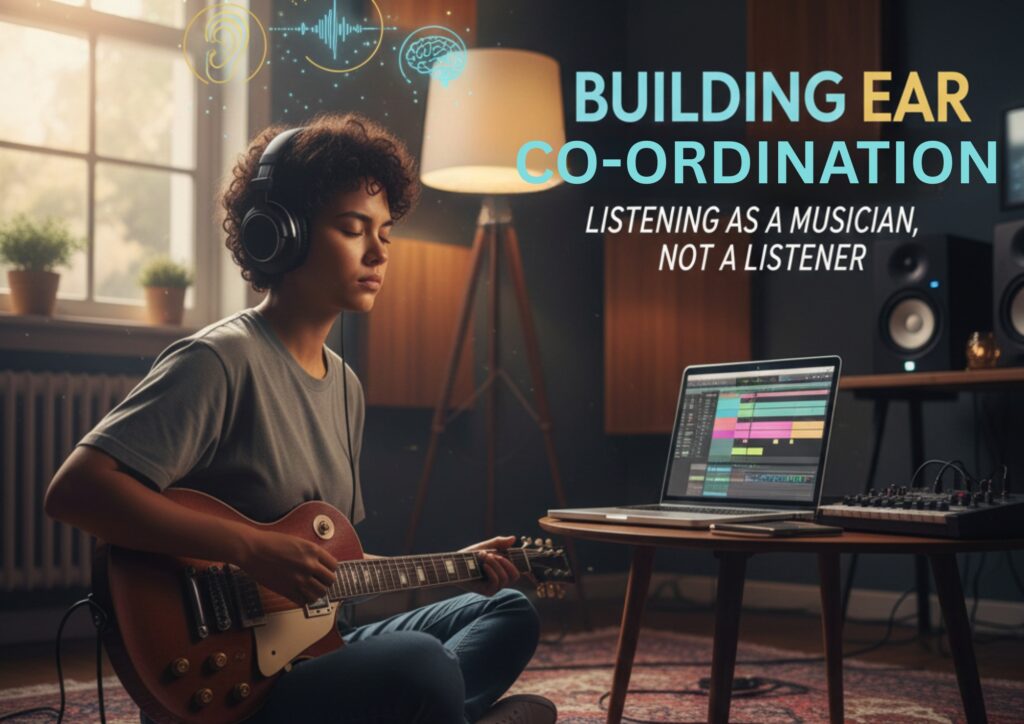
Building Ear Coordination | Listening as a Musician, Not a Listener
Listening is often mistaken as a passive act—something that simply happens when music plays. For musicians, however, listening is an active skill, one that must be trained with intention and sustained through motivation. The journey from casual listening to musician-level awareness is at the heart of musical growth, and it begins with building ear coordination.
Ear coordination allows sound to become information and emotion to become expression. It bridges what we hear with what we perform. Understanding how this coordination develops—and how motivation truly supports it—can transform the way we approach music practice and learning.
The Shift from Passive Hearing to Musical Awareness
Most learners begin their musical journey as listeners first. They enjoy melodies, rhythms, and emotions without questioning how they are constructed. This is natural. However, as musical training begins, listening slowly transforms into awareness.
A musician does not just hear a melody; they sense its direction. They notice how rhythm interacts with phrasing, and how tension and release are created. This shift marks the early stages of building ear coordination, where the ear starts actively engaging with musical structure instead of merely receiving sound.
Over time, this awareness deepens. The ear learns to stay alert, curious, and responsive—qualities that are essential for meaningful musical growth.
Building Ear Coordination Through Intentional Listening
Building ear coordination requires listening with purpose. This does not mean listening harder, but listening smarter. Intentional listening focuses attention on specific elements without losing the emotional essence of the music.
As learners practice this kind of listening, the ear begins to separate layers naturally—melody, harmony, rhythm, dynamics—without overwhelming the mind. Gradually, patterns become familiar, intervals sound recognizable, and musical phrases feel predictable in a helpful way.
This process strengthens the connection between the ear and musical understanding, laying the foundation for accurate singing, confident playing, and expressive interpretation.
What Building Ear Coordination Really Involves
Contrary to popular belief, building ear coordination is not limited to ear training exercises alone. It is a continuous process that develops through consistent interaction with music.
Every time a learner matches pitch, anticipates a chord change, or adjusts rhythm instinctively, ear coordination is at work. The ear learns not only to detect sound but to guide musical decisions in real time.
This coordination becomes especially powerful when learners stop relying solely on visual cues or muscle memory. When the ear leads, music feels more organic and less forced.
Motivation as the Engine Behind Ear Development
Motivation plays a critical role in sustaining the slow and subtle process of ear development. Unlike visible skills, ear coordination improves quietly, often without immediate results.
True motivation in music does not come from constant excitement. It comes from understanding the purpose behind listening and recognizing small moments of progress. When learners notice that they can hear differences more clearly or respond faster to musical cues, motivation strengthens naturally.
This inner motivation is far more reliable than external rewards. It keeps learners engaged even when progress feels gradual.
How Building Ear Coordination Strengthens Long-Term Motivation
As ear coordination improves, learners begin to feel more in control of their musical abilities. This sense of control fuels confidence, and confidence fuels motivation.
Music stops feeling like guesswork. Practice becomes more satisfying because results feel earned rather than accidental. The learner starts trusting their ear, and that trust creates a positive feedback loop—better listening leads to better performance, which in turn reinforces motivation.
Over time, this relationship makes learning music more sustainable and emotionally rewarding.
Listening as a Path to Musical Expression
At its highest level, building ear coordination unlocks true musical expression. Musicians refine their listening, noticing not just notes and rhythms but the subtle intentions behind them. This awareness allows them to respond instinctively—shaping phrases with natural flow, adjusting dynamics with sensitivity, and conveying emotion authentically.
Technique alone cannot achieve such nuanced expression; the ear guides every decision. When the ear, mind, and body work in harmony, musicians transform each note into a conscious choice rather than a mechanical action. In this state, listening becomes an active, participatory process, and musicians fully engage with every layer of sound and emotion.
Conclusion | Motivation Grows Where Listening Has Meaning
Building ear coordination does not chase perfection or speed. It grows through presence, patience, and purpose. When learners understand why they listen and how each sound connects to their own musical voice, practice stops feeling forced. Motivation no longer needs to be pushed—it begins to rise on its own.
At The Mystic Keys, this belief actively shapes the way students learn to listen. Teachers encourage awareness over pressure and guide students to let their ears lead before their hands or voice respond. This approach helps learners engage deeply with sound instead of reacting mechanically.
As students listen with intention, they begin to respond with clarity and expression. Sound informs action, emotion guides phrasing, and music starts to feel alive rather than rehearsed. When listening carries purpose, motivation follows naturally. Music then becomes more than something students play—it becomes something they understand, express, and truly own at The Mystic Keys.
For more information and exciting resources about learning music, visit our website at The Mystic Keys. For more music content and exciting offers follow us on
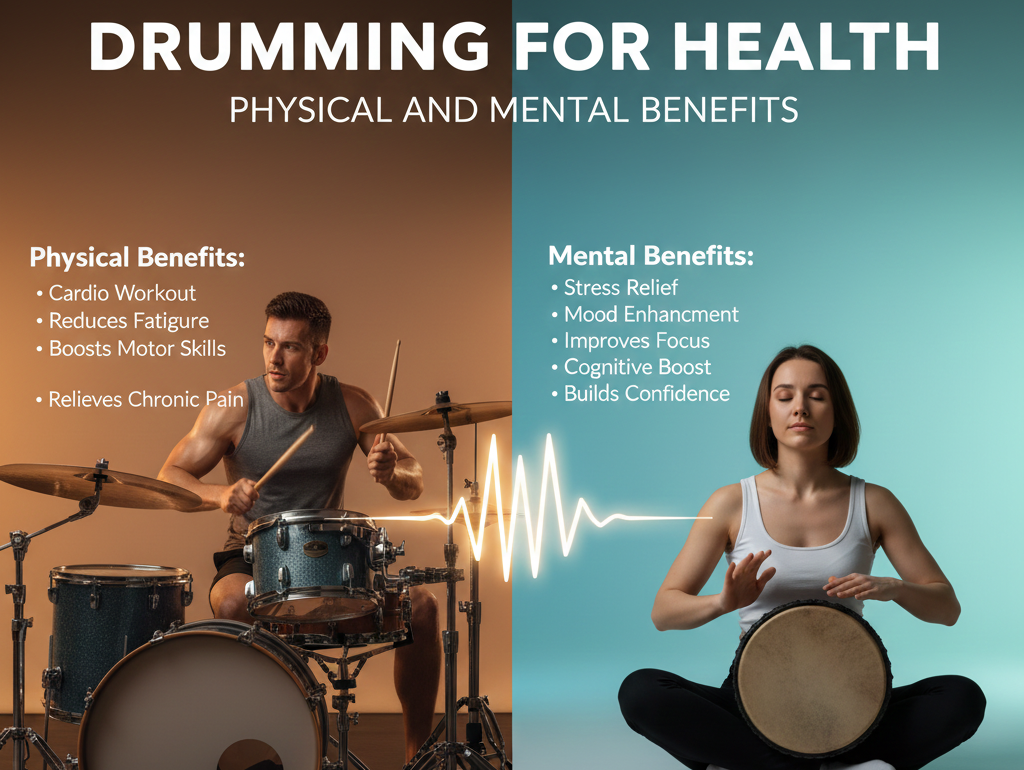
Drumming for Health | Physical and Mental Benefits
In a world that constantly demands speed, productivity, and mental agility, finding a single activity that nurtures both the body and the mind can feel rare. Drumming, often seen purely as a musical or performance skill, quietly stands out as one such powerful practice. Beyond rhythm and beats, drumming has a profound impact on physical health, mental well-being, and even long-term motivation.
Interestingly, the motivation to drum doesn’t work the way motivation for many other activities does. It doesn’t rely solely on discipline or external rewards. Instead, it grows naturally—fed by movement, emotion, connection, and the deep human relationship with rhythm.
Drumming for Health |The Body’s Natural Response to Rhythm
From ancient tribal ceremonies to modern music therapy rooms, drumming has always been intertwined with human life. Rhythm mirrors the most fundamental sounds we experience—our heartbeat, breathing patterns, and walking pace. Because of this, drumming feels instinctive rather than forced.
When someone begins drumming, the body immediately recognizes the pattern. This recognition creates comfort, grounding, and engagement, which is why people often feel “drawn” to drums even before understanding technique. This natural pull plays a key role in sustaining motivation over time.
Drumming for Health and Physical Vitality Without the Pressure of Exercise
One of the most underrated aspects of drumming is its physical impact. While it may not resemble traditional workouts, drumming engages the body in continuous, controlled movement.
As the arms, shoulders, wrists, and fingers work together, muscles gradually gain strength and endurance. At the same time, maintaining rhythm and posture activates the core and improves overall coordination. Over longer sessions, drumming also elevates heart rate, gently supporting cardiovascular health.
What makes this especially powerful is that drummers rarely think, “I’m exercising.” The focus remains on sound, rhythm, and expression—allowing physical benefits to accumulate effortlessly. This is where motivation works differently: the body improves without the mental resistance often associated with fitness routines.
Mental Health Benefits | Rhythm as a Regulator
While the physical effects are significant, the mental benefits of drumming are often life-changing. Rhythm has a direct influence on the nervous system. Repetitive drumming patterns can calm the mind, slow racing thoughts, and bring attention into the present moment.
For many, drumming becomes a form of moving meditation. Stress hormones reduce, while dopamine and serotonin—chemicals associated with pleasure and emotional balance—are released. This explains why people often feel lighter, calmer, or emotionally refreshed after a drumming session.
Over time, drumming can help manage anxiety, reduce symptoms of depression, and improve emotional regulation. It provides a safe outlet for expression, especially for emotions that are difficult to articulate in words.
Cognitive Growth | Training the Brain Through Rhythm
Beyond emotional well-being, drumming significantly strengthens cognitive abilities. Playing rhythms requires focus, memory, timing, and coordination between both hands and sometimes the feet. This bilateral engagement stimulates both hemispheres of the brain simultaneously.
As drummers practice, they enhance concentration, listening skills, and reaction time. The brain learns to process complex patterns while staying adaptable, which can positively influence problem-solving skills and mental flexibility in daily life.
This constant mental engagement makes drumming deeply satisfying. The brain feels challenged—but not overwhelmed—creating an ideal environment for sustained motivation.
How Motivation Really Works in Drumming for Health
Unlike many skill-based activities, motivation in drumming does not rely solely on external validation such as grades, applause, or rewards. Instead, motivation grows internally through experience.
Each improvement—whether cleaner timing, stronger coordination, or a groove that finally “locks in”—creates immediate feedback. The sound itself becomes the reward. This instant cause-and-effect loop fuels curiosity and commitment.
Additionally, drumming allows progress to be felt, not just measured. When the body relaxes, the rhythm flows better. When emotions shift, the sound changes. This deep mind-body connection makes practice feel meaningful rather than obligatory.
Social Connection and Collective Energy
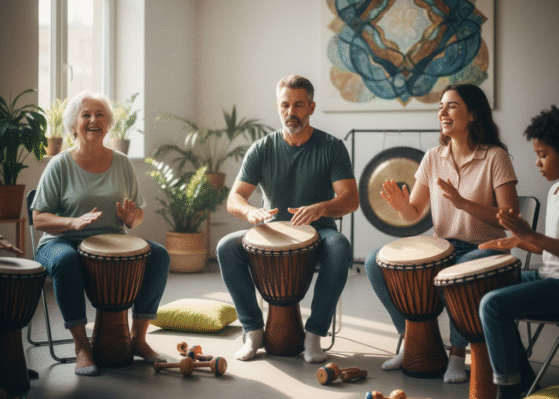
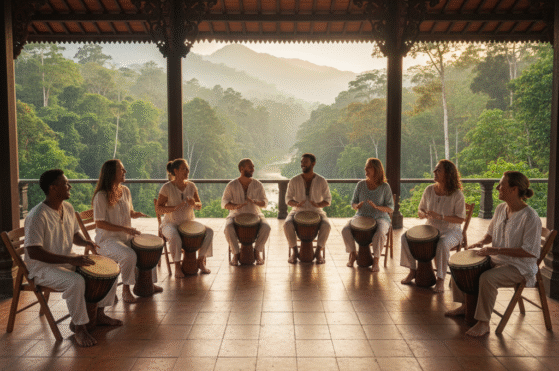
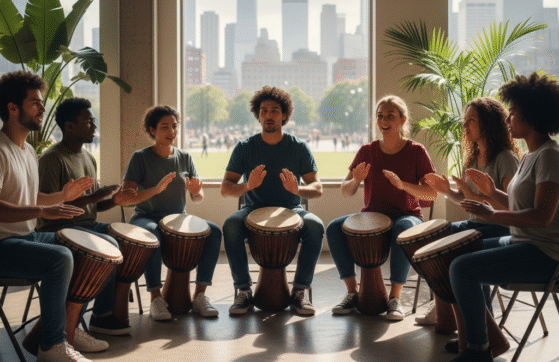
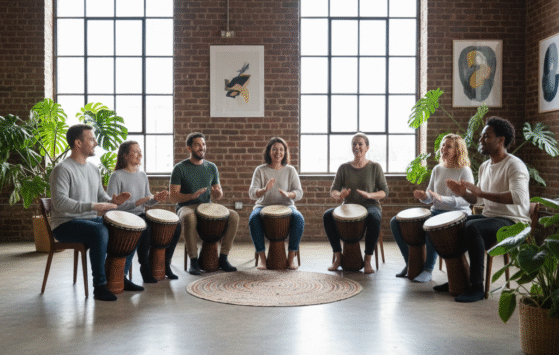
Drumming also has a strong social dimension. Group drumming sessions create a shared rhythm that fosters connection, trust, and a sense of belonging. Playing in sync with others naturally enhances empathy and cooperation.
This collective experience amplifies motivation. People are more likely to return, practice, and grow when they feel part of a rhythmic community. The drum circle doesn’t judge—it includes. That inclusivity makes drumming accessible and sustaining for people of all ages and backgrounds.
Consistency Without Burnout
One of the most powerful health benefits of drumming lies in its sustainability. Because drumming is enjoyable, expressive, and emotionally rewarding, people are more likely to continue it long-term.
Motivation here is not forced through discipline alone. It is renewed each time the drum is played—through sound, sensation, and emotional release. This makes drumming an ideal lifelong practice rather than a short-lived habit.
Conclusion| Drumming for Health as a Lifelong Practice
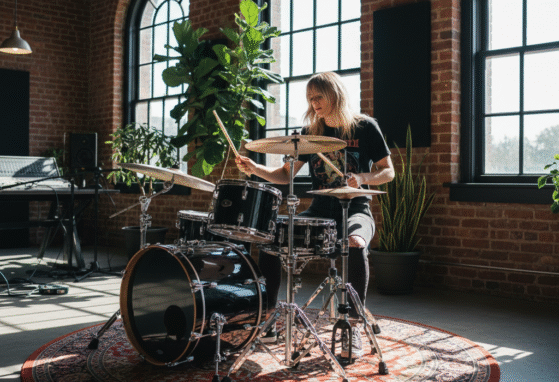
At The Mystic Keys, this philosophy of Drumming for Health is at the heart of how drum lessons are designed and taught. Through Drum Lessons Online, learners are guided not just to play rhythms, but to experience drumming as a complete mind–body practice—one that grows with them, wherever they are.
Drumming is far more than an artistic skill. It is a holistic practice that strengthens the body, sharpens the mind, and nurtures emotional balance. Its true power lies in how naturally it motivates—by aligning movement, rhythm, and inner experience.
In a time when motivation often feels fragile, drumming reminds us that the most sustainable drive comes not from pressure, but from joy, connection, and rhythm. When the beat begins, the body listens—and the mind follows.
For more information and exciting resources about learning music, visit our website at The Mystic Keys. For more music content and exciting offers follow us on