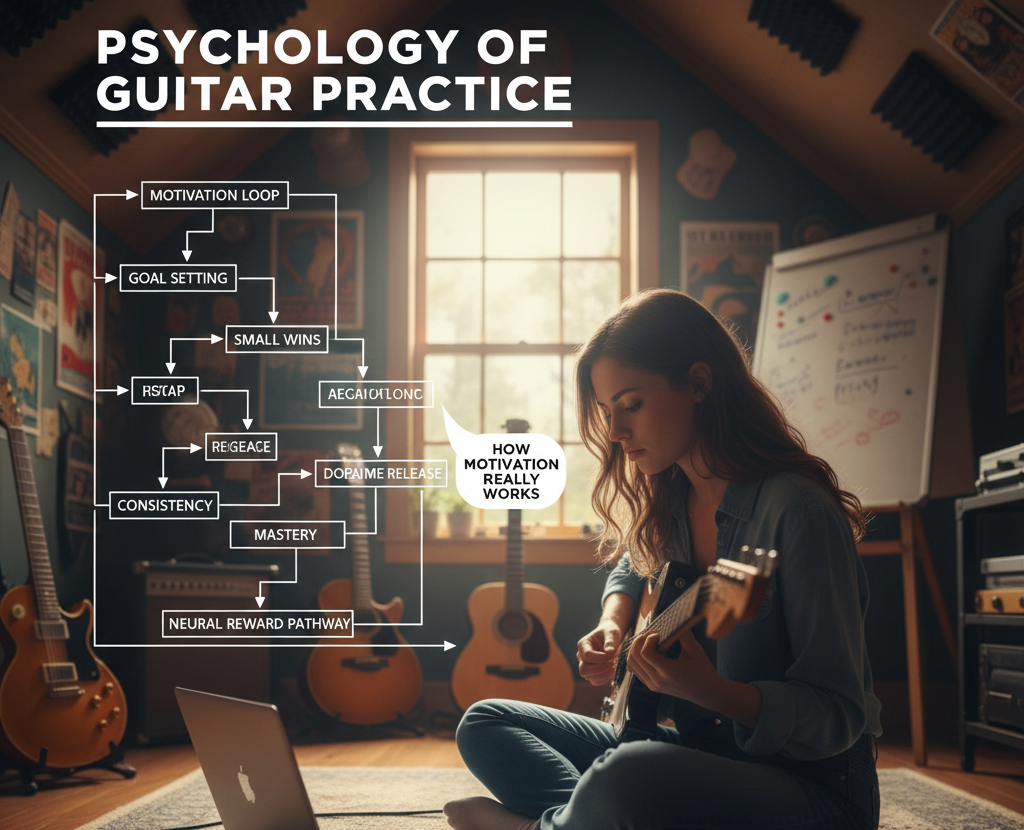
Psychology of Guitar Practice | How Motivation Really Works
Psychology of Guitar Practice | How Motivation Really Works
Learning the guitar is rarely just about fingers, strings, and chords. The real challenge often lies much earlier—inside the mind—a concept at the heart of the Psychology of Guitar Practice. You may start with excitement, imagining yourself playing your favorite songs effortlessly, only to find that enthusiasm slowly fading somewhere between sore fingertips and stubborn chord transitions.
This is where the psychology of guitar practice becomes crucial. Understanding how motivation really works can transform the way you practice, helping you stay consistent, focused, and fulfilled—even when progress feels slow.
The Psychology of Guitar Practice | Why Motivation Fades After the Start
Most guitar journeys begin with a surge of motivation fueled by imagination. Your brain creates vivid images of future success—performing confidently, impressing friends, or simply enjoying music more deeply. Psychologists call this anticipatory reward. The excitement comes not from skill, but from possibility.
However, as practice begins, reality sets in. Progress feels incremental, mistakes are frequent, and the rewards are delayed. The brain, which prefers immediate gratification, starts questioning the effort. This is not a lack of discipline—it’s a natural neurological response. When the reward feels distant, motivation weakens.
Understanding this shift is crucial. Motivation isn’t meant to stay high on its own. It needs structure, reinforcement, and meaning to survive beyond the honeymoon phase.

Motivation vs. Discipline in Guitar Practice
Many learners believe that successful guitarists are always motivated. In truth, what sustains long-term progress is not motivation but habits shaped by psychology. Motivation is emotional and fluctuating, while discipline is cognitive and trainable.
When you rely solely on motivation, practice becomes inconsistent. But when you design your practice environment intentionally—same time, same place, manageable duration—your brain begins to associate guitar practice with routine rather than effort. Over time, this reduces resistance and makes progress feel natural.
Interestingly, discipline doesn’t kill joy. It creates safety. When your brain knows exactly what’s expected, anxiety decreases, and creativity has space to grow.
How Small Wins Rewire Your Brain
One of the most powerful psychological drivers of motivation is progress that feels visible. The brain releases dopamine not when a goal is achieved, but when it senses movement toward that goal.
This is why overly ambitious practice plans often backfire. Practicing for an hour but feeling unsuccessful drains motivation, whereas practicing for fifteen minutes and mastering a small section builds confidence. The size of the win matters less than the certainty of it.
Over time, these small wins compound. They train your brain to associate guitar practice with success rather than struggle, making it easier to return the next day.

Why Consistency Matters More Than Talent
Talent is often misunderstood as a mysterious advantage. Psychologically, what we label as “talent” is usually the result of consistent reinforcement over time. The brain strengthens neural pathways through repetition, not inspiration.
Every time you pick up the guitar—even on low-energy days—you reinforce the identity of “someone who practices.” This identity shift is critical. Once your self-image aligns with being a guitarist, motivation becomes internal rather than forced.
Instead of asking, “Do I feel motivated today?” the question becomes, “This is what I do.”

The Emotional Side of Guitar Practice
Guitar practice is emotionally demanding. Frustration arises when progress doesn’t match effort. Boredom appears when repetition lacks purpose. Self-doubt creeps in when comparison enters the room.
These emotions are not signs of failure; they are signals. Frustration often indicates that a task is slightly beyond your current level—a prime zone for growth. Boredom suggests a need for variation, not abandonment. Self-doubt is usually social, not musical, triggered by unrealistic expectations.
When learners stop interpreting these emotions as reasons to quit and start viewing them as information, practice becomes more compassionate and sustainable.
Intrinsic Motivation and the Psychology of Guitar Practice
Extrinsic motivation—praise, likes, certificates, or external validation—can spark short-term effort. But it fades quickly once the reward disappears. Intrinsic motivation, on the other hand, comes from enjoyment, curiosity, and personal meaning.
In guitar practice, intrinsic motivation grows when learners connect emotionally with music. Playing songs that resonate personally, improvising freely, or simply enjoying sound over perfection strengthens this internal drive.
Ironically, the more you chase outcomes, the less enjoyable practice feels. The more you enjoy the process, the better the outcomes become.
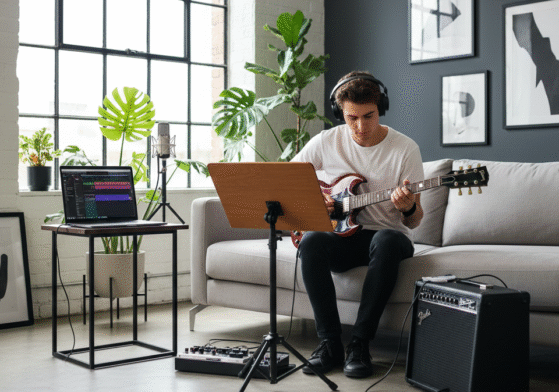
Conclusion | Building Motivation Through Psychology
The psychology of guitar practice reveals a powerful truth: you do not wait for motivation—you design it. When you build strong habits, stay emotionally aware, set realistic goals, and engage meaningfully with music, motivation naturally follows. At The Mystic Keys, this belief shapes every aspect of learning, helping students approach guitar practice in a way that supports both progress and mindset.
Learning guitar goes beyond improving technique. It requires understanding how your mind learns, struggles, and grows. Through carefully designed Guitar Lessons Online, students actively develop confidence, consistency, and musical clarity. When you work with your psychology instead of fighting it, practice feels more natural, focused, and rewarding.
As practice shifts from a task to a relationship—one that grows deeper with time, awareness, and intention—music truly begins.
For more information and exciting resources about learning music, visit our website at The Mystic Keys. For more music content and exciting offers follow us on
Facebook, Instagram, YouTube, LinkedIn, Twitter, Pinterest, and Threads.