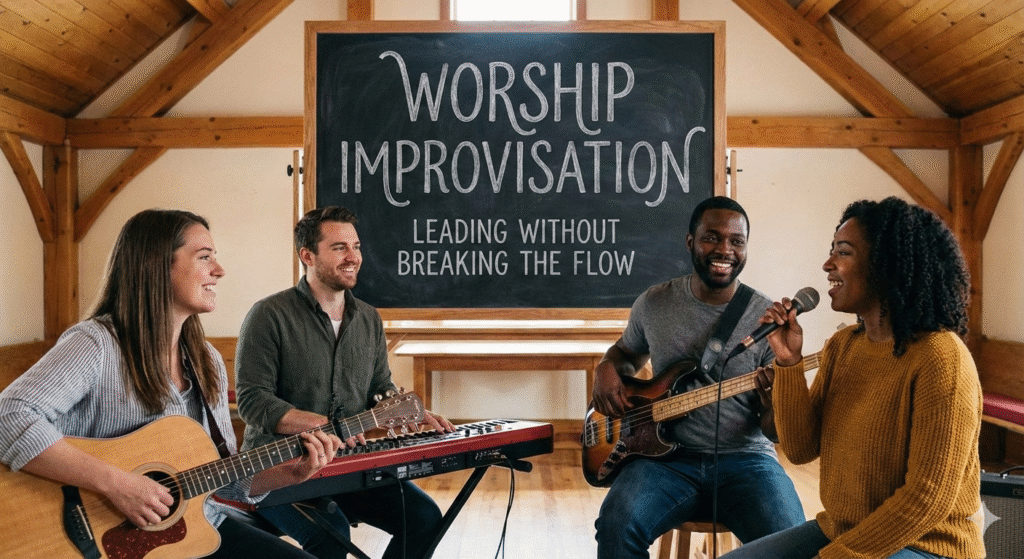
Worship Improvisation | Leading Without Breaking the Flow
Worship is not merely a sequence of songs. It is a living, breathing moment—an unfolding conversation between hearts and heaven. While planning, structure, and rehearsal are essential, some of the most powerful worship moments happen when leaders sense something beyond the plan and respond in real time. This is where worship improvisation comes in—not as chaos, but as sensitive, Spirit-led leadership that preserves and deepens the flow rather than disrupting it.
Improvisation in worship is not about showing musical brilliance or spontaneous creativity for its own sake. Instead, it is about discernment, humility, and awareness—knowing when to lead, when to wait, and when to gently guide the congregation into deeper engagement without drawing attention away from the purpose of worship itself.
Understanding Worship Flow Before Worship Improvisation
Before we talk about improvisation, we must understand what flow truly means in worship.
Flow is not perfection. It is not flawless transitions or uninterrupted sound. Worship flow is the emotional, spiritual, and communal continuity that allows people to remain focused on God rather than on what comes next.
When flow is intact:
The congregation feels safe to engage deeply
Transitions feel natural rather than forced
Silence feels meaningful, not awkward
Music supports worship instead of dominating it
Improvisation, when done well, actually protects this flow. When done poorly, it fractures attention and pulls people out of the moment.

Worship Improvisation Is Not Randomness
A common misconception is that improvisation means “doing whatever feels right in the moment.” In worship, that mindset can be dangerous.
True worship improvisation is:
Rooted in preparation
Guided by spiritual sensitivity
Aligned with the theme and moment
A response, not an interruption
Randomness, on the other hand, often stems from:
Insecurity or overconfidence
Desire to fill silence
Lack of listening—to God or the room
Performance-driven instincts
The difference lies in intent and awareness. Improvisation listens first, then responds.

Preparation| The Hidden Strength Behind Worship Improvisation
Ironically, the freedom to improvise comes from discipline.
Worship leaders who improvise effectively are usually those who:
Know their songs deeply
Understand song structures and keys
Are comfortable musically and vocally
Have rehearsed transitions and dynamics
Preparation creates muscle memory, freeing the leader from technical anxiety. This allows space to listen—to the Spirit, to the band, and to the congregation.
Improvisation without preparation often leads to confusion. Preparation without openness leads to rigidity. Worship thrives in the balance between the two.

Listening as the Core of Worship Improvisation
Improvisation begins not with playing or singing—but with listening.
A worship leader must listen on multiple levels:
Listening to God’s prompting
Listening to the congregation’s engagement
Listening to the band’s dynamics
Listening to the atmosphere in the room
Sometimes improvisation means extending a chorus. Sometimes it means softening the volume. And sometimes, it means doing nothing at all.
The ability to pause—to let a moment breathe—is often more powerful than adding another musical idea.

Worship Improvisation Without Breaking the Focus
One of the greatest challenges in worship improvisation is learning to lead without shifting the focus inward. When a leader steps beyond the planned structure, the line between sensitivity and self-expression can become subtle. Improvisation should never feel like a vocal showcase, a musical experiment, a sudden shift that confuses the band, or a moment that redirects attention toward the leader. Instead, it should blend so seamlessly into the worship experience that it feels almost unnoticeable—serving the atmosphere rather than standing out within it.
When improvisation is led well, people often cannot explain why a moment felt powerful; they simply know that it did. This is where intentional self-checks become essential in the moment. Asking, “Is this helping the congregation worship, or is it helping me express myself?” keeps the heart aligned with servant leadership. True worship leaders choose the former every time, allowing improvisation to deepen engagement without disrupting the flow or drawing attention away from its true purpose.

Transitions That Carry the Moment Forward
Transitions are where worship flow is most vulnerable.
Improvisation during transitions should aim to:
Maintain emotional continuity
Avoid abrupt key or tempo changes
Give the band clear cues
Help the congregation stay engaged
Simple spoken prayers, gentle instrumental pads, or a repeated refrain can act as bridges. Silence, when intentional, can also be a powerful transition—allowing reflection rather than rushing ahead.
The goal is not to fill every gap, but to guide the journey smoothly.

Trusting the Team | Improvisation Is Not a Solo Act
Worship is communal, and improvisation should be too.
When leaders trust their band:
Musicians respond intuitively
Transitions feel organic
The atmosphere becomes cohesive
Clear eye contact, agreed-upon signals, and mutual respect allow improvisation to happen without confusion. When the team feels safe, they play with confidence rather than fear of mistakes.
Improvisation thrives in unity, not control.

When Not to Improvise | Wisdom in Restraint
Just because you can improvise doesn’t mean you always should.
There are moments when sticking to the plan is the most loving choice:
When the congregation is unfamiliar with the song
When time is limited
When the atmosphere calls for clarity rather than exploration
When improvisation may distract rather than deepen worship
Restraint is not a lack of faith—it is wisdom. Worship leadership is about serving the moment, not forcing one.

Cultivating a Heart That Leads, Not Performs
At its core, worship improvisation is not simply a musical skill or a momentary creative decision—it is a heart posture shaped by humility and awareness. Long before it shows up in melodies or transitions, it begins internally, in the way a leader views their role in worship. When the focus shifts from expressing self to serving the moment, improvisation becomes less about spontaneity and more about obedience, discernment, and trust.
From this posture flows a distinctive kind of leadership. A leader rooted in humility learns to remain flexible without losing direction, to stay spiritually sensitive without becoming unstable, and to lead with boldness that never overpowers the room. In such hands, improvisation becomes a tool rather than a temptation—a means to gently deepen worship instead of hijacking it. Rather than drawing attention, it quietly strengthens the flow, allowing worship to remain centered, unified, and genuinely transformative.

Conclusion | Flow Is Felt, Not Forced
The most memorable worship moments are rarely planned down to the last detail, yet they never feel accidental. They emerge when preparation meets sensitivity, when leadership meets surrender, and when improvisation serves the greater purpose of worship rather than personal expression.
At The Mystic Keys, this understanding lies at the heart of our approach to Worship Piano & Singing Lessons Online—training worship leaders not just to play or sing well, but to lead with awareness, humility, and spiritual attentiveness.
Leading without breaking the flow is not about musical perfection; it is about presence. It is about staying anchored in the moment, listening deeply, and responding faithfully.
When worship leaders learn to prepare diligently, listen carefully, and improvise wisely, worship becomes more than music. It becomes a shared encounter—gentle, powerful, and deeply transformative.
And in those sacred moments, the flow doesn’t merely continue—it carries every heart in the room into a deeper, more meaningful place of worship.
For more information and exciting resources about learning music, visit our website at The Mystic Keys. For more music content and exciting offers follow us on
Facebook, Instagram, YouTube, LinkedIn, Twitter, Pinterest, and Threads.