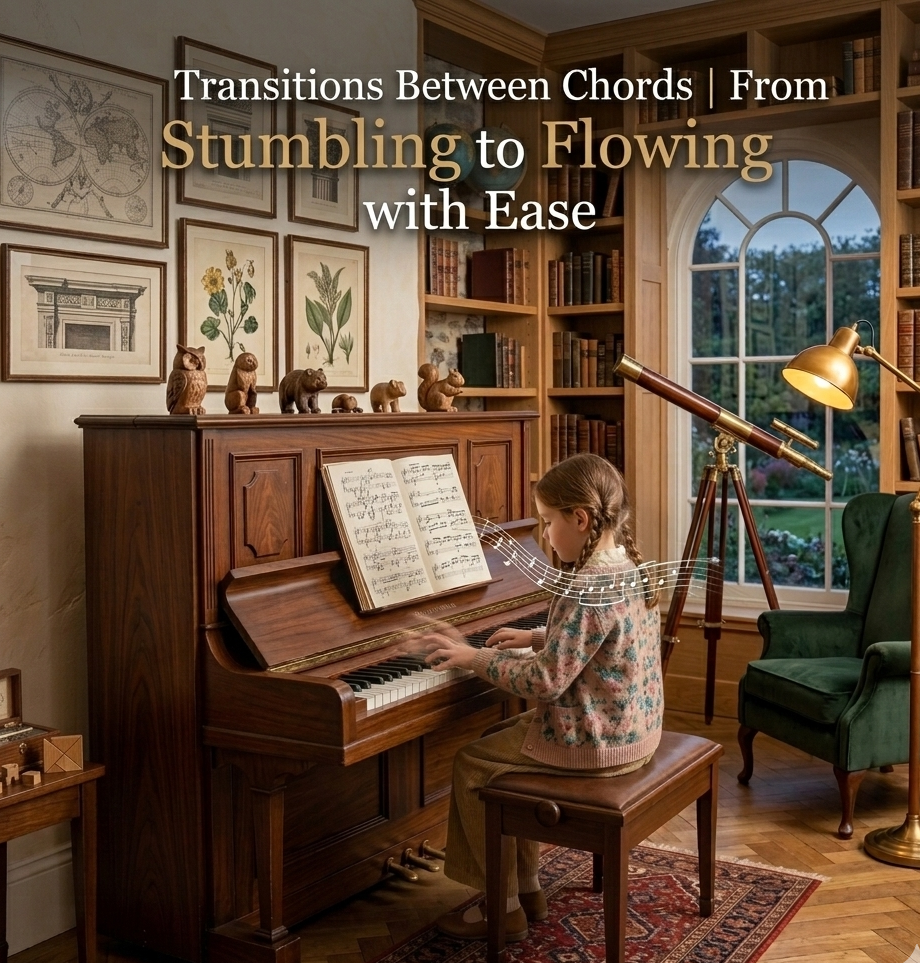
Transitions Between Chords | From Stumbling to Flowing with Ease
For any musician, the difference between sounding mechanical and sounding musical often comes down to one skill: Transitions Between Chords. Whether you play guitar, piano, ukulele, or keyboard, moving smoothly from one chord to another without hesitation transforms a collection of notes into flowing music. Beginners frequently encounter the frustration of awkward pauses, tangled fingers, or jarring stops. However, these stumbling moments are a natural part of the learning process and, with the right techniques, Transitions Between Chords can quickly evolve from awkward and hesitant into effortless and expressive.
Recognizing the Root of Stumbling in Transitions Between Chords
Before solving a problem, it’s essential to understand its cause. Chord transition difficulties usually stem from three main factors: unfamiliarity with chord shapes, weak finger memory, and rushed timing. When fingers are unsure where to go next, hesitation naturally occurs, disrupting the musical flow. Often, the challenge is not the chords themselves but the lack of coordination between brain and hand. Recognizing this disconnect is empowering because it allows you to focus on training the hands without pressuring the mind. Stumbling is not failure—it is a guide, highlighting which movements need attention.
Embracing Slow and Focused Practice
Speed is the enemy of smooth transitions at the beginning. Practicing slowly allows the brain to map precise finger movements and the hands to build lasting muscle memory. Start by isolating problematic transitions instead of running through entire songs. Repeat each movement deliberately, noticing where fingers hesitate or stray. Over time, the brain remembers the motion, and speed naturally follows. This approach encourages mindful practice: every repetition counts, and every pause teaches awareness, leading to transitions that feel natural rather than forced.
Mental Visualization to Improve Transitions Between Chords
The mind often leads the hands. By visualizing chord changes before even touching the instrument, you train anticipation and fluidity. Imagine each finger traveling its path, sliding into position with precision and ease. This technique is especially helpful for complex chords or fast sequences. Mental rehearsal reduces errors, primes muscle memory, and allows your hands to react almost instinctively. When visualization is combined with physical practice, transitions evolve from mechanical motions into a graceful, automatic flow.
Anchoring Fingers to Facilitate Transitions Between Chords
Many chord transitions become easier when you use “anchor fingers”—fingers that remain on a fret or string while other fingers move. Anchors reduce unnecessary motion, shorten travel distance, and provide a tactile guide for the rest of your hand. For instance, in common guitar chord progressions, the index finger often stays in place across multiple chords, forming a pivot point. Discovering these anchors turns chaotic hand movements into controlled, deliberate gestures. It’s a subtle adjustment that yields disproportionately smooth results.
Integrating Rhythm to Support Transitions Between Chords
Transition practice is incomplete without rhythm. Practicing chords in isolation builds finger memory, but playing in time builds musicality. Begin by strumming or tapping lightly while changing chords, even if you start slowly. Let the rhythm guide your transitions, aligning timing and movement. Over time, this creates a sense of anticipation—the hands begin moving in sync with the beat rather than reacting to it. Rhythm is the invisible thread weaving chords into a flowing melody, and cultivating it early prevents abrupt, jarring changes.
Bridging Theory with Practice
Understanding why chords follow each other deepens the ease of transitions. Knowledge of key signatures, chord families, and common progressions allows your brain to anticipate upcoming changes. When you know that C naturally leads to G, or Am resolves to F, your hands are ready before your mind catches up. Theory becomes a roadmap, guiding your fingers through the musical landscape. This connection between what you know intellectually and what you do physically reduces hesitation and infuses confidence into every chord change.
Strengthening Finger Independence and Dexterity
Smooth transitions rely heavily on finger strength and flexibility. Exercises like finger stretching, individual note drills, or chord shape repetitions can dramatically improve speed and precision. Each finger must move independently without dragging or colliding with others. This is especially critical for complex chords or fast sequences. Building dexterity is not instantaneous, but consistent, focused effort ensures that fingers respond instinctively, moving fluidly even under the pressure of tempo or performance.
Patience and Consistency | The Unsung Heroes
Improvement does not happen overnight. Even expert musicians once struggled to change chords without breaking rhythm. Progress requires consistent, patient practice. Celebrate small victories: a transition that used to take two seconds now takes one, or a previously awkward chord now feels natural. Over weeks and months, these micro-improvements accumulate, turning hesitant movements into flowing musical expression. Patience transforms frustration into mastery, proving that persistence outweighs raw talent.
Moving From Stumbling to Flowing
When chord transitions become effortless, music transforms. Stumbling pauses give way to fluid, expressive playing. Each chord leads seamlessly into the next, allowing the melody and harmony to breathe. The journey from awkward, hesitant changes to smooth transitions is both technical and emotional. It strengthens hands, sharpens awareness, and cultivates a deep connection with the instrument. With guidance from resources like The Mystic Keys and structured Piano Lessons Online, this journey becomes even more accessible and inspiring. Ultimately, it’s not just about playing chords—it’s about letting the music move through you with ease, confidence, and joy.
For more information and exciting resources about learning music, visit our website at The Mystic Keys. For more music content and exciting offers follow us on