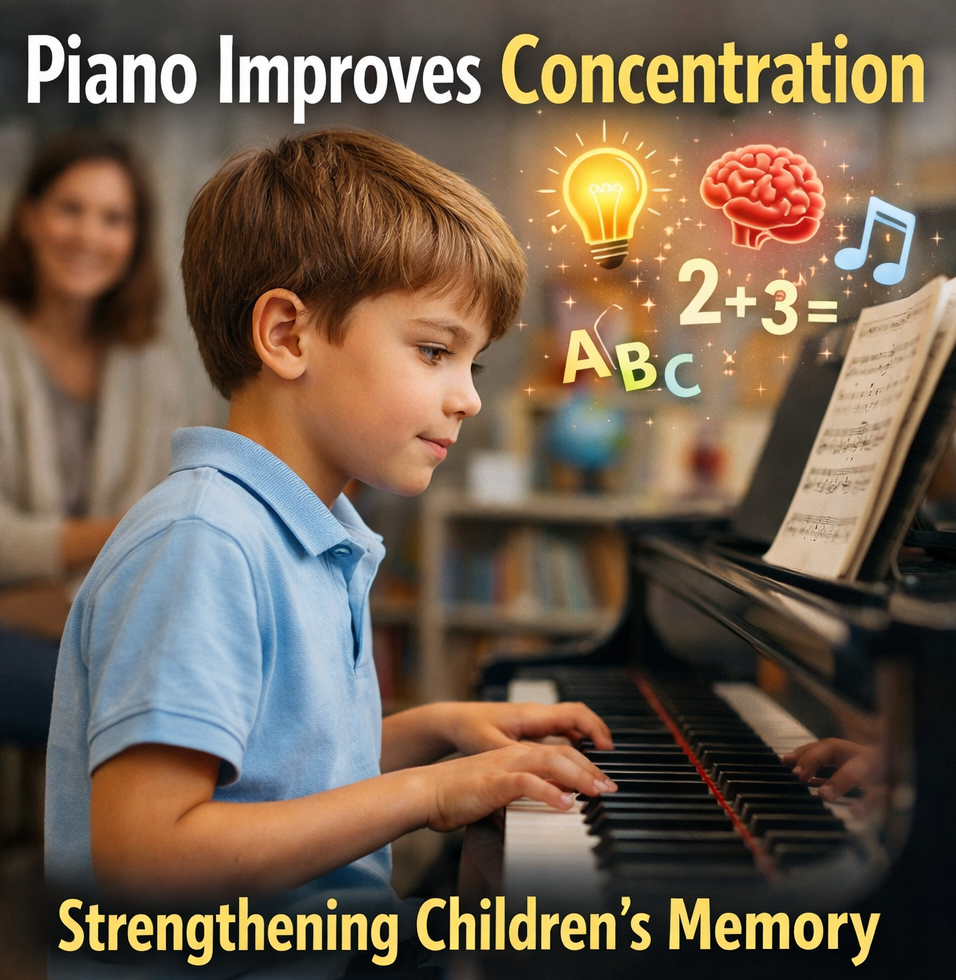
Piano Improves Concentration | Strengthening Children’s Memory
In an age of constant notifications, fast entertainment, and endless digital distractions, helping children develop deep concentration has become a real challenge. Parents often search for activities that are not only enjoyable but also mentally enriching. Among the many options available, learning the piano stands out as one of the most powerful tools for developing focus and strengthening memory in children, clearly demonstrating how piano improves concentration while supporting overall cognitive development.
Piano learning is not simply about playing beautiful music. The process engages the brain in complex ways, combining listening, reading, coordination, and emotional expression. As a result, children who learn the piano gradually build stronger attention spans, sharper memory, and improved mental discipline. Over time, these benefits extend far beyond music lessons and influence many areas of learning and daily life.
The Piano | A Complete Workout for the Brain
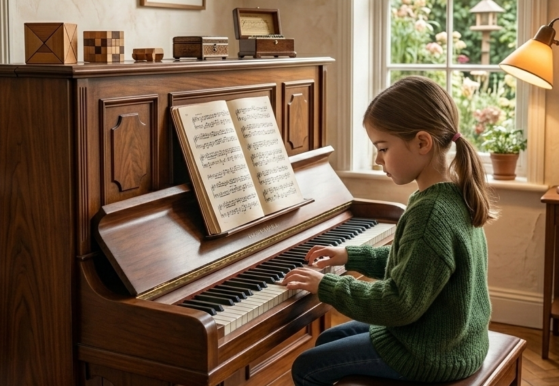
Playing the piano requires the brain to manage multiple tasks simultaneously. A child must read musical notes, interpret rhythm, coordinate both hands, control finger movements, and listen carefully to the sound produced. Each of these actions activates different regions of the brain.
Because of this multi-layered activity, piano practice stimulates both the left and right hemispheres of the brain. Logical thinking works alongside creativity, while analytical reading of notes blends with emotional interpretation of music. Gradually, the brain learns to process several streams of information at once.
As children continue practicing, their brains become more efficient at managing complex tasks. This process strengthens neural connections and improves overall cognitive function. Over time, children begin to demonstrate better attention control not only during music lessons but also in academic settings.
How Piano Learning Builds Concentration
Concentration is the ability to stay mentally engaged with a task for an extended period of time. Piano learning naturally trains this ability. When a child sits at the keyboard, even a short piece of music demands sustained attention.
A student must carefully observe each note, maintain the correct rhythm, and control hand movements. Losing focus for even a moment often results in mistakes. Because of this immediate feedback, children quickly learn the value of sustained concentration.
Practice sessions gradually lengthen attention spans. What may begin as ten minutes of focused effort slowly expands into longer periods of deep engagement. Instead of becoming easily distracted, children develop the habit of completing a task with patience and care.
Over time, this improved focus begins to appear in other areas as well. Schoolwork, reading, and problem-solving activities become easier when a child’s brain has already been trained to concentrate through music practice.
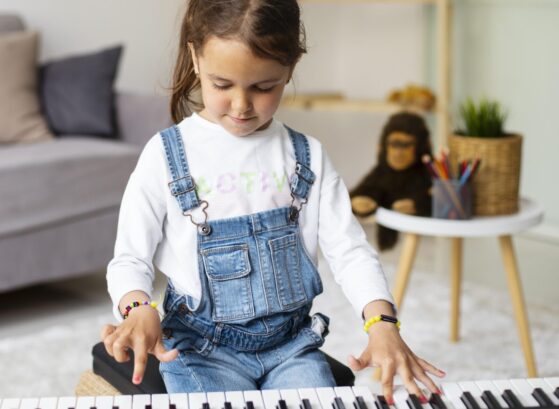
Piano Improves Concentration While Strengthening Memory
Memory plays a crucial role in learning the piano. Children are required to remember musical notes, rhythms, hand positions, and patterns within a piece. The brain stores this information in both short-term and long-term memory systems.
While practicing, children repeatedly recall and reinforce these musical patterns. Each repetition strengthens the neural pathways responsible for memory retention. Gradually, the brain becomes more efficient at storing and retrieving information.
Memorizing pieces of music provides an additional cognitive challenge. A child learns to recall entire sequences of notes without relying on the sheet music. This process exercises the brain in a manner similar to solving puzzles or learning a new language.
As a result, children who study piano often develop stronger memory skills that support academic learning. Subjects such as mathematics, language studies, and science benefit from improved information retention and recall.

The Role of Pattern Recognition in Brain Development
Music is built on patterns—melodic phrases, rhythmic structures, and repeating motifs. Piano students become highly familiar with these patterns as they practice different pieces.
Recognizing patterns helps children predict what comes next in a musical phrase. Instead of reading every note individually, the brain begins to identify familiar shapes and sequences. This ability significantly speeds up the learning process.
Pattern recognition is also a valuable cognitive skill in other areas of learning. Mathematics, reading comprehension, and logical reasoning all rely on recognizing structures and relationships. Through piano practice, children strengthen this mental ability in an engaging and creative way.
Gradually, the brain becomes better at identifying order within complex information. Such skills are essential for problem-solving and analytical thinking.
Lorem ipsum dolor sit amet, consectetur adipiscing elit. Ut elit tellus, luctus nec ullamcorper mattis, pulvinar dapibus leo.

Piano Improves Concentration Through Discipline and Patience
Learning the piano is not an instant achievement. Progress requires patience, consistent practice, and determination. Each new piece presents small challenges that children must overcome step by step.
As students work through these challenges, they develop resilience and mental endurance. Mistakes become part of the learning process rather than a source of frustration. Gradually, children learn that improvement comes through persistence.
This disciplined approach has a powerful effect on concentration. Instead of rushing through tasks, children become more willing to slow down and focus carefully. Over time, this mindset helps them approach difficult academic subjects with greater confidence.
In many cases, piano practice teaches children one of the most valuable life lessons: meaningful results often require sustained effort and dedication.
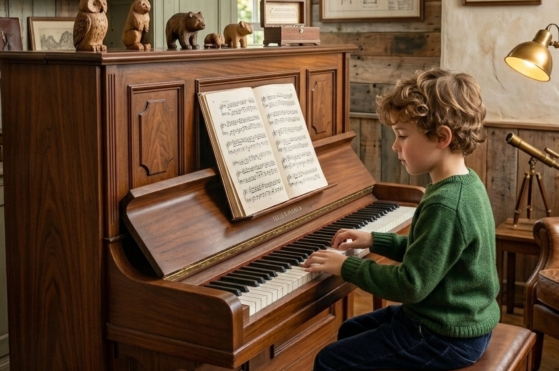
Piano Improves Concentration Through Emotional Engagement
Another important factor in memory development is emotional engagement. Music naturally connects with emotions, making the learning experience more meaningful for children.
When a child enjoys a piece of music, the brain tends to remember it more easily. Emotional involvement strengthens memory formation by linking information with feelings and personal expression.
As children learn to interpret music, they become active participants in the creative process. Each performance becomes an opportunity to express mood, dynamics, and character. This emotional connection makes the learning experience memorable and rewarding.
Because of this deeper engagement, piano students often retain musical knowledge for long periods of time. The brain associates learning with enjoyment rather than obligation.
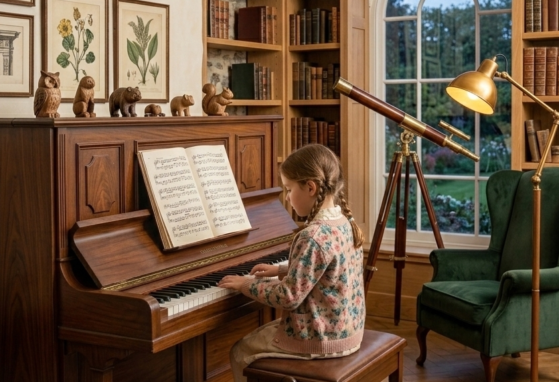
Piano Improves Concentration With Long-Term Cognitive Benefits
The cognitive advantages of piano learning extend well beyond childhood. Studies have shown that musical training can support long-term brain development, improving memory, attention control, and mental flexibility.
Children who practice the piano regularly often demonstrate stronger executive functioning skills. These include planning, organization, and the ability to manage complex tasks. Such skills are essential for success in both academic and professional environments.
Furthermore, the habit of focused practice encourages lifelong learning. Children who develop patience and concentration through music often carry these traits into adulthood.

Conclusion | Music as a Foundation for Mental Growth
Learning the piano offers far more than the ability to play beautiful melodies. The instrument becomes a powerful educational tool that strengthens concentration, enhances memory, and nurtures cognitive development. At The Mystic Keys, structured guidance and thoughtfully designed Piano Lessons Online help children experience these benefits in a supportive and engaging learning environment.
Through consistent practice, children train their brains to focus deeply, recognize patterns, and recall complex information. With well-guided Piano Lessons Online at The Mystic Keys, young learners receive step-by-step instruction that encourages steady progress while making the learning process enjoyable and meaningful. These skills gradually influence academic learning, emotional development, and personal discipline.
In a world where distractions are everywhere, activities that cultivate genuine focus are invaluable. Piano learning provides such an opportunity—combining creativity, intellectual challenge, and emotional expression in a way that benefits the developing mind. Programs like those offered by The Mystic Keys make this journey accessible through structured Piano Lessons Online, allowing children to learn effectively from the comfort of their homes.
For children, the journey of learning the piano is not simply about mastering an instrument. It is about building a stronger, sharper, and more resilient mind for the future. With dedicated mentorship and thoughtfully designed Piano Lessons Online at The Mystic Keys, young learners can develop both musical skills and lifelong cognitive strengths
For more information and exciting resources about learning music, visit our website at The Mystic Keys. For more music content and exciting offers follow us on
Facebook, Instagram, YouTube, LinkedIn, Twitter, Pinterest, and Threads.