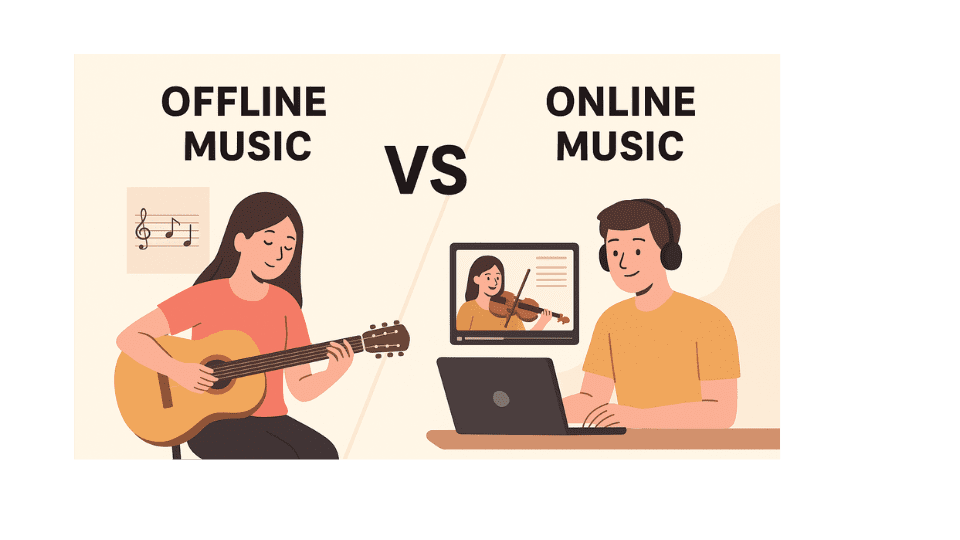
Offline vs Online Music Lessons – Which Is Better?
In the world of modern music education, one debate continues to grow:
Offline vs online music lessons — which is better?
For decades, offline learning was the only choice for students who wanted to learn piano, guitar, vocals, Carnatic music, Hindustani classical, drums, or even choir singing. But with today’s digital tools, online platforms, better internet speeds, and global access to expert musicians, the entire learning landscape has evolved.
While both offline and online lessons come with their own strengths, online music lessons have proven to be the better option for most learners in 2025—especially when we consider flexibility, technology, accessibility, and long-term progress.
In this detailed blog, we’ll break down the complete comparison of offline vs online music lessons, so you can clearly understand why online learning stands out as the superior choice.
1. Accessibility in Offline vs Online Music Learning

Accessibility is one of the biggest deciding factors in today’s music education.
Offline Music Lessons – Limited by geography & schedules
Offline classes depend heavily on physical location. This creates challenges:
Students must travel long distances.
Weather, traffic, or vehicle issues cause delays.
Schedules are fixed; missing a class means losing progress.
Parents need to accompany children.
Good teachers might not be available in every city or town.
For students in small towns or rural areas, finding a qualified music teacher is often impossible.
Online Music Lessons – Flexible, global, and always accessible
Online classes completely remove these limitations:
Learn from home, office, school, or even while travelling.
Morning, evening, and weekend batches available.
Zero travel time or cost.
No weather interruptions.
Parents can monitor every session.
Students worldwide get access to top teachers.
Why Online Is Better:
It provides uninterrupted, consistent learning, making music education accessible for everyone.
2. Teacher Availability in Offline vs Online Music Lessons

Many students wonder if online learning can match the quality of offline classes. In reality, online learning often offers even better clarity and precision.
Offline Learning Quality
Teachers explain concepts in real time.
Demonstrations happen live.
Students can ask immediate questions.
But:
If you forget something, there’s no “replay.”
Bigger groups mean less personal attention.
You depend on whatever the teacher writes or says during class.
Online Learning Quality
Online platforms use high-quality audio and video tools:
Close-up camera angles make hand techniques easier to observe.
Teachers share screens to show notes, lyrics, chords, and theory.
Students receive class recordings for revision.
Digital whiteboards make explanations clearer.
Advanced apps help analyse pitch, timing, and rhythm.
Why Online Is Better:
Modern tools allow more accurate demonstrations, better revision, and higher-quality instruction.
3. Tools & Technology | The Digital Advantage
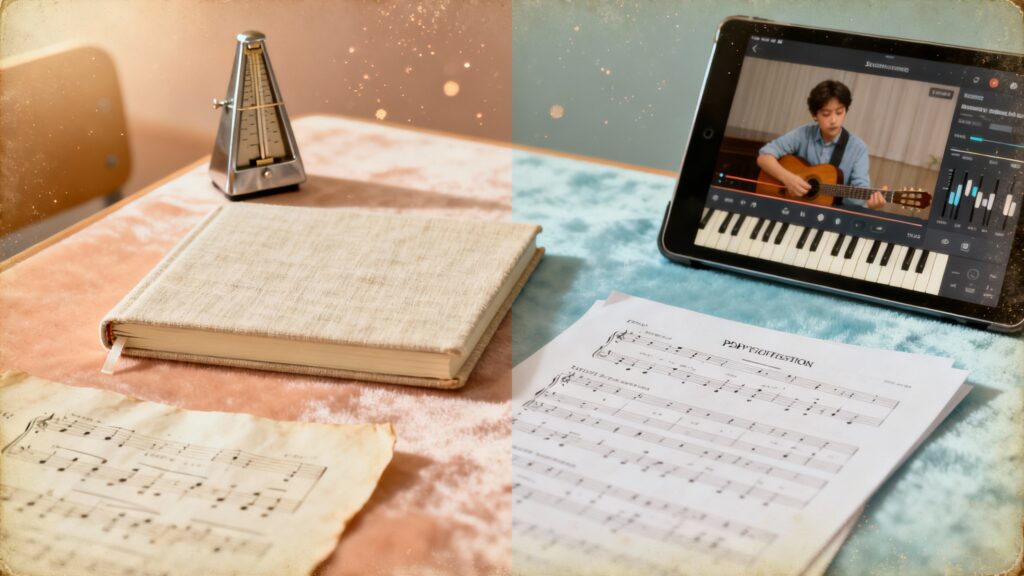
Technology has become the backbone of modern music learning.
Offline Classes – Limited Tools
Offline classes rely mostly on:
Teacher’s live demonstration
Handwritten notes
Physical books
Verbal explanations
There are no built-in tools for:
Slow-motion breakdown
Speed control
Pitch analysis
Instant replay
Digital tracking
Online Classes – A Complete Digital Learning Experience
Online lessons come with powerful learning tools:
Recorded Sessions – Never forget what was taught
PDF Notes & Sheet Music
Digital Whiteboard
Slow-Down Tools – Analyse fast songs note by note
On-Screen Keyboard/Guitar Diagrams
Metronome, Tuner & Rhythm Generators
Backing Tracks
Practice Reminder Apps
These tools make learning deeper, faster, and more enjoyable.
Why Online Is Better:
Technology offers a richer, more interactive learning experience that offline classes cannot match.
4. Learning Pace | Adapted to Every Student

Every student learns differently. Some grasp quickly. Some need time.
Offline Pace
Teachers must follow a fixed curriculum.
Slow learners may feel left behind.
Fast learners may feel bored.
Missed classes disrupt understanding.
Online Pace
Students can slow down or speed up their learning.
Recorded sessions allow unlimited revision.
Teachers can customise lessons for individuals.
Practice modules help reinforce learning step-by-step.
Why Online Is Better:
Online learning respects every student’s personal pace, helping them grow with confidence.
5. Comfort & Confidence | A Better Environment for Learning
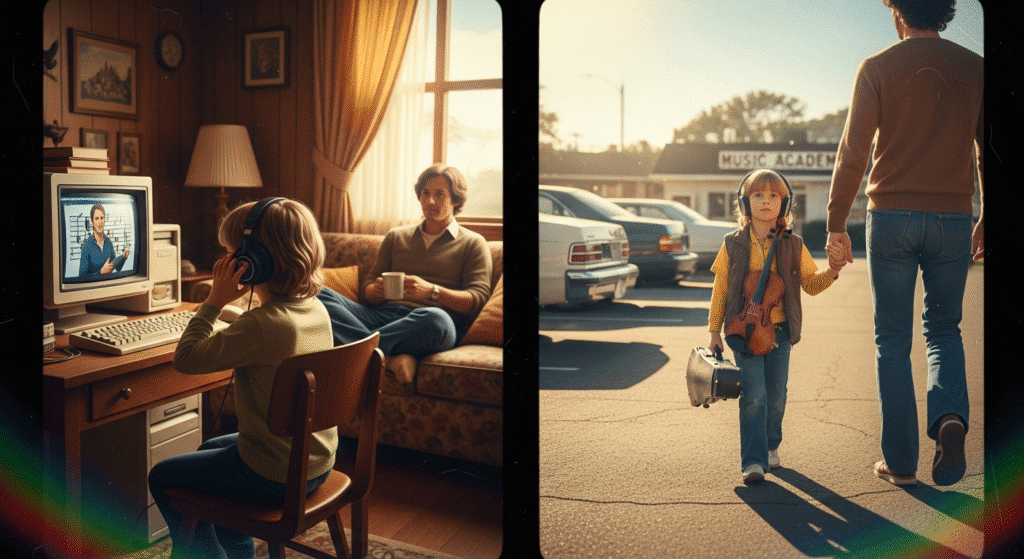
Confidence plays a huge role in musical improvement.
Offline Classes
Some students feel shy performing in front of others.
Group settings can create pressure or comparison.
Loud environment reduces focus.
Students may hesitate to ask questions.
Online Classes
Students learn in a safe, comfortable environment.
No fear of judgement.
Better for introverts and beginners.
Focus increases because there are fewer distractions.
Students speak more freely.
Why Online Is Better:
A relaxed student performs better. Online lessons naturally build confidence.
6. Cost Comparison | Which One Saves More?
Music education is an investment—but it doesn’t have to be expensive.
Offline Classes
Expenses include:
Higher monthly fees
Travel cost (fuel / auto / bus)
Extra books or notes
Time cost
Occasional workshop charges
Online Classes
Costs are reduced significantly:
Lower monthly fees
Zero travel cost
Free materials included
No need for extra books (PDFs provided)
Save hours every week
Why Online Is Better:
It is more affordable while offering more value.
7. Consistency & Long-Term Progress
The biggest factor in becoming a good musician is consistency.
Offline Learning Problems
Missed classes due to attend travel, exams, health, events
Difficulty rescheduling
Breaks during holidays reduce rhythm
Online Learning Benefits
Attend from anywhere
Easy rescheduling
Consistent weekly progress
Recorded classes ensure zero learning loss
Why Online Is Better:
Consistency leads to faster improvement—and online ensures consistency.
8. Which Learning Style Is Better for Each Instrument?
Different instruments require different teaching styles.
Online is excellent due to:
On-screen visual keyboards
Close-up hand demonstrations
Recorded practice routines
Online works beautifully for:
Chords
Fingerstyle
Strumming patterns
Riff tutorials
Vocals (Western, Carnatic, Hindustani)
Online allows:
Close-mic vocal correction
Scale practice with digital tools
Online is ideal for:
Rudiments
Technique
Counting
Rhythm training
Offline may help more during band practice—but foundation learning online is very effective.
Choir
Online helps with:
Harmony training
Ear training
Individual vocal preparation
Offline is needed only for final stage rehearsals.
After comparing accessibility, learning quality, tools, pace, confidence, cost, and consistency, one thing becomes absolutely clear:
Online Music Lessons are the Better Choice for Most Students in 2025.
They offer:
✔ Maximum flexibility
✔ Global teachers
✔ Advanced digital tools
✔ Better personalised learning
✔ More confidence
✔ Lower cost
✔ Higher consistency
✔ Faster progress
Offline lessons still matter—especially for group rehearsals and face-to-face interactions—but for overall growth and long-term learning, online music lessons provide a better, smarter, and more effective learning experience.
Intersted in learning music with us? Register now
For more information and exciting resources about learning music, visit our website at The Mystic Keys. For more music content and exciting offers follow us on
Facebook, Instagram, YouTube, LinkedIn, Twitter, Pinterest, and Threads.