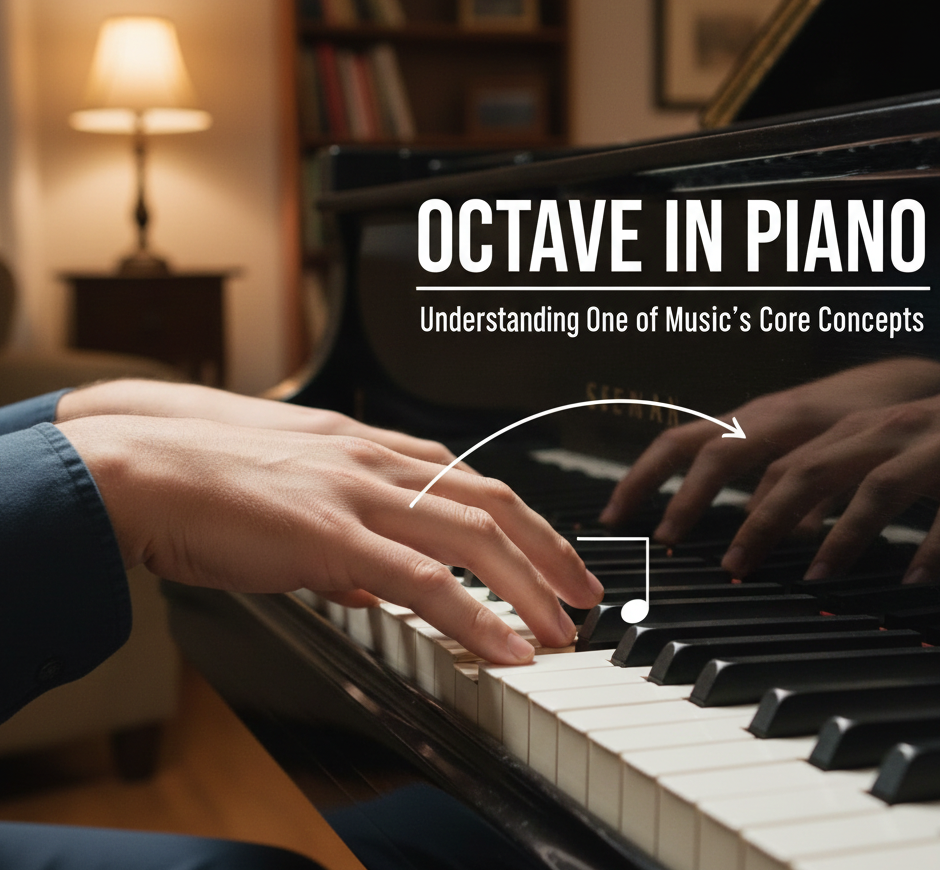
Octave in Piano | Understanding One of Music’s Core Concepts
Music often feels magical, but behind that magic lies a beautifully ordered system. One of the most important building blocks of this system—especially for pianists—is the octave. Whether you are just beginning your piano journey or revisiting fundamentals with fresh curiosity, understanding octaves will deepen how you hear, see, and play music. In this blog, we will explore what an octave is, how it appears on the piano, why it sounds the way it does, and how pianists use octaves musically and technically.
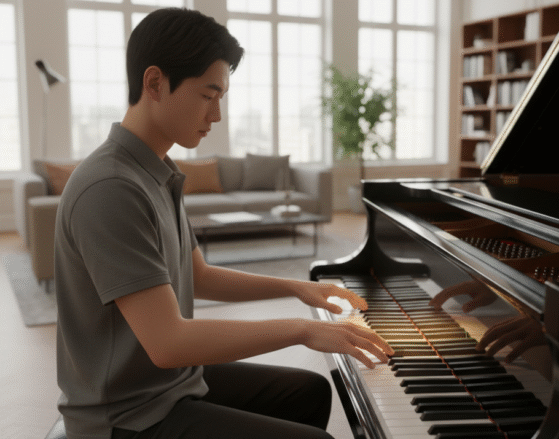
Understanding the Meaning of an Octave in Piano
An octave is the distance between one musical note and the next note with the same name, either higher or lower in pitch. For example, moving from one C to the next C above it is called an octave.
The word octave comes from the Latin octavus, meaning “eighth.” This refers to the higher note being the eighth when counting musical letters, including both the starting and ending note. More than the number, however, an octave is important because of how it sounds—notes an octave apart feel naturally connected, like the same note in different pitch ranges.
This similarity is not a coincidence. Notes an octave apart vibrate at frequencies that are exactly double or half of each other. Because of this, the human ear hears them as closely related, making octaves a fundamental part of musical structure across instruments and cultures.

Octave in Piano | Understanding the Keyboard Layout
The piano is one of the clearest instruments for understanding octaves. Its repeating pattern of white and black keys makes octaves easy to recognize once you know what to observe.
Each octave on the piano has 12 keys—seven white and five black. Together, these keys include all the notes used in Western music before the pattern repeats. A group of two black keys followed by three black keys is a clear sign of this octave structure.
If you begin on any note, such as C, and move up to the next C, you complete one octave. This repeating layout helps pianists move across the keyboard with confidence, identify intervals quickly, and understand the instrument’s layout more clearly.
Why an Octave in Piano Sounds the Same but Higher or Lower
One fascinating aspect of octaves is that, despite being higher or lower in pitch, they retain a strong sense of identity. A C played low on the keyboard and a C played high on the keyboard sound different in brightness and depth, yet they unmistakably feel like the same note.
This happens because of the mathematical relationship between their sound waves. When one note vibrates at twice the frequency of another, the ear naturally groups them together. In practical terms, this means octaves blend easily, sound stable, and feel resolved to the listener.
Because of this natural harmony, composers and performers frequently use octaves to reinforce melodies, create power, or add richness without introducing tension.
How Many Octaves Are There on a Piano?
A standard full-size piano has 88 keys, which span a little over seven octaves. The lowest note is A, and the highest note is C, meaning the instrument does not start and end exactly on the same letter name.
These octaves cover a wide range of sound—from deep, resonant bass notes to bright, bell-like treble tones. This vast range is one reason the piano is so versatile. It can carry melody, harmony, rhythm, and bass all at once, often using different octaves simultaneously.
Understanding where you are on this octave spectrum helps with reading music, controlling tone, and shaping musical expression.

Octave in Piano Playing Technique
Beyond theory, octaves play a major role in piano technique. Pianists frequently encounter passages where the same note is played simultaneously in two different octaves, often using the thumb and little finger of one hand.
Playing octaves requires a balance of strength, flexibility, and relaxation. While octaves can sound powerful and dramatic, they should never feel forced. Learning to move the hand smoothly across octave patterns is an essential skill, especially in advanced repertoire.
Over time, octave practice improves hand coordination and builds confidence across the keyboard, allowing pianists to tackle larger, more expressive musical gestures.

Musical Uses of Octaves
Octaves are not just technical tools; they are expressive devices. Composers use them in many ways to shape musical character. A melody doubled in octaves can sound bold and heroic, while soft octave passages can feel warm and expansive.
In accompaniment, octaves in the left hand often provide a strong harmonic foundation. In the right hand, octave melodies can project clearly over complex harmonies. Across styles—from classical and jazz to film music and pop—octaves help music sound fuller and more confident.
Their versatility makes them a favorite choice for emphasizing important musical moments.

Learning to Recognize and Use Octaves
For beginners, recognizing octaves starts with visual awareness. Noticing repeating key patterns and matching note names across the keyboard builds familiarity quickly. With time, the ear also learns to recognize the distinct sound of octaves, both when played together and when heard melodically.
As this understanding deepens, octaves stop feeling like a theoretical concept and start becoming a natural part of musical thinking. Pianists begin to sense where notes belong, how melodies can shift registers, and how sound changes across the keyboard.
Conclusion | Why Octaves Matter in Piano Music
An octave is more than the distance between two notes. It is a core principle that shapes how music is heard, organized, and performed. On the piano, octaves give structure to the keyboard, strengthen melodies, and add depth to musical expression—an idea strongly emphasized at The Mystic Keys through its Piano Lessons Online.
When pianists understand octaves, the keyboard begins to feel familiar and logical. Musical patterns become easier to recognize and play with confidence. From early lessons to advanced pieces, octaves quietly guide both the hands and the ears.
This understanding improves finger coordination and listening skills. It also helps pianists move smoothly across the keyboard. With consistent practice and guided learning, octaves become a natural part of expressive piano playing.
For more information and exciting resources about learning music, visit our website at The Mystic Keys. For more music content and exciting offers follow us on
Facebook, Instagram, YouTube, LinkedIn, Twitter, Pinterest, and Threads.