Music Theory Is Easier When You Learn Piano
Many students struggle with understanding scales, chords, harmony, and notation—until they realize that music theory is easier when you learn piano. The visual structure of the keyboard, the logical arrangement of notes, and the direct relationship between keys and sound make theoretical concepts far more intuitive. Instead of memorizing abstract rules, piano learners see and hear theory happening in real time.
Whether you are a beginner or an experienced musician transitioning from another instrument, understanding why music theory is easier when you learn piano can completely transform the way you approach musical learning.
This article explores the scientific, visual, structural, and practical reasons the piano is considered the best instrument for mastering music theory.
The Visual Layout of the Keyboard Simplifies Theory

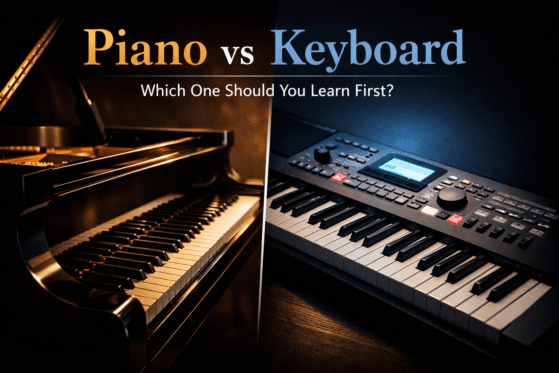
One of the strongest reasons music theory is easier when you learn piano lies in the visual design of the keyboard. Unlike many instruments, the piano lays out all twelve notes in a clear, repeating pattern.
The alternating groups of two and three black keys create a recognizable structure. This structure helps students instantly locate notes, intervals, and scales without guessing or shifting positions.
On the piano:
Every note is visible at once
Each octave follows the same pattern
Sharps and flats are clearly distinguished
There is no change in fingering positions for different keys
Because of this layout, theoretical concepts become physical shapes rather than abstract ideas.
Understanding Scales Becomes Logical and Clear
Scales are the foundation of music theory. On many instruments, learning scales requires memorizing complicated fingering patterns that change in different keys. On piano, scale construction is visually mapped out.
Students can physically see:
Whole steps and half steps
The pattern of major and minor scales
The relationship between white and black keys
How modes shift from the same starting notes
For example, the C major scale contains only white keys. This simplicity allows beginners to focus on understanding intervals instead of technical difficulty.
When students physically observe the pattern of tones and semitones, music theory is easier when you learn piano because the keyboard demonstrates the formula automatically.
Chords Are Instantly Visible on Piano

Harmony becomes dramatically clearer on the keyboard. A chord is simply a combination of stacked notes, and on piano, this stacking is physically visible.
Students can immediately see:
Root position chords
Inversions
Major and minor differences
Diminished and augmented structures
Seventh chords and extended harmonies
Instead of imagining how notes relate, learners place their fingers on the keys and hear the result immediately.
This tactile and visual reinforcement is a major reason music theory is easier when you learn piano compared to instruments where harmony is less visually structured.
Intervals Become Easy to Identify
Intervals are the building blocks of melody and harmony. On piano, measuring intervals becomes a matter of counting keys.
For example:
A major third is four semitones
A perfect fifth is seven semitones
An octave is twelve semitones
Because every semitone is represented by a neighboring key, students can count and hear intervals directly.
This removes confusion and makes ear training far more effective.
Reading Sheet Music Is More Straightforward

The piano uses both treble and bass clefs, which helps students understand the full musical staff from the beginning.
Learning piano develops:
Pitch recognition across clefs
Hand independence
Awareness of chord voicings
Students visually connect written notes to exact keys without repositioning or adjusting finger patterns for different tonalities.
This direct mapping between notation and instrument makes theory concepts more practical and less theoretical.
Harmony and Counterpoint Are Easier to Grasp
Because pianists can play multiple notes at once, they naturally develop harmonic awareness. They do not just think melodically; they think vertically.
This helps students understand:
Voice leading
Chord progressions
Cadences
Functional harmony
Modulation
When students play chord progressions in real time, they hear tension and resolution physically. This experiential learning reinforces theoretical knowledge deeply.
Why Music Theory Is Easier When You Learn Piano as a Beginner

Beginners benefit the most from starting theory on piano because:
The instrument is linear and logical
There is no need to tune finger positions differently in each key
Sound production is immediate
Dynamics are controlled through touch
Unlike wind or string instruments, where tone production itself requires technical mastery, piano allows beginners to focus on musical understanding from day one.
This early clarity builds confidence and long-term musical intelligence.
Transposition Becomes Simpler
Transposition is often challenging for musicians. On piano, once students understand interval patterns, they can shift entire scales and chords simply by moving shapes up or down.
The repeating structure of the keyboard helps students recognize:
Key relationships
Relative minors
Parallel keys
Circle of fifths patterns
When visual patterns are clear, theoretical relationships become predictable rather than mysterious.
Composition and Songwriting Are More Accessible

Many composers write on piano because it allows them to experiment with harmony and melody simultaneously.
On piano, students can:
Experiment with modulation
Layer melodies over harmony
Understand chord extensions
Because of this flexibility, music theory is easier when you learn piano, especially for those interested in composing or producing music.
Piano Strengthens Ear Training
Theory is not only visual; it must be heard. Piano strengthens ear training by linking:
Physical movement
Visual patterns
Audible results
When students play intervals, chords, and progressions repeatedly, they begin recognizing sounds instinctively.
This strengthens relative pitch and harmonic awareness.
Why Music Theory Is Easier When You Learn Piano Compared to Guitar

While guitar is versatile, it involves shifting patterns across strings and frets. The same note can appear in multiple locations.
On piano:
Each pitch has only one location
Notes move left to right in ascending order
There is no duplication confusion
This linear clarity reduces mental overload and accelerates understanding.
The Role of Piano in Formal Music Education
Globally, piano is used as the primary tool for teaching music theory in conservatories and universities.
Students studying:
Composition
Conducting
Arranging
Music production
are often required to learn basic piano skills, even if it is not their primary instrument.
This institutional preference exists because music theory is easier when you learn piano due to its structural clarity.
Advanced Harmony and Jazz Theory on Piano
As students progress, piano continues to simplify complex theoretical ideas such as:
Modal interchange
Secondary dominants
Altered chords
Polychords
Jazz voicings
Seeing extended chords stacked visually helps students understand sophisticated harmonic movement without memorizing abstract formulas.
Common Misconception: Piano Is Only for Classical Music
Some learners avoid piano because they believe it is limited to classical styles. In reality, piano supports:
Pop
Jazz
Film scoring
Worship music
Contemporary production
Because the instrument supports all genres, theory learned on piano transfers easily into other musical contexts.
Psychological Advantage of Visual Learning
Many learners absorb information visually. The keyboard layout supports pattern recognition and spatial memory.
Students often report that:
Theory feels less overwhelming
Patterns are easier to memorize
Concepts stick longer
When abstract ideas become shapes under the fingers, comprehension improves dramatically.
How Learning Piano Improves Other Instruments
Once students grasp theory on piano, transitioning to other instruments becomes smoother.
They understand:
Key signatures
Chord construction
Harmonic progressions
Scale relationships
Instead of memorizing positions, they understand why the notes work together.
This foundational clarity is another reason music theory is easier when you learn piano first.
For Adult Learners: A Practical Advantage
Adult beginners often fear theory because it seems mathematical or complex. Piano reduces this fear by offering immediate clarity.
Adults appreciate:
Structured learning
Logical progression
Clear visual feedback
Measurable improvement
Piano transforms theory from abstract rules into understandable patterns.
Conclusion
Understanding theory does not have to be overwhelming. When students experience the keyboard’s logical design, they quickly realize that music theory is easier when you learn piano because the instrument visually, physically, and audibly explains every concept. From scales and chords to advanced harmony and composition, the piano serves as a complete theoretical laboratory.
At The Mystic Keys, students build a strong theoretical foundation through structured and practical learning methods that connect technique with understanding. If you want to strengthen your musical knowledge while developing expressive skill, structured Piano Lessons Online can provide the clarity and confidence needed to master both performance and theory.
For more information and exciting resources about learning music, visit our website at The Mystic Keys. For more music content and exciting offers follow us on
Facebook, Instagram, YouTube, LinkedIn, Twitter, Pinterest, and Threads.