How Music Improves Mathematical Skills
Introduction
Music is often seen as a creative art form, but its impact goes far beyond melodies and rhythms. In recent years, educators and researchers have discovered a powerful connection between music training and academic performance—especially in mathematics. From improving memory to strengthening pattern recognition, music activates the same cognitive processes used in solving math problems. Understanding How Music improves mathematical Skills can help parents, teachers, and students use musical learning as a tool to boost mathematical confidence and performance. Whether it’s practising rhythm, reading musical notation, or analysing melodies, music training builds mental abilities that make learning math easier, faster, and more enjoyable.
1. How Music Training Builds Stronger Neural Connections and Helps Improve Mathematical Skills
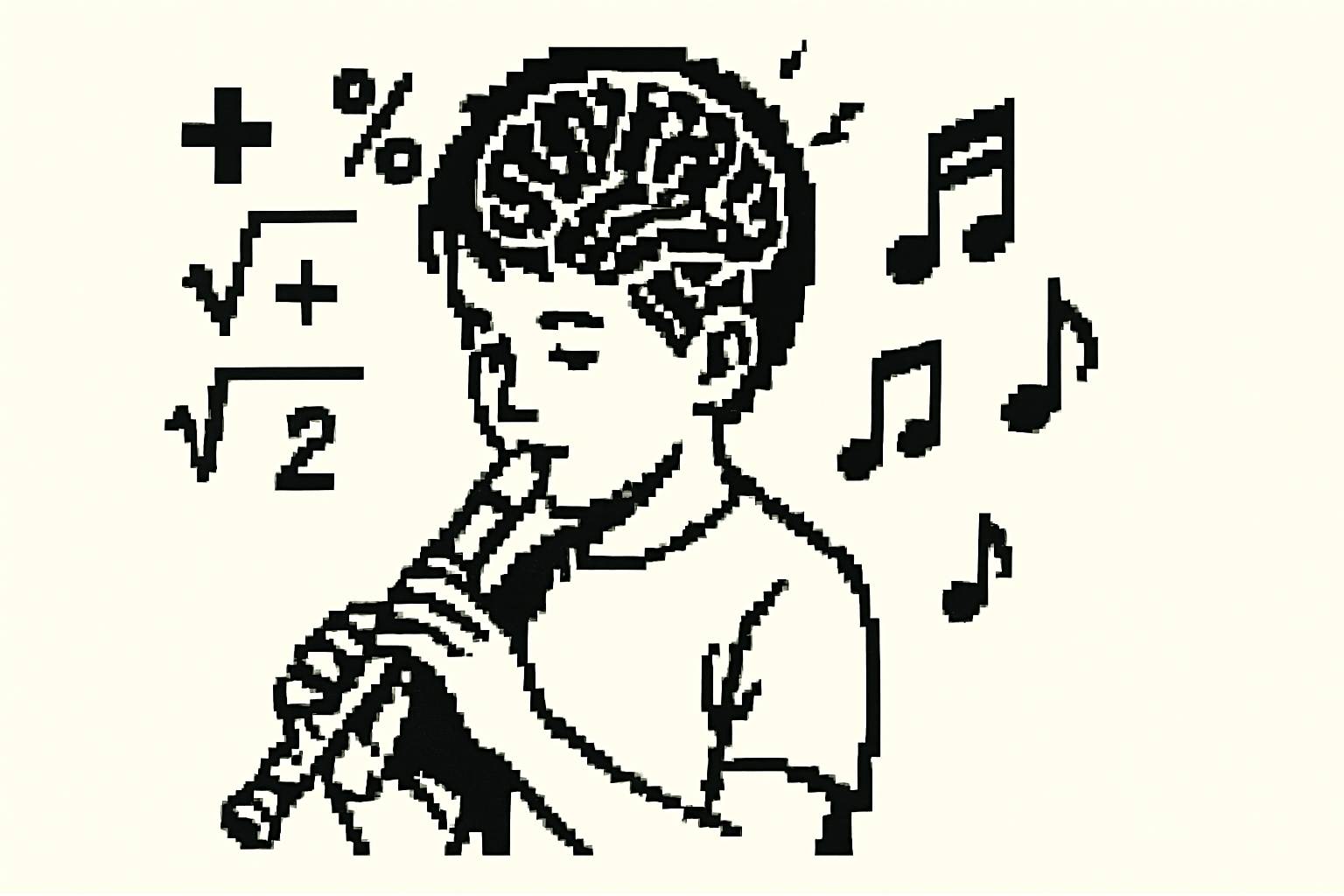
Learning an instrument is one of the most effective ways to activate and exercise multiple regions of the brain simultaneously. When students read sheet music, coordinate hand movements, listen for pitch accuracy, and maintain rhythm—all at the same time—their brain works like a high-performance machine. This multi-sensory engagement stimulates areas responsible for auditory processing, spatial reasoning, logical thinking, and memory retention.
These brain functions are the same ones heavily used in mathematics. For example, spatial-temporal reasoning, which helps students visualize patterns and solve multi-step math problems, is significantly enhanced through music training. Neuroscientists have shown that musical activities increase communication between the left and right hemispheres of the brain, creating stronger neural pathways. This cognitive boost directly supports mathematical development.
By practicing scales, recognizing chord structures, counting beats, and interpreting rhythm patterns, learners strengthen the mental processes that mathematics relies on. Over time, this consistent brain stimulation helps music improve mathematical skills by enhancing concentration, improving problem-solving abilities, and developing a sharper sense of logical sequencing. Students trained in music often show faster information processing, better memory recall, and more confidence when approaching complex math concepts—all because their brains have been conditioned through musical training.
2. How Rhythm and Counting in Music Improves Mathematical Skills
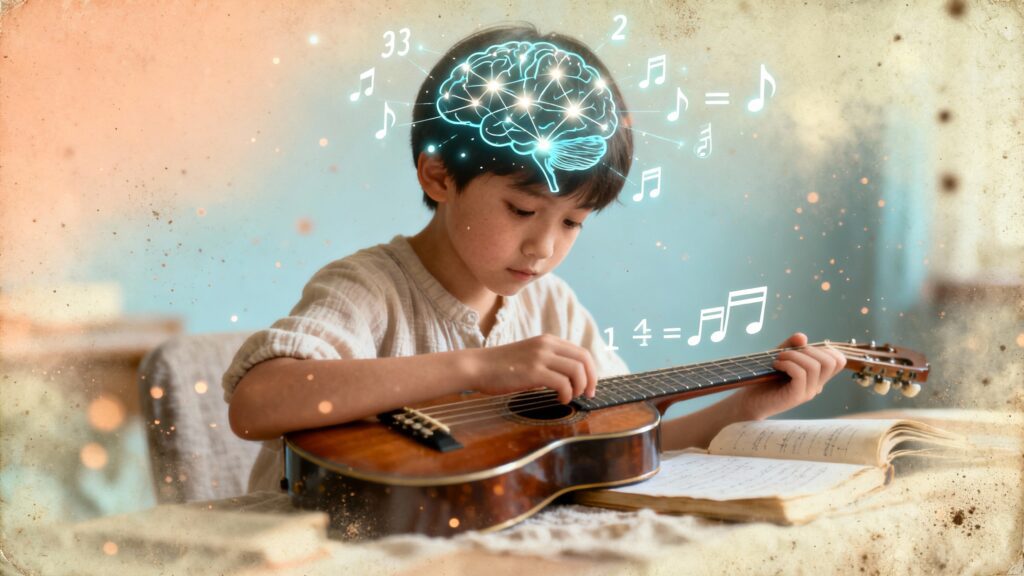
Rhythm is one of the strongest bridges between music and math because it relies heavily on counting, timing, and numerical structure. When students learn rhythm, they constantly calculate beats, note lengths, and tempo changes. For example, understanding that a whole note equals four beats or that eighth notes must be played twice as fast as quarter notes strengthens their understanding of fractions and ratios.
This repeated practice of dividing, multiplying, and sequencing beats is essentially mathematical training disguised as music. Rhythm teaches students how to break down larger concepts into smaller components—just like solving an equation. It also enhances timing accuracy, which improves cognitive processing speed. Research shows that learning rhythmic skills enhances mathematical abilities in children, highlighting the direct link between music and numerical cognition.
As learners develop more advanced rhythmic skills, their ability to understand abstract math concepts grows stronger. This is why consistent rhythm exercises help music improve mathematical skills, giving students a natural and enjoyable way to internalize numerical relationships. The more they engage with rhythmic patterns, the more confident and efficient they become in performing mathematical operations.
3. How Pattern Recognition in Music Improve Mathematical Skills and Enhances Problem-Solving

Music is built on patterns—melodic sequences, harmonic progressions, scale formations, and rhythmic loops. When students listen to or play music, their brain is constantly identifying, predicting, and interpreting these patterns. This skill directly mirrors the pattern recognition required in mathematics, where students must identify trends, solve sequences, and understand the logic behind formulas. Research shows that music training enhances pattern recognition and mathematical reasoning, highlighting the cognitive link between musical and numerical intelligence.
Recognizing musical patterns trains the brain to think analytically. For example, understanding how a chord progression repeats or how a melody resolves teaches students to anticipate what comes next. This type of predictive thinking is essential for solving algebraic problems, decoding geometry patterns, and understanding probability.
As students become more comfortable recognizing patterns in music, they naturally become better at identifying mathematical structures. This ability to categorize, compare, and break down information is one of the main ways music improves mathematical skills. Music trains the mind to look for order and relationships, strengthening critical thinking and boosting problem-solving accuracy in math.
4. How Music Enhances Memory and Concentration to Help Music Improve Mathematical Skills
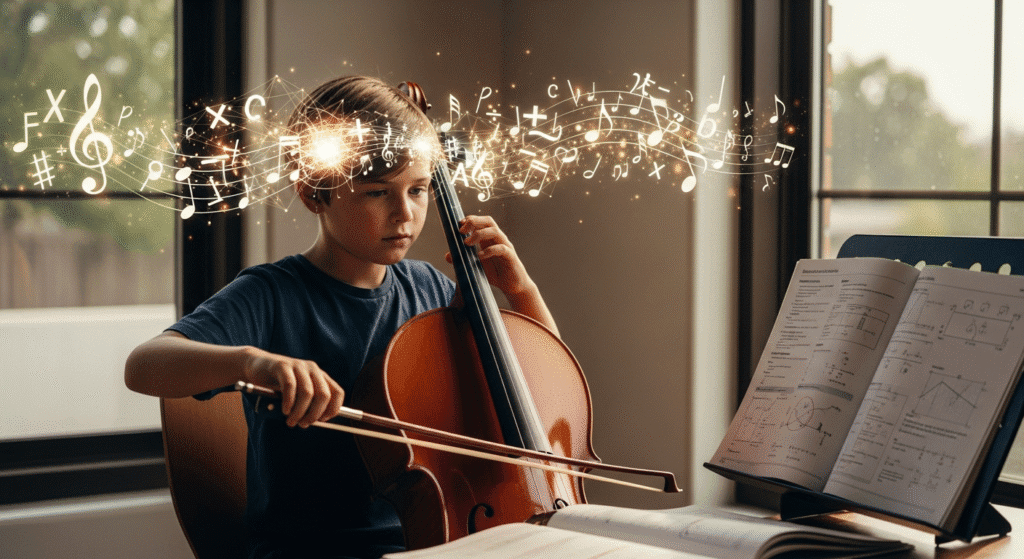
Learning music requires intense focus, discipline, and mental endurance. Students must memorize notes, finger positions, scales, lyrics, and rhythmic structures. This constant engagement trains the brain to retain information for longer periods, which is crucial for mathematical success.
Mathematics often requires remembering formulas, steps, and problem-solving methods. Students with stronger working memory can process numbers more quickly and perform multi-step calculations without losing track. Music enhances this ability by keeping the brain active, improving both short-term and long-term memory.
Additionally, practicing an instrument improves concentration and reduces cognitive distractions. When students focus on maintaining tempo or perfecting a musical piece, they develop sustained attention skills. These skills directly support math learning, as focus is essential when solving complex equations or analyzing graphs.
This is another powerful way music improve mathematical skills—by giving students stronger mental stamina, sharper recall, and improved focus, all of which contribute to better mathematical performance in the classroom and beyond.
5. Why Music Students Score Higher in Math and How Music Improve Mathematical Skills
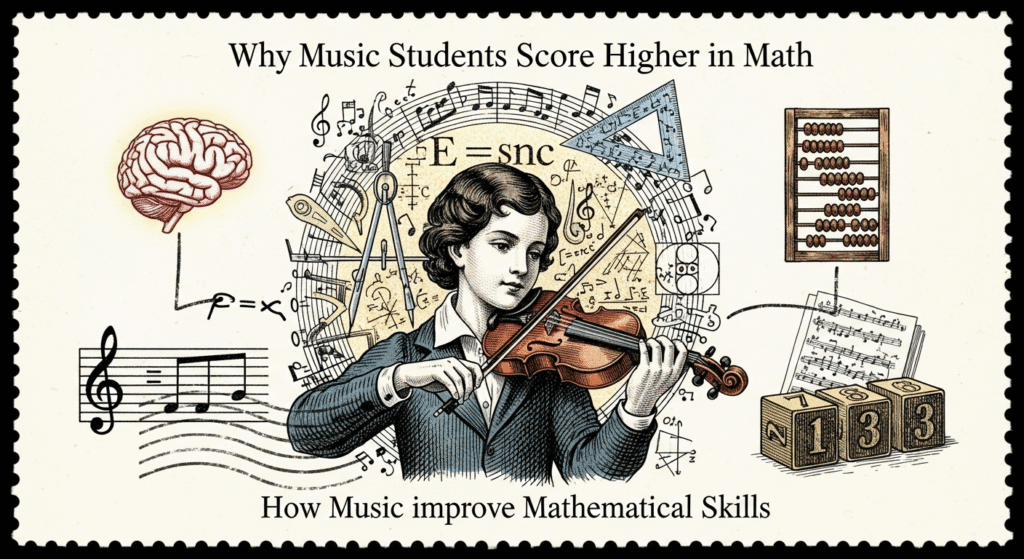
Many studies have shown that students who participate in music education tend to achieve higher scores in math tests compared to those who don’t. This advantage comes from the unique cognitive training that music provides. Through consistent practice, musicians develop discipline, problem-solving skills, analytical thinking, and the ability to process information quickly—qualities that are essential in math.
Music students are also accustomed to structured learning. They break down complex pieces into smaller sections, practice repeatedly, and gradually build mastery. This mirrors the process of learning mathematics, where concepts must be learned step-by-step and applied regularly.
Furthermore, musicians develop a natural sense of patterns, timing, fractions, and structure—all of which directly support mathematical thinking. Because their brain is already conditioned to handle these elements, math feels more intuitive and less intimidating.
This strong overlap between musical and mathematical skills explains why music improves mathematical skills and why musically trained students often outperform their peers in math assessments. Their brains are simply better prepared to handle the logical and analytical demands of mathematics.

Conclusion
Music is much more than an artistic pursuit—it is a scientifically proven tool that strengthens the brain in ways that directly enhance mathematical learning. From building stronger neural connections to improving rhythm-based counting and pattern recognition, music training activates the same cognitive processes that mathematics relies on. Students who engage in musical activities develop sharper memory, better concentration, and stronger analytical thinking skills. These mental advantages make it easier to understand formulas, solve equations, recognize patterns, and approach math with greater confidence.
The relationship between music and mathematics is not accidental; it is rooted in how the brain processes structure, sequences, and logical patterns. Whether students are learning rhythm, identifying musical motifs, memorizing notes, or analyzing harmony, they are strengthening the mental skills needed for mathematical success. This is why researchers consistently find that music students perform better in math assessments and show enhanced problem-solving abilities.
In the end, music education offers more than creative expression—it provides a powerful cognitive foundation that supports academic growth. Understanding how music improve mathematical skills helps parents, teachers, and learners recognize the enormous value of musical training. By integrating music into everyday learning, students can unlock their full academic potential and enjoy a more balanced, enriched, and intellectually rewarding educational journey.
Intersted in learning music with us? Register now
For more information and exciting resources about learning music, visit our website at The Mystic Keys. For more music content and exciting offers follow us on
Facebook, Instagram, YouTube, LinkedIn, Twitter, Pinterest, and Threads.