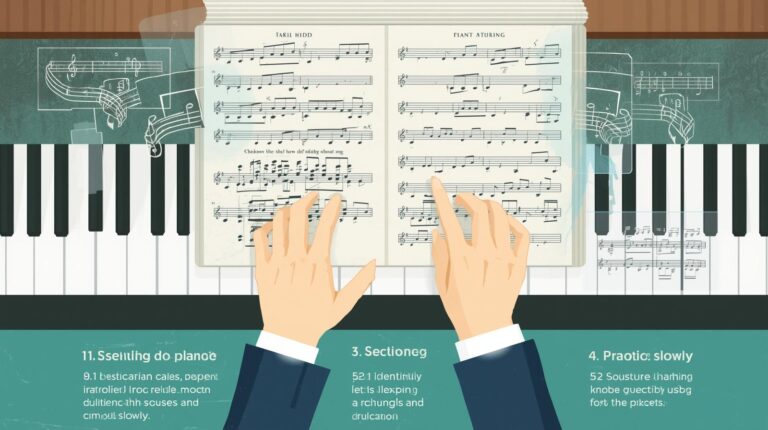
How to Break Down Difficult Piano Pieces Step-by-Step
Every pianist eventually Break down difficult piano pieces that feels too complex to play. Difficult rhythms, fast passages, wide hand movements, and unfamiliar patterns can make learning a piece feel overwhelming.
However, professional pianists rarely try to play an entire difficult piece from start to finish right away. Instead, they break down difficult piano pieces into smaller sections and practice them strategically.
This step-by-step approach makes complex music far easier to learn while improving technique, accuracy, and confidence.
Step 1: Listen to the Piece First
Before starting to practice, listen to the piece several times. This helps you understand the overall structure and musical style.
Practice each section separately until it feels comfortable. Small sections are easier to master and help you make faster progress.
Step 4: Practice One Hand at a Time
Many difficult piano passages become much easier when practiced with one hand at a time.
Start by practicing:
The right hand alone
The left hand alone
This allows you to focus on the notes, rhythm, and finger movement without feeling overwhelmed.
Once each hand feels comfortable, try playing them together slowly.
Step 5: Practice Slowly
One of the most effective methods for learning difficult music is slow practice.
Playing slowly allows you to focus on:
Correct notes
Proper fingering
Smooth hand movement
Accurate rhythm
Speed should come later. First build accuracy and control.
Step 6: Identify the Most Difficult Sections
In every piece, there are usually a few measures that cause the most trouble.
Instead of repeating the entire piece, isolate these difficult sections and practice them separately.
Repeat these sections slowly several times until they become comfortable.
This targeted practice helps you improve much faster.
Step 7: Use Repetition Wisely
Repetition is essential when learning piano, but it should be intentional repetition.
Instead of repeating the entire piece, focus on repeating:
Short passages
Challenging transitions
Difficult rhythms
This focused practice strengthens muscle memory and improves accuracy.
Step 8: Gradually Increase the Tempo
Once you can play a section correctly at a slow tempo, begin increasing the speed gradually.
You can increase the tempo in small steps so that accuracy remains consistent.
This gradual approach allows your fingers to adjust naturally to faster playing.
Step 9: Connect the Sections Together
After mastering small sections, start connecting them.
For example:
Combine two sections and play them together
Then connect three sections
Continue until the entire piece flows smoothly
This step helps transform isolated practice into a complete performance.
Step 10: Add Musical Expression
Once you are comfortable with the notes and rhythm, focus on making the music expressive.
Pay attention to:
Dynamics
Phrasing
Articulation
Musical emotion
Expression is what turns correct notes into beautiful music.
The Importance of Consistent Practice
Learning difficult piano pieces takes patience and regular practice. Progress may feel slow at times, but consistent effort strengthens both technique and confidence.
With daily practice, you will gradually develop:
Finger strength
Better coordination
Stronger rhythm control
Greater musical understanding
Over time, pieces that once felt impossible become manageable.
How Guided Piano Lessons Help
Working with an experienced piano teacher can make learning difficult pieces much easier. Teachers can help students identify challenging sections, improve technique, and develop effective practice routines.
Structured lessons also provide personalized feedback, helping students progress more efficiently.
About The Mystic Keys
The Mystic Keys is an online music academy dedicated to helping students build strong musical foundations through personalized instruction. The academy offers one-on-one online lessons for piano, guitar, vocals, drums, and other instruments.
Students receive guidance from experienced instructors along with recorded lessons and customized practice materials. This approach helps learners develop strong technique, rhythm, and musical confidence.
The academy also prepares students for internationally recognized music certifications such as Trinity College London, helping them achieve important milestones in their musical journey.
Final Thoughts
Learning how to break down difficult piano pieces step-by-step is an essential skill for every pianist. By dividing music into small sections, practicing slowly, and focusing on challenging passages, even complex pieces become manageable.
With patience, consistency, and the right practice strategy, you can gradually master difficult piano music and improve your overall playing ability.
For more information and exciting resources about learning music, visit our website at The Mystic Keys. For more music content and exciting offers follow us on