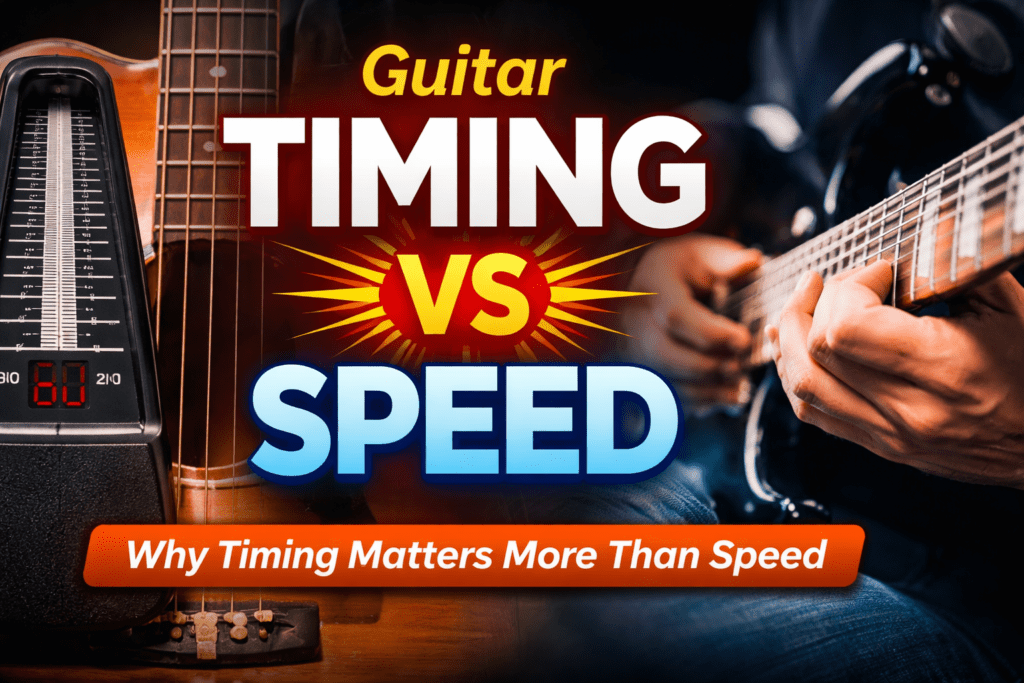
Many guitarists—especially beginners—believe that speed defines skill. When it comes to guitar timing vs speed, most players focus too much on playing fast instead of developing proper rhythm and control.
They spend hours trying to play fast solos, thinking it will make them sound more professional. But when they play, something still feels off.
The truth is simple:
Speed without timing is noise. Timing with control is music.
If your rhythm is not solid, even the fastest playing will sound unpolished. But if your timing is strong, even simple playing can sound powerful and professional.
What Is Timing in Guitar Playing? (And Why It Matters)
Timing is your ability to place every note exactly where it belongs in the beat.
Think of timing as the foundation of music. Just like a building cannot stand without a strong base, your guitar playing cannot sound good without solid timing.
Guitar Timing vs Speed | Understanding the Real Difference
Speed
How fast you can play notes
Often used in solos and technical passages
Impressive, but not always musical
Timing
When you play the notes
Determines rhythm, groove, and feel
Essential in every style of music
A slow guitarist with great timing sounds better than a fast guitarist with poor timing.
Why Timing Matters More Than Speed
1. Timing Creates Groove and Feel
Groove is what makes people tap their feet or nod their heads.
Even a simple chord progression becomes powerful when played with good timing.
Without timing:
Music feels disconnected
There is no emotional impact
Timing is what makes music feel alive.
2. Clean Playing Comes From Good Timing
Fast playing often hides mistakes.
But poor timing exposes them:
Notes overlap incorrectly
Rhythm becomes uneven
Phrases sound rushed or delayed
Strong timing gives clarity and control to your playing.
3. Timing Builds Musical Confidence
When your timing is solid:
You play more confidently
You stay consistent
You recover easily from mistakes
Confidence in music comes from control, not speed.
4. You Can’t Play With Others Without Timing
In any musical setting—band, church, or recording:
Everyone follows the same tempo
Timing keeps everything tight
If your timing is weak:
You will drift off beat
The performance will sound uncoordinated
Timing makes you a reliable musician.
5. Professional Guitarists Focus on Timing First
Great players are not just fast—they are precise.
They:
Practice slowly
Use metronomes
Focus on rhythm before speedThat’s why their playing sounds clean and effortless.
10 minutes – Metronome exercises 10 minutes – Slow practice of songs 10 minutes – Playing along with tracks 5 minutes – Recording and reviewing
Just 30–35 minutes daily can transform your timing.
Timing First, Speed Later |The Golden Rule
Always follow:
Timing → Accuracy → Speed
In the long run, mastering guitar timing vs speed in the right order will give you better results and cleaner playing.
Being a great guitarist is not about how fast you can play.
It’s about:
Control
Consistency
Musical feel
When you understand guitar timing vs speed, you realize that timing is the skill that connects everything.
Improve your timing, and your playing will automatically sound more professional, confident, and musical.
If you want to build these skills the right way, Guitar Lessons Online with The Mystic Keys can help you develop strong timing, rhythm, and musical confidence step by step.
Intersted in learning music with us? Register now
For more information and exciting resources about learning music, visit our website at The Mystic Keys. For more music content and exciting offers follow us on