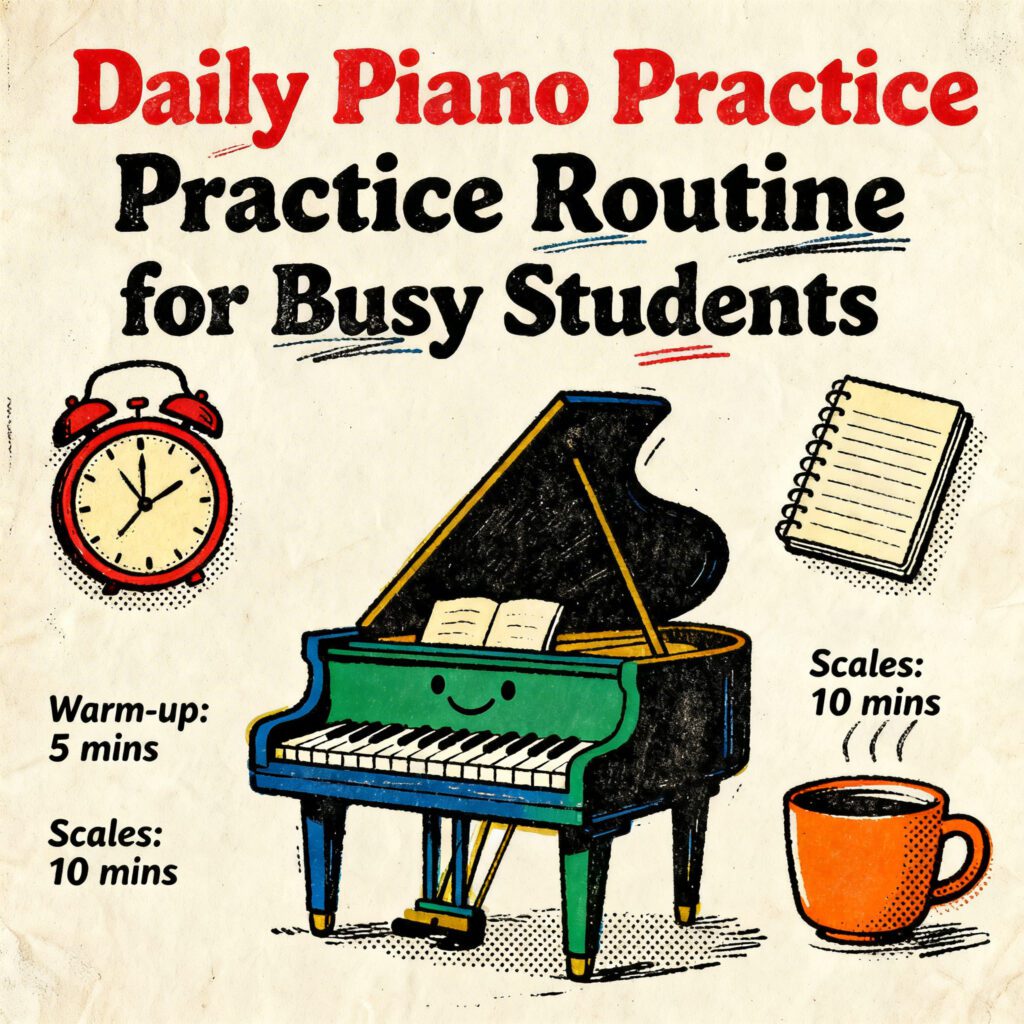
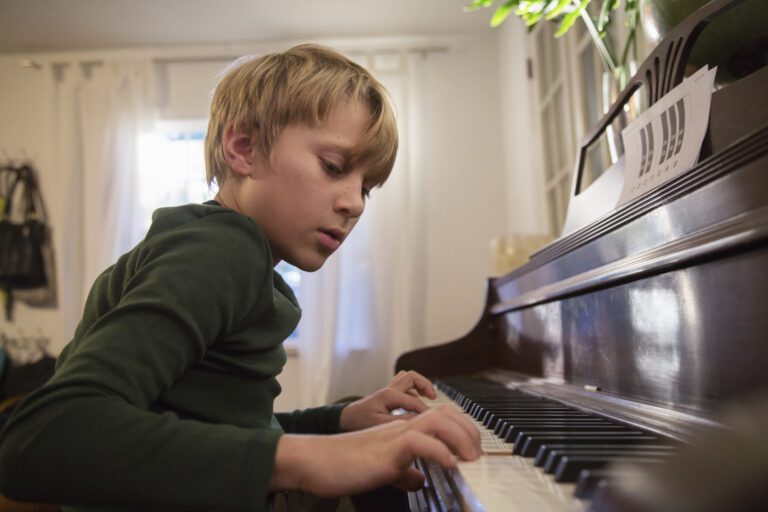
Balancing academics, extracurricular activities, family responsibilities, and personal time can feel overwhelming. For young learners and working professionals alike, maintaining consistency in music can seem nearly impossible. However, a well-structured daily piano practice routine for busy students makes it possible to grow steadily without spending hours at the keyboard.
The key is not practicing longer — it is practicing smarter. With focused sessions, clear goals, and intentional structure, even 20 to 40 minutes a day can produce remarkable progress. This guide provides a realistic, professional, and practical framework to help busy students stay consistent while continuing to improve musically.
Why Busy Students Struggle With Piano Consistency
Before building an effective daily piano practice routine for busy students, it is important to understand the challenges.
Most students struggle because:
School schedules are demanding
Homework and exams take priority
Energy levels fluctuate throughout the day
Practice feels unstructured or overwhelming
There is no clear plan for improvement
Without structure, practice becomes random. When practice feels unproductive, motivation decreases. Over time, inconsistency replaces progress.
A defined routine eliminates this cycle.
The Science Behind Short, Focused Practice Sessions
Research in skill development shows that shorter, highly focused sessions are more effective than long, distracted ones. The brain absorbs information better in structured intervals.
For busy learners, this means:
20–30 minutes of deep focus is enough
Quality matters more than quantity
Clear objectives accelerate improvement
Consistency beats occasional long sessions
How Long Should Busy Students Practice Daily?
The ideal duration depends on age and level, but general guidelines include:
Beginners 20–30 minutes per day
Intermediate students 30–40 minutes per day
Advanced students 45–60 minutes per day (if schedule allows)
However, the structure inside those minutes matters more than total time.
The Ideal Daily Piano Practice Routine for Busy Students
Below is a structured template that balances technique, repertoire, and musical development within limited time.
Small daily exposure prevents theory from becoming overwhelming later.
Repertoire Practice (10–20 minutes)
This is the core of the daily piano practice routine for busy students.
Divide repertoire into:
Section 1 – Review Piece Play a previously learned piece to maintain confidence and memory.
Section 2 – Current Piece Work on challenging sections slowly. Break difficult passages into smaller segments.
Section 3 – Musical Expression Focus on dynamics, phrasing, articulation, and emotional interpretation.
Avoid playing the entire piece repeatedly with mistakes. Isolate problems and correct them intentionally.
Creative Exploration (Optional 5 Minutes)
If time allows, include:
Improvisation
Playing by ear
Simple composition
Chord progression exploration
This keeps practice enjoyable and reduces burnout.
Weekly Structure for Maximum Efficiency
Instead of repeating the same pattern daily, busy students can rotate focus areas across the week.
Example:
Monday Technique emphasis
Tuesday Sight reading and rhythm
Wednesday Repertoire polishing
Thursday Theory integration
Friday Performance run-through
Weekend Longer expressive session or revision
This flexible system keeps practice engaging.
Time Management Tips for Busy Students
A daily piano practice routine for busy students works best when practice is scheduled like an academic subject.
Effective strategies include:
Practicing at the same time daily
Choosing a low-distraction environment
Turning off notifications
Setting a timer for focused sessions
Tracking daily goals in a notebook
Small habits create long-term discipline.
Morning vs Evening Practice
Morning practice benefits:
Fresh concentration
Stronger memory retention
Fewer distractions
Evening practice benefits:
Emotional relaxation after school
Creative expression
Flexible scheduling
Students should choose the time when energy is highest.
How to Stay Motivated During Busy Academic Periods
During exam seasons, practice time may reduce. Instead of stopping completely:
Shorten sessions to 15 minutes
Focus only on warm-ups and one piece
Maintain muscle memory
Consistency, even at lower intensity, prevents regression.
Avoiding Common Practice Mistakes
Many students waste time because they:
Play pieces from start to finish repeatedly
Practice too fast
Ignore rhythm accuracy
Skip warm-ups
Avoid difficult passages
A structured daily piano practice routine for busy students eliminates these habits.
Why Consistency Matters More Than Duration
Practicing 25 minutes daily is far more powerful than practicing two hours once a week.
Daily repetition:
Strengthens neural pathways
Builds muscle memory
Enhances confidence
Improves accuracy
Consistency compounds over months and years.
The Role of Structured Guidance
Independent practice is valuable, but direction accelerates growth.
At The Mystic Keys, students receive:
Personalized weekly practice plans
Clear goal setting
Structured technique development
Feedback that maximizes limited practice time
This ensures that even busy learners progress steadily.
Parental Support for Younger Students
Parents can help by:
Creating a consistent practice schedule
Encouraging positive reinforcement
Attending small home performances
Communicating with the piano teacher regularly
Structured guidance improves accountability.
Conclusion
A structured daily piano practice routine for busy students proves that progress does not require endless hours. With smart planning, focused sessions, and consistent effort, even the busiest learners can improve steadily. The goal is not perfection, but daily improvement.
At The Mystic Keys, students are guided with personalized strategies that align music learning with academic responsibilities. For learners seeking structured support and meaningful progress, Piano Lessons Online provide a flexible and effective way to stay consistent while balancing a demanding schedule.
For more information and exciting resources about learning music, visit our website at The Mystic Keys. For more music content and exciting offers follow us on