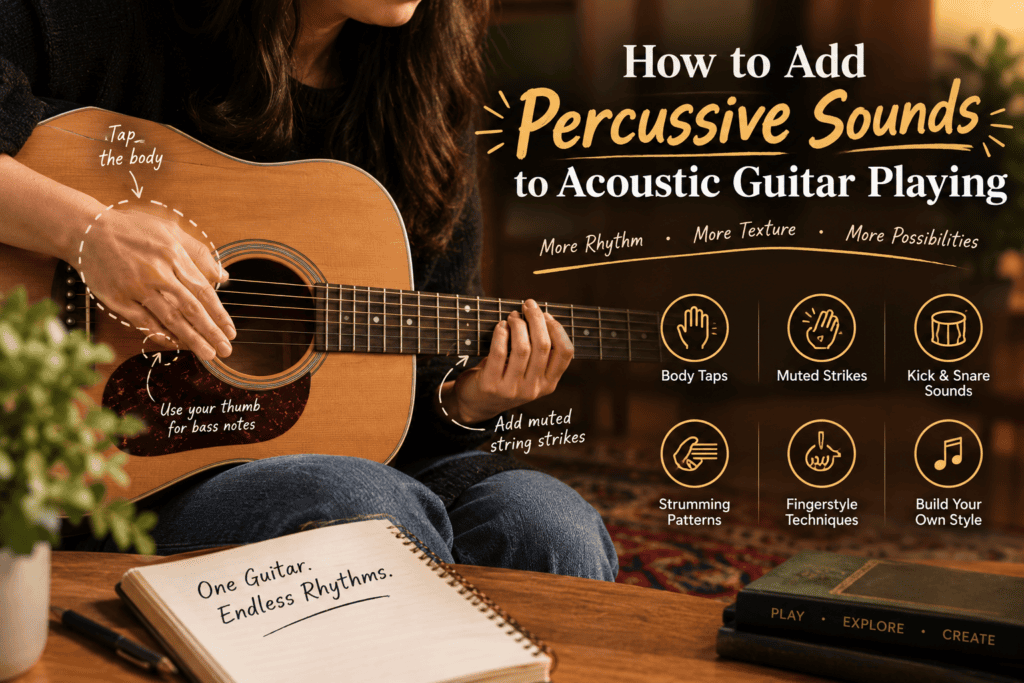
How to Add Percussive Sounds to Acoustic Guitar Playing
Introduction
Learning how to add percussive sounds to acoustic guitar playing can transform a simple chord progression into a rhythmic, full-bodied performance. By tapping, slapping, and striking different parts of the guitar, you can create drum-like sounds while continuing to play melodies and chords. This technique is especially popular in modern fingerstyle guitar, solo acoustic performances, and arrangements where one guitarist wants to create the feeling of an entire band.
The best part is that you do not need additional instruments to get started. With the right techniques, good timing, and consistent practice, your acoustic guitar can produce both harmonic and percussive sounds. Whether you are a beginner exploring rhythm or an experienced guitarist looking to make your arrangements more dynamic, this guide will help you understand the techniques and incorporate them into your playing.
What Are Percussive Sounds in Acoustic Guitar Playing?
Percussive guitar playing involves using the body, strings, and other parts of the guitar to create rhythmic sounds that complement the notes and chords. Instead of relying only on strumming or picking, you introduce taps, slaps, knocks, and muted string strikes to imitate elements of a drum kit.
These sounds can provide several musical effects:
A stronger rhythmic foundation: Percussive accents help establish the beat.
A fuller solo performance: Combining bass notes, chords, melody, and percussion can make one guitar sound like multiple instruments.
Greater musical expression: Different accents can emphasize important moments in a song.
More engaging arrangements: Percussive techniques introduce contrast between quieter and more energetic sections.
Percussive acoustic guitar playing is often associated with fingerstyle music, but you can also incorporate simple rhythmic taps into ordinary strumming patterns.
1. Percussive Guitar Techniques for Beginners
Before attempting complex fingerstyle patterns, learn to produce a few basic sounds consistently. Start slowly and focus on the quality of each sound rather than how quickly you can play it.
Learn the Bass-Side Thumb Tap
A light tap near the bass strings can create a low, rounded sound that resembles a kick drum. You can use the side of your picking-hand thumb to produce a controlled accent while keeping your hand close to the strings.
Start with a simple chord, such as G major. Strum the chord once, then pause and lightly tap near the bass-string area. Repeat until the movement feels comfortable.
Avoid hitting the guitar aggressively. You want a clear rhythmic accent, not a loud impact that risks damaging the instrument.
Practice a Body Tap
A gentle tap on a suitable area of the guitar’s top can produce a higher, sharper percussive sound. This can work like a snare or hand drum when combined with lower taps.
Use your fingers rather than a forceful fist, and begin with a light touch. The precise sound depends on the guitar’s construction and the location of the tap.
Important: Avoid striking the soundboard heavily, especially near the bridge, thin areas, or delicate components. Repeated forceful impacts can damage the guitar. If you are unsure where to tap, ask an experienced guitar teacher to demonstrate safe locations for your instrument.
Use Muted String Strikes
Muted string strikes produce a short, dry rhythmic sound without a clearly ringing pitch. Lightly rest your fretting hand against the strings to stop them from ringing, then strike or brush the strings with your picking hand.
This technique is useful between chords, during rhythmic breaks, and in patterns where you want a snare-like accent without interrupting the flow of the music.
2. Percussive Guitar Techniques for Acoustic Guitar
Once you can produce basic taps, experiment with different sounds and learn how they fit into a rhythm.
The Kick-Drum Sound
A kick-drum-style sound is a low accent that reinforces the main beat. On acoustic guitar, you can approximate it with a controlled thumb tap near the bass-string area or a suitable light body tap.
Try placing the accent on beats one and three in a simple four-beat pattern. This creates a strong foundation that can support your strumming or fingerpicking.
The Snare-Drum Sound
A snare-style sound is sharper and more cutting. You can approximate it with a light tap on a suitable area of the guitar’s top or a muted string strike.
Practice placing the accent on beats two and four. These accents help establish a familiar pop or rock groove.
The String Slap
A string slap involves striking the strings in a controlled way to create a short, percussive attack. Depending on the technique, the sound may combine a muted string noise with a little pitch.
Start with muted strings so you can concentrate on timing and consistency. Once you are comfortable, introduce the slap between chord changes.
The Rhythmic Brush
A rhythmic brush is a quick, light movement across the strings that emphasizes rhythm without producing a full chord. It can be useful for adding subtle texture to a fingerstyle arrangement or creating a softer percussive effect during quieter sections.
Keep your wrist relaxed and avoid excessive force. The goal is to add rhythmic detail without making the playing feel stiff.

3. How to Add Percussive Guitar Sounds to Strumming
One of the easiest ways to introduce percussion is to add muted strokes and light taps to a familiar strumming pattern.
Begin with a simple four-beat rhythm. Count:
1 – 2 – 3 – 4
Strum a chord on each beat, then replace one or two strokes with muted strikes.
For example:
Beat 1: Strum the chord.
Beat 2: Play a muted string strike.
Beat 3: Strum the chord.
Beat 4: Play another muted strike.
Repeat this pattern at a comfortable tempo. Once it feels natural, experiment with different accents and rests.
Try a Simple Down-Up Pattern
A common strumming pattern is down, down-up, up-down-up. First, play it normally. Then experiment with muting selected strokes to create a more rhythmic, drum-like effect.
Keep the hand moving in a consistent pattern, even when a stroke does not produce a full chord. This helps preserve the groove and makes it easier to reintroduce the chords without losing time.
Do not add too many percussive sounds at once. One or two well-placed accents can make a bigger musical difference than a complicated pattern played inconsistently.
4. Percussive Guitar Techniques for Fingerstyle Playing
Fingerstyle guitar offers more opportunities for combining rhythm, harmony, and melody because different fingers can perform different roles.
For example, your thumb can maintain a bass line while your index and middle fingers play chord tones or melody notes. A controlled tap or muted strike can then provide a percussive accent between notes.
Practice a Bass-and-Percussion Pattern
Start with a simple chord progression such as G–D–Em–C.
Add two or three higher chord notes.
Introduce a light percussive tap at a point where your picking hand can perform it comfortably.
Repeat the pattern slowly until all the movements feel coordinated.
At first, leave out the melody and concentrate on maintaining the bass, chord, and percussion pattern. Add a melody only after the rhythm feels stable.
Avoid Interrupting the Melody
One of the biggest challenges in percussive fingerstyle guitar is producing a tap without disrupting the other musical parts.
Choose moments where a percussive accent fits naturally, such as a gap between melody notes or the end of a chord. Practice the transition between the note and the tap separately before attempting the entire arrangement.
A good arrangement should sound like one continuous musical idea rather than several techniques forced together.

5. Improve Timing and Rhythm in Percussive Guitar Playing
Percussive guitar techniques depend on timing. Even a beautiful percussive sound can feel distracting if it lands outside the intended beat.
Practice With a Metronome
Set a metronome to a slow tempo, such as 60 beats per minute. Play a basic chord progression and add one percussive accent at a time.
Start by placing the accent directly on the beat. When you can do this consistently, try introducing accents between beats to create syncopation.
Gradually increase the tempo only when the pattern feels comfortable.
Count Aloud While Playing
Counting aloud helps you understand where each tap belongs in the measure. Begin with four steady beats and identify which beats contain chords, muted strikes, or body taps.
If counting and playing simultaneously feels difficult, clap the rhythm first. Then transfer the pattern to the guitar.
Record Your Practice
A short recording can reveal timing problems that are difficult to notice while playing. Listen for accents that are too loud, uneven spacing between taps, and moments when the rhythm speeds up or slows down.
Focus on one improvement at a time rather than trying to fix everything in a single practice session.
6. Percussive Guitar Techniques for Different Music Styles
Percussive acoustic guitar techniques can work in several genres, but the approach should suit the music.
Pop Acoustic Guitar
For pop songs, use subtle muted strokes and occasional body taps to reinforce a steady rhythm. Keep the chord progression clear so the percussion supports the song rather than overpowering it.
Rock Acoustic Guitar
Rock-inspired acoustic arrangements can use stronger rhythmic accents, muted strums, and a more energetic groove. Keep the pattern consistent and reserve the strongest accents for important beats or transitions.
Folk and Singer-Songwriter Music
For folk music, a lighter percussive approach can add movement while preserving the natural sound of the guitar. Soft taps and muted strings often work better than frequent, forceful slaps.
Modern Fingerstyle Guitar
Modern fingerstyle arrangements may combine bass notes, melody, chords, harmonics, and percussive techniques. Begin with a simple pattern and gradually introduce additional layers as your coordination improves.
The key is to choose techniques that complement the song. Not every arrangement needs percussion on every beat.
7. Create a Percussive Guitar Arrangement Step by Step
Once you have practiced individual techniques, try putting them together in a short musical arrangement.
Use the following four-bar exercise with a comfortable G–D–Em–C progression.
| Bar | Chord | Suggested pattern |
|---|---|---|
| 1 | G major | Bass note, chord, light muted strike, chord |
| 2 | D major | Bass note, chord, gentle percussive tap, chord |
| 3 | E minor | Bass note, two chord notes, muted string strike |
| 4 | C major | Bass note, chord, light tap, sustained chord |
Start by playing only the chords. Next, introduce the muted strikes. Finally, add the percussive taps where they fit comfortably.
This is a practice framework rather than a fixed arrangement. Adjust the rhythm to suit your playing ability and the style of the song.
Add Dynamics to Make the Arrangement More Musical
Dynamics refer to changes in volume and intensity. They help prevent a performance from sounding repetitive.
Try playing the first two bars softly, making the third bar slightly stronger, and allowing the final chord to ring naturally. You can also leave out percussion in one bar to create contrast before bringing the rhythm back.
Silence is an important musical tool. A brief pause can make the next accent feel more powerful.

8. Common Mistakes to Avoid in Percussive Acoustic Guitar Playing
Learning percussive guitar requires patience and coordination. Avoid these common mistakes as you develop your technique.
Hitting the guitar too hard: Excessive force can damage the instrument and make the sound unpleasant. Begin with light, controlled movements.
Losing the beat: Focusing on the tap can cause you to rush or delay the next chord. Practice slowly with a metronome.
Adding too many techniques too soon: Master one or two percussive sounds before combining them with complicated fingerstyle patterns.
Ignoring the melody: Percussion should support the musical idea. Keep the main melody and chord progression clear.
Using excessive volume: Percussive sounds can easily overpower the guitar’s natural tone. Adjust your technique so the taps blend with the music.
Practicing through pain: Stop if you experience pain or discomfort in your fingers, wrist, or hand. Relax your movements and seek guidance if discomfort persists.
Striking delicate parts of the guitar: Avoid forceful impacts around the bridge, soundboard, and other vulnerable components. If you want to explore more advanced body percussion, learn safe techniques from an experienced instructor.
9. A Simple Seven-Day Practice Plan for Percussive Guitar
Consistency is more valuable than trying to learn every technique in one session. Use this seven-day plan to build your coordination gradually.
| Day | Practice focus | Suggested duration |
|---|---|---|
| 1 | Learn gentle taps and muted string strikes | 10–15 minutes |
| 2 | Practice a steady four-beat rhythm | 10–15 minutes |
| 3 | Add muted strikes to simple strumming | 15 minutes |
| 4 | Combine bass notes with chord patterns | 15 minutes |
| 5 | Add one percussive accent to fingerstyle playing | 15–20 minutes |
| 6 | Practice the G–D–Em–C arrangement | 20 minutes |
| 7 | Record your playing and review your timing | 15–20 minutes |
Move at your own pace. If a technique still feels awkward, repeat that day’s exercise before moving forward.
How The Mystic Keys Can Help You Improve Your Acoustic Guitar Playing
Learning to add percussive sounds to acoustic guitar playing becomes easier when you develop strong foundations in rhythm, chord transitions, fingerstyle technique, and musical expression.
At The Mystic Keys, students can build their guitar skills through personalized online lessons with internationally certified teachers. Guided practice can help you improve hand coordination, develop consistent timing, understand different playing styles, and gradually incorporate more advanced techniques into your arrangements.
Whether you are learning your first chord progression or refining a fingerstyle performance, structured lessons can help you progress with greater confidence.
Explore online guitar lessons at The Mystic Keys to develop your technique and discover new ways to express yourself through music.
Conclusion
Adding percussive sounds to acoustic guitar playing allows you to combine rhythm, harmony, and melody using a single instrument. By learning basic taps, muted string strikes, rhythmic brushes, and simple fingerstyle patterns, you can gradually create arrangements that sound fuller and more engaging.
Start slowly, focus on timing, and choose techniques that complement the music. With regular practice, you can develop the coordination needed to add percussion without losing the natural flow of your playing.
Remember that the goal is not to make every part of the guitar sound like a drum kit. It is to use rhythm creatively, support the melody, and make each performance more expressive.
For more information and exciting resources about learning music, visit our website at The Mystic Keys. For more music content and exciting offers follow us on
Facebook, Instagram, YouTube, LinkedIn, Twitter, Pinterest, and Threads