Singing and Piano Connection | How Both Strengthen Each Other
Singing and piano may seem like two different musical skills, but they share a remarkably strong connection. One uses the human voice as its instrument, while the other relies on keys, strings, rhythm, and technique. When learned together, however, singing and piano can strengthen each other in ways that make musical learning more expressive, coordinated, and enjoyable.
A singer who understands the piano gains a clearer sense of melody, harmony, pitch, and musical structure. At the same time, a pianist who learns to sing develops a stronger awareness of phrasing, rhythm, expression, and musicality. This connection goes beyond simply playing and singing at the same time. It helps musicians understand what they are performing from a deeper musical perspective.
Whether you are a beginner learning your first song or an experienced musician looking to expand your skills, combining singing and piano can open up a more complete approach to music.
Understanding the Connection Between Singing and Piano
The voice and piano are naturally complementary. A piano can provide the melody, chords, rhythm, and harmonic foundation, while the voice can bring words, emotion, and personal expression into the music.
When a student sings while playing simple piano chords, they begin to experience how different musical elements work together. The hands may maintain the harmonic structure while the voice follows the melody. This requires the brain to process rhythm, pitch, timing, and coordination simultaneously.
As a result, learning both instruments does not simply mean learning two separate skills. Instead, each skill can reinforce the other.
For example, a singer who struggles to identify the starting note of a song can use the piano to find and establish the correct pitch. Similarly, a pianist who finds it difficult to understand how a melody should be phrased can benefit from singing the same musical line. The two disciplines become practical tools for improving one another.

How Piano Strengthens Singing
One of the biggest advantages of learning piano alongside singing is improved pitch awareness. The piano provides a visual and physical reference for musical notes, allowing singers to see and hear the relationship between pitches.
When a singer plays a note and then matches it with their voice, they begin developing a stronger connection between what they hear and what they produce. Over time, this can make it easier to recognise whether a note is too high, too low, or accurately placed.
Piano also helps singers understand scales and intervals. Instead of simply memorising a melody, students can explore how one note moves to another. That understanding becomes especially useful when learning unfamiliar songs or working on vocal exercises.
Another important benefit is harmonic awareness. A singer who understands basic chords can recognise how the melody interacts with the accompaniment. Major and minor chords, chord progressions, and changes in harmony can then become more meaningful rather than sounding like unrelated background music.
This awareness can also improve a singer’s confidence. Knowing the underlying chord structure makes it easier to find one’s place in a song, especially when practising without a complete backing track.
How Singing Strengthens Piano Playing
The connection works both ways. Piano students can gain a great deal from learning to sing.
Singing encourages pianists to think beyond individual notes and focus on musical phrases. When a pianist sings a melody, they experience where the musical line naturally rises, falls, pauses, and builds in intensity.
That experience can influence the way they play. Instead of treating every note equally, they may begin shaping phrases with greater intention. Dynamics, articulation, timing, and expression become connected to the musical idea rather than being treated as isolated technical instructions.
Singing can also improve rhythmic awareness. A pianist who sings while counting or playing can develop a stronger internal sense of pulse. This becomes particularly useful when performing pieces with syncopation, changing rhythms, or complex phrasing.
Moreover, singing a melody before playing it can help pianists understand the music more naturally. They begin to hear the musical line internally, which can contribute to more expressive and confident playing.

Developing a Stronger Sense of Pitch
Pitch is one of the clearest areas where singing and piano support each other.
The piano offers fixed pitches that can act as a reliable reference for vocal practice. A student can play a note, listen carefully, and attempt to reproduce it with their voice. Repeating this process gradually strengthens the connection between the ear and the voice.
Once basic pitch matching becomes comfortable, students can move towards scales, intervals, melodies, and more complex vocal exercises. The piano can provide the starting point while the singer learns to maintain accurate pitch independently.
This process is particularly valuable because good singing is not only about having a pleasant voice. Musical accuracy plays an important role as well. Understanding pitch allows singers to perform melodies with greater consistency and confidence.
At the same time, pianists benefit from developing their ears because listening carefully to vocal pitch can make them more attentive to musical details when they return to the keyboard.
Building Better Musical Coordination
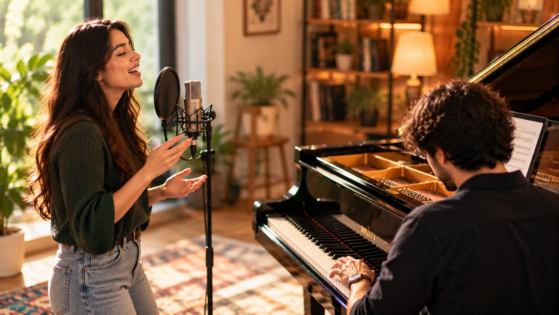
The singing and piano connection also helps develop an important musical skill: coordination. Playing a repeating chord pattern while singing a melody requires the hands and voice to work independently while staying connected to the same rhythm.
At first, this may feel challenging, as the brain has to manage several musical elements at once. With regular practice, however, simple chord progressions and familiar melodies become easier to coordinate.
Over time, this practice strengthens independence between the hands and voice while helping musicians maintain a steady pulse. As a result, singing while playing piano becomes an effective way to build overall musical coordination and confidence.
Understanding Chords Through the Voice
Chords become much easier to understand when musicians can hear how individual notes interact with a melody.
A pianist may learn that a particular song uses a C major, F major, and G major progression. However, singing the melody over those chords provides a more practical understanding of why the progression works.
The singer can hear how certain notes feel stable over one chord and how others create tension before resolving. This experience introduces harmony in a more musical and intuitive way.
As students become familiar with common chord progressions, they may also begin recognising patterns across different songs. That can make learning new music faster because the musician is no longer approaching every song as a completely new structure.
For singers, basic chord knowledge can also make rehearsals more comfortable. For pianists, understanding the vocal melody can make accompaniment more responsive and musical.
Improving Musical Expression
Technical accuracy is important, but music is ultimately about communication and expression.
Singing naturally encourages musicians to think about words, emotion, breathing, phrasing, and storytelling. These elements can influence piano playing as well.
A pianist who sings a piece before playing it may begin to understand where a phrase should breathe or where a musical idea should build. Even without lyrics, the concept of vocal phrasing can influence how the pianist shapes the performance.
Similarly, singers who accompany themselves on piano learn how accompaniment can support the emotional direction of a song. A softer chord pattern may create intimacy, while stronger dynamics can add energy and intensity.
Therefore, combining both skills can help musicians move beyond simply playing the correct notes or singing the correct pitches. The goal becomes creating a performance that feels connected and intentional.
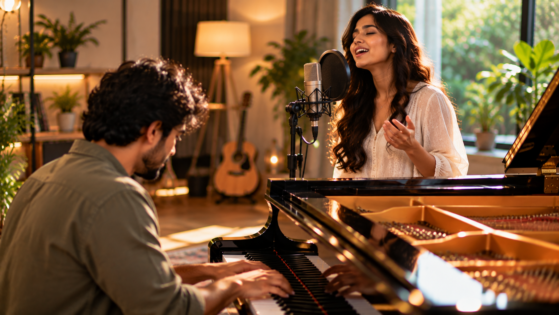
Singing and Piano for Songwriting and Creativity
The Singing and Piano Connection can also encourage creativity by bringing melody, harmony, and expression together. The piano provides chords and a musical foundation, while the voice explores different melodies and phrases.
A simple chord progression can inspire a vocal melody, while a new vocal idea can lead to a different chord or rhythm. For beginners, playing a few basic chords while humming different melodies can be a simple and enjoyable introduction to songwriting.
A Practical Way to Learn Singing and Piano Together
Learning both skills does not mean that every practice session needs to involve complicated pieces. In fact, starting with simple material often produces better results.
A beginner might first learn the melody of a familiar song on piano. Once the melody feels comfortable, the next step can be singing the melody without playing it. After that, simple chords can be introduced underneath the vocal line.
Gradually, the student can practise playing the chords while singing. Once coordination improves, attention can shift towards dynamics, phrasing, rhythm, and expression.
The process works best when the difficulty increases gradually. Trying to play complicated accompaniment while singing a demanding melody from the beginning can create unnecessary frustration.
Instead, small improvements in pitch, rhythm, coordination, and expression can build towards confident performance.

Why One-on-One Learning Can Make a Difference
When singing and piano are learned together, personalised guidance can be particularly helpful. Each student may experience different challenges: one person may have strong vocal pitch but struggle with keyboard coordination, while another may play confidently but need more support with vocal control.
A personalised learning approach allows lessons to adapt to these individual needs. The instructor can decide when to focus on vocal exercises, piano technique, rhythm, ear training, chord understanding, or combined practice.
For students preparing for structured music examinations, learning both areas can also provide a broader musical foundation. Depending on the student’s goals, lessons may incorporate music theory, notation, performance skills, and practical musicianship alongside the main instrument or vocal training.
The Benefits for Beginners and Experienced Musicians
The Singing and Piano Connection helps musicians develop complementary skills. Singing strengthens pitch, melody, rhythm, phrasing, and expression, while piano builds an understanding of notes, chords, harmony, and musical structure.
For beginners, learning both creates a strong foundation in pitch, rhythm, melody, harmony, and coordination. Playing a note and matching it with the voice, or singing while playing simple chords, can make musical concepts easier to understand.
For experienced musicians, combining singing and piano can refine musicality. Pianists can develop more expressive phrasing through singing, while singers can become more musically independent through keyboard skills.
You don’t need to master both. Even basic knowledge of one can help strengthen the other and lead to greater musical confidence and understanding.
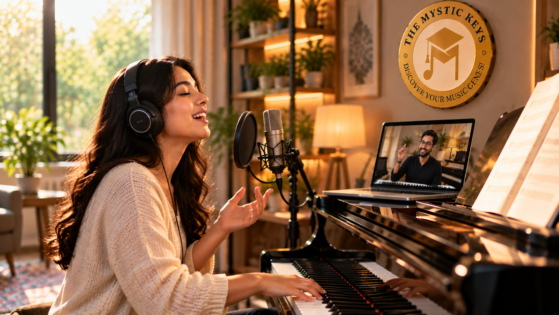
Singing and Piano | Two Skills, One Musical Language
At their core, singing and piano are not competing disciplines. They are two ways of understanding the same musical language.
The piano can make pitch, harmony, and structure visible and tangible. Singing brings melody, breath, emotion, and expression into the experience. When these skills come together, musicians can develop a more complete understanding of how music works.
A singer who accompanies themselves can become more independent. A pianist who understands the voice can become more sensitive to melody and phrasing. Together, the two skills encourage musicians to listen more carefully, play more intentionally, and express musical ideas with greater confidence.
Whether your goal is to sing your favourite songs while accompanying yourself, improve your piano performance, strengthen your pitch, explore songwriting, or simply become a more versatile musician, learning singing and piano together can be a rewarding musical journey.
At The Mystic Keys, personalised online piano lessons can help students develop their musical skills through structured guidance and individual attention. With the right approach, singing and piano can grow together—turning two individual skills into one connected musical experience.
For more information and exciting resources about learning music, visit our website at The Mystic Keys. For more music content and exciting offers follow us on Facebook, Instagram, YouTube, LinkedIn,
Twitter, Pinterest, and Threads.