

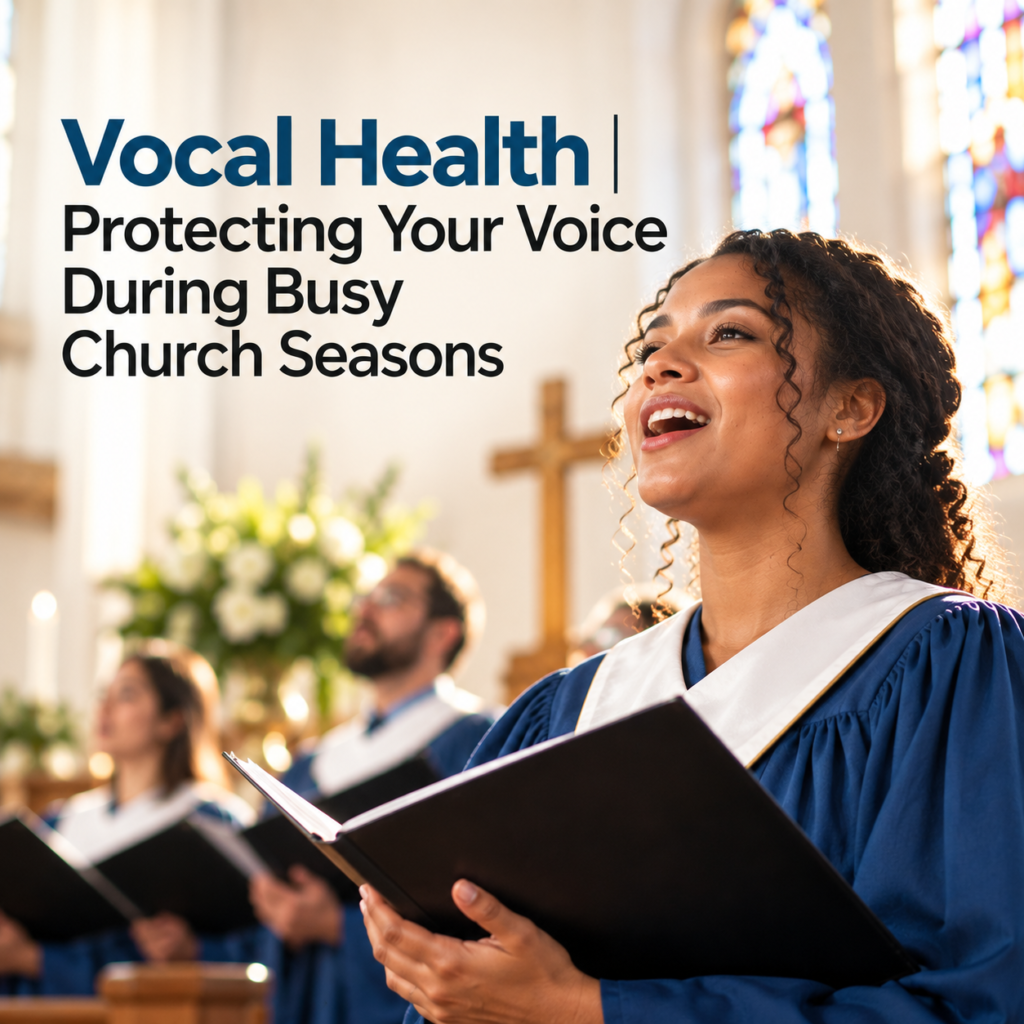
Vocal Health | Protecting Your Voice During Busy Church Seasons
Busy church seasons can be some of the most meaningful and musically demanding times of the year. Christmas, Easter, Holy Week, special worship services, concerts, choir celebrations, and seasonal programs often bring singers together for more rehearsals, additional services, and longer performances. While these occasions can be spiritually fulfilling, they can also place considerable strain on the voice, making vocal health an essential part of preparing for and getting through these demanding seasons.
For singers, worship leaders, choir members, and musicians, the voice is an instrument that cannot simply be replaced when it becomes tired. Unlike a guitar that can be restrung or a piano that can be tuned, your vocal folds need time, care, and healthy habits to function properly. That is why maintaining vocal health during busy church seasons should be part of your preparation, not something you think about only after your voice becomes hoarse.
With the right approach, you can participate fully in a demanding worship schedule while protecting your voice and maintaining vocal quality.
Understand Why Busy Seasons Can Be Hard on Your Voice
During an ordinary week, a singer may have one or two rehearsals and perhaps a worship service. Busy church seasons can change that routine dramatically. Rehearsals may become longer and more frequent, while multiple services, choir practices, solo performances, and special events can create several consecutive days of heavy vocal use.
The challenge becomes even greater when singers try to compensate for tiredness by pushing their voices harder. Singing louder than necessary, reaching for notes without adequate preparation, or continuing to sing despite discomfort can increase vocal fatigue.
Church environments can also present acoustic challenges. Large sanctuaries, outdoor gatherings, microphones, live instruments, and enthusiastic congregations may encourage singers to increase their volume. Instead of forcing the voice to compete with the surroundings, singers should rely on proper microphone technique, breath support, and efficient vocal production.
Recognizing these demands early makes it easier to prepare your voice before the busiest part of the season begins.

Begin With Consistent Hydration for Better Vocal Health
Hydration is one of the simplest and most important parts of vocal care. The vocal folds need adequate moisture to vibrate efficiently, particularly when you are singing for extended periods.
Drinking water throughout the day is more useful than consuming a large amount immediately before rehearsal. Consistent hydration gives your body time to maintain the moisture balance your voice needs. Keep water nearby during rehearsals and services so that drinking becomes a regular habit rather than an afterthought.
Temperature can also matter. Some singers find extremely cold beverages uncomfortable before singing, while others prefer room-temperature water. The important consideration is understanding what works comfortably for your own voice.
Hydration alone, however, cannot compensate for excessive singing or inadequate rest. That leads to another essential part of vocal health: giving your voice enough recovery time.

Give Your Voice Time to Rest
A busy church calendar can make vocal rest seem almost impossible. There may be choir rehearsal in the evening, a worship service the next morning, and another performance later in the day. Even when you are not formally rehearsing, talking with people, socializing, giving instructions, or speaking loudly in a crowded room can continue to use your voice.
Strategic vocal rest can therefore make a significant difference. Between rehearsals or services, allow your voice periods of reduced use. Speak naturally and comfortably when necessary, but avoid unnecessary shouting, prolonged conversations, or trying to speak over loud background noise.
Complete silence is not always necessary, but reducing unnecessary vocal activity can help your voice recover between demanding sessions. Think of vocal rest as recovery time for an athlete—it becomes especially valuable when your schedule is intense.
Once rest becomes part of your routine, the next step is preparing the voice properly before asking it to perform.

Never Skip Your Vocal Health Warm-Up
When rehearsals are rushed, warm-ups are often the first thing to be shortened or skipped. Yet singing immediately at full intensity can place unnecessary stress on the voice.
A gentle warm-up gradually prepares the vocal mechanism for singing. Begin with relaxed breathing and easy vocal exercises before moving toward your full singing range. Gentle humming, lip trills, sirens, and comfortable scales can help you transition from speaking to singing without immediately demanding high volume or difficult notes.
The purpose of a warm-up is not to exhaust the voice before rehearsal. Instead, it should leave you feeling more comfortable, flexible, and ready to sing.
Similarly, cooling down after an intense rehearsal or performance can help you transition away from heavy vocal use. Gentle, comfortable exercises followed by vocal rest can be a useful part of your routine, particularly during weeks filled with multiple services.

Sing With Healthy Technique, Not Extra Force
One of the biggest mistakes singers make during busy seasons is attempting to produce more volume by simply pushing harder. This can happen when a choir is competing with a band, when a sanctuary is large, or when a singer feels that their voice is not carrying far enough.
Good vocal technique allows the voice to project without unnecessary tension. Breath management, posture, resonance, articulation, and appropriate microphone use all contribute to a stronger and more sustainable sound.
Pay attention to physical sensations while singing. Tightness in the throat, jaw tension, excessive neck engagement, or the feeling that you have to force high notes are signs that your technique may need adjustment. Instead of increasing pressure, step back, reset your breathing, and find a more efficient way to approach the passage.
This becomes particularly important when singing repeated services. A technique that feels manageable for one performance may become exhausting when repeated several times in a short period.

Support Vocal Health by Being Smart About Rehearsal Intensity
Not every rehearsal needs to be treated like a performance. During long church-season rehearsals, singers can protect their voices by understanding when full vocal intensity is actually necessary.
For example, difficult passages can sometimes be rehearsed more softly while focusing on rhythm, lyrics, harmonies, entrances, and musical interpretation. Full-volume singing can then be reserved for sections where the director needs to hear the overall balance.
This approach is especially helpful for choir members who may spend several hours rehearsing the same material. Singing every repetition at maximum volume can create unnecessary fatigue before the actual performance arrives.
Communication with the choir director or worship leader also matters. If your voice is becoming tired, informing the person leading the rehearsal can help them make practical adjustments. Vocal health is easier to protect when everyone involved understands the importance of sustainable singing.

Pay Attention to Your Speaking Voice
Singers often focus so much on singing that they forget how much speaking they do throughout the day. During church events, conversations can continue for hours before and after services, sometimes in noisy environments where people naturally raise their voices.
Speaking loudly over music, talking across large rooms, cheering, calling out to someone, or whispering for long periods can all add to vocal demands. Whispering, despite seeming gentle, may not always be restful for a tired voice.
Try to keep your speaking voice comfortable and relaxed. Move closer to someone instead of shouting across a room, and allow your voice to remain at a natural volume whenever possible.
Protecting your speaking voice becomes particularly valuable when you have another rehearsal or service coming up shortly afterward.

Protect Your Voice From Dry and Irritating Environments
The environment around you can influence how comfortable your voice feels. Air conditioning, heating systems, dry indoor air, dust, smoke, and other irritants may contribute to throat discomfort or dryness.
Churches and event venues can vary considerably in temperature and air quality. Spending several hours in a dry environment may make singing feel more demanding, especially when combined with extended vocal use.
Keeping yourself hydrated and avoiding known irritants can help. If the air around you feels particularly dry, using an appropriate humidifying strategy at home may also provide comfort. However, avoid relying on quick fixes or products that simply mask discomfort while the underlying vocal fatigue continues.
Your voice is giving you useful information. Learning to recognize those signals can prevent a minor problem from becoming a bigger one.

Protect Your Vocal Health by Listening to Signs of Hoarseness
A little tiredness after a long performance may not seem serious, but persistent hoarseness, pain, reduced range, frequent throat clearing, or difficulty producing normal notes should not be ignored.
Many singers make the mistake of continuing to sing because an important service is approaching. Unfortunately, pushing through vocal problems can potentially worsen irritation and prolong recovery.
If your voice repeatedly becomes hoarse after singing or you experience pain or persistent changes in your voice, consider seeking advice from a qualified medical professional, such as an ENT specialist or a speech-language pathologist with expertise in voice. Early attention is often much better than waiting until the problem significantly affects your ability to sing.
Listening to your voice does not mean being overly cautious. It means understanding that vocal health is part of being a responsible and sustainable singer.

Prioritize Sleep and Overall Recovery
Vocal health is closely connected to your overall physical condition. During major church seasons, late rehearsals, early services, travel, event preparation, and busy personal schedules can make proper sleep difficult.
Yet fatigue can affect breathing, concentration, coordination, and vocal control. When you are physically exhausted, maintaining efficient singing technique can become harder, and you may unconsciously compensate by using more muscular effort.
Whenever possible, prioritize adequate sleep between demanding vocal commitments. Give your body time to recover after particularly long rehearsals or performances, and avoid filling every available break with additional activities.
Rest is not lost productivity. It is preparation for the next performance.

Protect Your Vocal Health From Last-Minute Vocal Habits
When an important performance is approaching, singers sometimes experiment with unfamiliar remedies, excessive throat lozenges, or other quick solutions in the hope of making the voice sound better immediately.
A better approach is to rely on habits that have already proven comfortable and effective for you. Avoid introducing major changes to your vocal routine immediately before an important service or performance.
It is also worth remembering that feeling temporarily better does not necessarily mean the voice has fully recovered. If something simply masks discomfort, continuing to sing heavily may still place stress on an already tired voice.
Preparation several days and weeks in advance is much safer and more effective than searching for a last-minute solution.

Plan Your Singing Schedule Wisely
During especially busy seasons, singers may find themselves participating in almost every rehearsal, service, and special program. While enthusiasm is wonderful, your voice may not always benefit from saying yes to everything.
If you have control over your schedule, consider how demanding each commitment will be. A solo performance, choir rehearsal, worship service, and extended practice session all place different levels of demand on your voice.
Spacing out particularly intensive singing commitments can provide valuable recovery time. When scheduling cannot be changed, adjusting your vocal intensity during less important portions of rehearsals may help conserve energy for the moments that matter most.
A sustainable singing schedule allows you to remain present throughout the season instead of reaching the final performance with an exhausted voice.

Make Vocal Health Part of Your Church-Season Preparation
Vocal health should not begin on the morning of Christmas service or immediately before an Easter performance. Ideally, preparation starts well before the busiest period arrives.
Build healthy habits into your normal routine: stay hydrated, practice efficiently, warm up consistently, manage your speaking voice, get sufficient rest, and pay attention to changes in your vocal quality. When these habits become part of your everyday routine, managing a demanding church season becomes much easier.
The goal is not to avoid singing when your schedule becomes busy. Instead, it is to create a healthy balance between musical commitment and vocal recovery.

Let Your Voice Support Your Vocal Health and the Music
Church music brings emotion, meaning, and connection. Whether you are leading worship, singing in a choir, or performing a solo, your voice plays an important role in that experience.
With proper vocal care and healthy technique, you can sing with confidence without unnecessary strain. At The Mystic Keys, our Worship Piano & Singing Lessons Online help aspiring worship musicians develop vocal technique, piano skills, musical expression, and performance confidence.
Take care of your voice, strengthen your skills, and keep sharing the gift of music and worship.
For more information and exciting resources about learning music, visit our website at The Mystic Keys. For more music content and exciting offers follow us on
Facebook, Instagram, YouTube, LinkedIn, Twitter, Pinterest, and Threads.