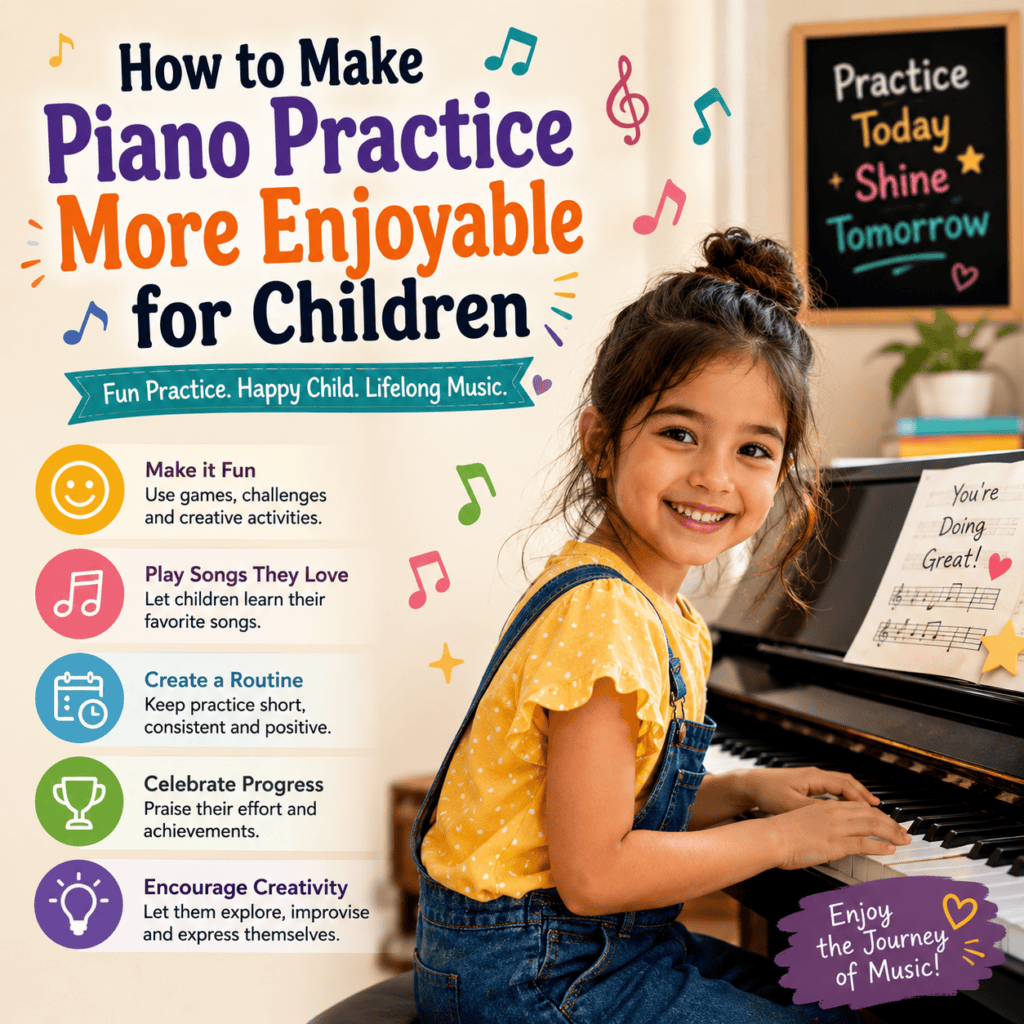
How to Make Piano Practice More Enjoyable for Children
Learning to play the piano can be an exciting experience for children, but regular practice can sometimes feel repetitive or difficult. Knowing how to make piano practice more enjoyable for children can help parents and teachers create a positive learning environment where children look forward to sitting at the piano. Instead of treating practice as a daily obligation, children can be encouraged to see it as an opportunity to explore music, learn new skills, play familiar songs, and express their creativity.
A successful piano practice routine does not always need to involve long hours at the instrument. What matters more is creating focused, engaging, and age-appropriate practice sessions. By introducing games, small challenges, musical choices, rewards, and variety, parents can help children develop consistent practice habits without making them feel pressured. With the right approach, piano practice can become one of the most enjoyable parts of a child’s musical education.
1. Make Piano Practice Enjoyable for Children With a Routine That Fits Them
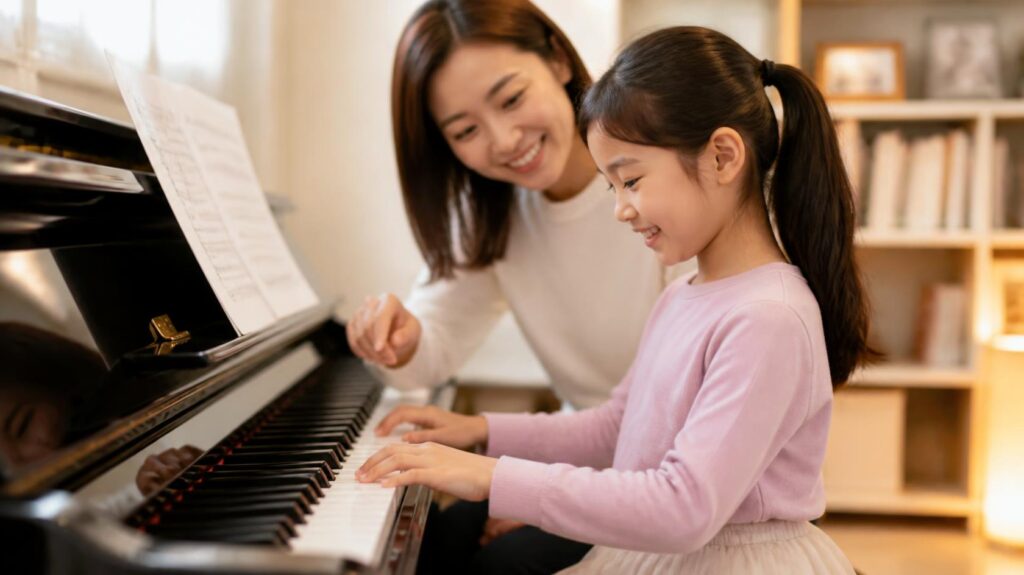
One of the simplest ways to make piano practice more enjoyable for children is to create a routine that feels manageable and predictable. Children often respond better when they know when practice will happen and what they are expected to accomplish. Instead of suddenly asking a child to practise for a long period, choose a regular time that works naturally with their school, homework, meals, and relaxation schedule. A short and focused practice session can be much more productive than a long session in which the child becomes tired or distracted.
The practice routine should also be appropriate for the child’s age and current ability. Younger beginners may benefit from shorter sessions with frequent changes in activity, while older children may be able to concentrate for longer periods. Parents can divide practice into sections such as warm-up exercises, scales or technique, a current song, and a fun activity. This structure gives children a clear sense of progress while preventing the session from becoming monotonous. A consistent routine can also gradually help children develop the discipline needed to practise independently.
2. Let Children Choose Some of the Music They Play
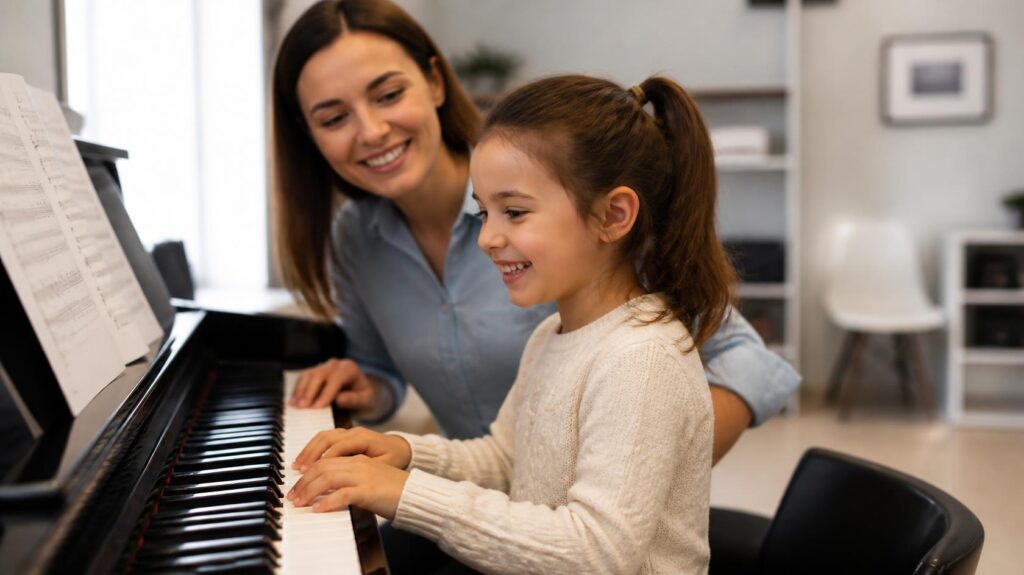
Children are naturally more motivated when they have some control over what they are learning. Although a structured piano syllabus is important for developing technique and musical understanding, children should also have opportunities to play songs that they personally enjoy. A favourite movie theme, children’s song, popular melody, worship song, or simple version of a familiar piece can give them an exciting reason to practise. To make piano practice enjoyable for children, parents and teachers can include familiar songs that match the child’s interests and musical preferences.
Giving children choices can make a significant difference in their attitude toward the instrument. For example, parents can ask whether the child would like to practise a particular song first or choose between two pieces. Even small decisions can make practice feel more personal. When children become emotionally connected to a piece of music, they are often more willing to repeat difficult sections because they want to hear themselves improve.
Children can build stronger motivation when they learn songs they genuinely enjoy, making personalised piano lessons a valuable part of their musical development.
3. Make Piano Practice Enjoyable for Children Through Musical Games
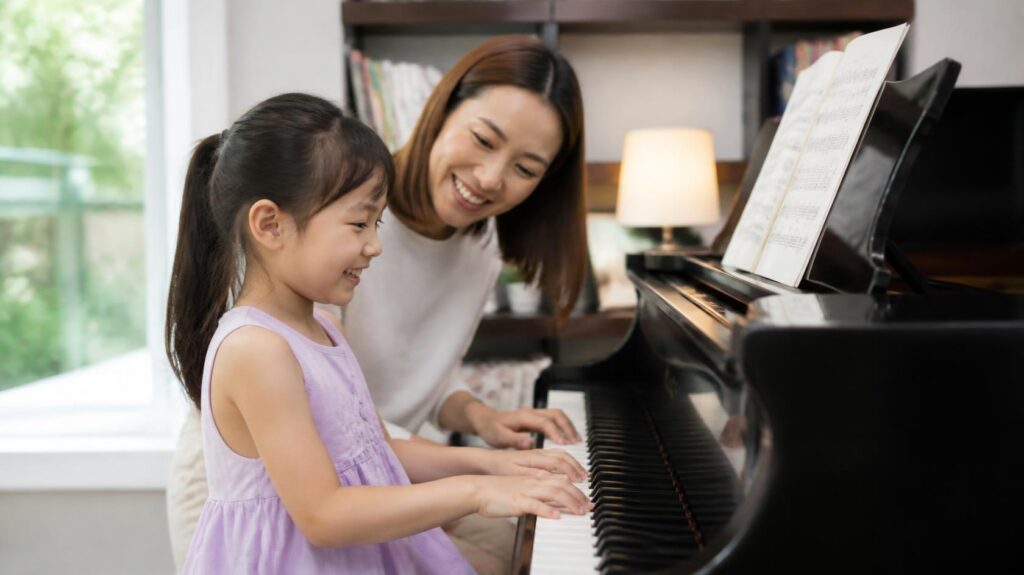
Games can transform repetitive exercises into enjoyable musical challenges. Instead of simply asking a child to repeat a difficult passage several times, parents and teachers can introduce small goals and challenges. A child might try to play a section without stopping, identify notes correctly within a certain amount of time, maintain a steady rhythm, or complete a passage three times with accurate fingering. To make piano practice enjoyable for children, these small challenges can turn everyday exercises into exciting activities that give children a clear sense of achievement.
Rhythm games can also make practice more interactive. Children can clap rhythms before playing them, tap along with a metronome, identify high and low notes, or create simple rhythmic patterns of their own. Flashcards, musical quizzes, note-recognition activities, and ear-training games can also be included between playing activities. These exercises help develop important musical skills while making the practice session feel less like repetitive drilling.
Fun piano practice games can help children develop rhythm, note recognition, coordination, and musical confidence while keeping their attention focused.
4. Break Difficult Piano Pieces Into Smaller Goals
A difficult piano piece can quickly become frustrating when a child tries to learn the entire composition at once. Breaking the piece into smaller sections makes the learning process more manageable and allows children to experience frequent moments of success. Instead of focusing on completing the whole song, choose a short phrase, a few measures, or a specific technical challenge for each practice session.
Small goals are particularly effective because children can clearly see their progress. For example, one day might focus on learning the right-hand melody, while another session concentrates on the left-hand accompaniment. Once both hands are comfortable separately, the child can begin combining them slowly. Difficult passages can then be practised at a comfortable tempo before gradually increasing speed.
Learning challenging piano pieces step by step can help children improve accuracy, coordination, and confidence without feeling overwhelmed by the entire composition.
5. Make Piano Practice Enjoyable for Children With Rewards and Positive Encouragement
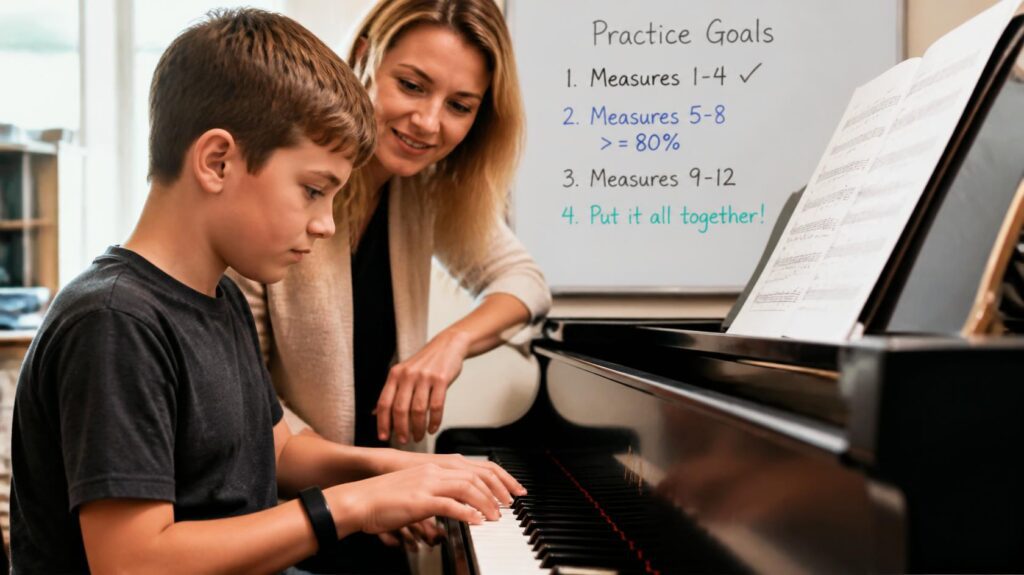
Positive encouragement can have a powerful effect on a child’s motivation. Rather than focusing only on mistakes, parents can recognise effort, improvement, concentration, and consistency. Saying something as simple as “Your rhythm was much steadier today” or “You played that difficult section more confidently than yesterday” helps children understand that progress is more important than perfection.
Small reward systems can also make practice exciting, particularly for younger learners. Children could collect points or stickers for completing specific practice goals, learning a section, or practising independently. The reward does not always need to be a physical item. Choosing the next song, performing for a family member, playing a favourite piece, or enjoying additional creative time at the piano can also serve as meaningful rewards.
The goal should not be to make children dependent on rewards. Instead, rewards should gradually help them recognise the satisfaction that comes from improvement. Over time, seeing themselves play something that was previously difficult can become the strongest motivation of all.
6. Encourage Children to Perform for Family and Friends
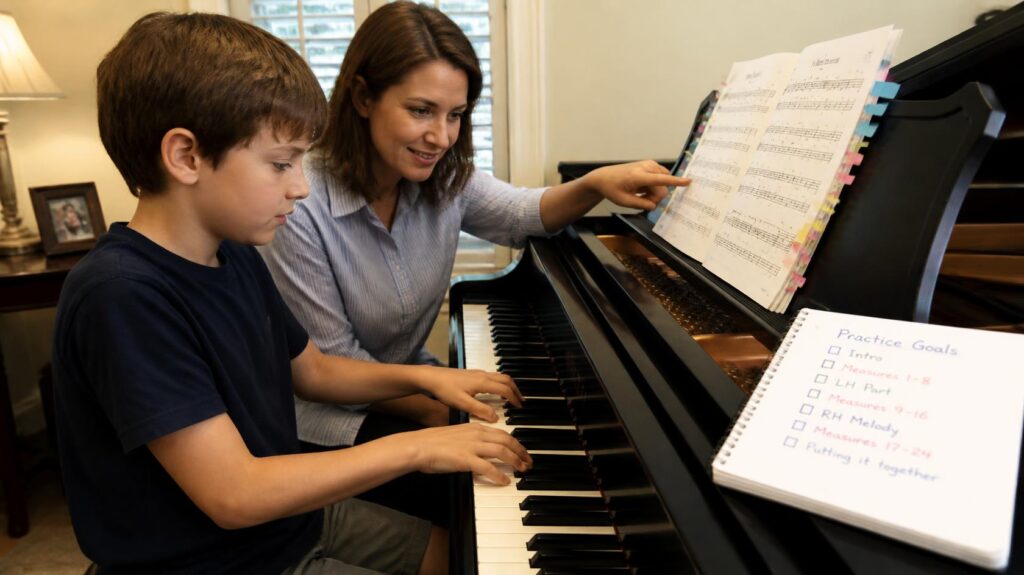
Performance opportunities can give children a meaningful reason to practise. A child who knows that they will perform a favourite song for their parents, grandparents, siblings, or friends may become more interested in improving the piece. These performances do not need to be formal concerts. A short family performance at home can be enough to create excitement and a sense of achievement.
Parents should keep these performances positive and relaxed. The purpose is not to judge every mistake but to celebrate the child’s effort and musical development. Recording a performance can also allow children to hear their own progress over time. Looking back at an older recording and comparing it with a newer performance can show children how much they have improved.
Regular performance opportunities can help children build piano confidence while giving their daily practice a clear and motivating purpose.
7. Make Piano Practice Enjoyable for Children Through Creative and Interactive Activities
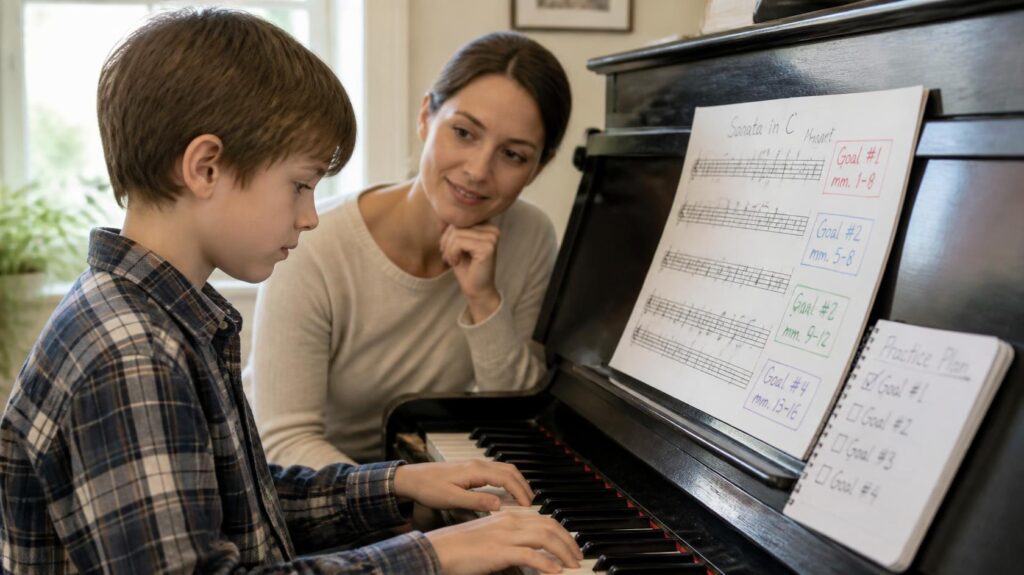
Piano practice does not always have to mean following the same exercises in the same order every day. Creativity can make sessions much more engaging. Children can be encouraged to improvise melodies, create simple compositions, experiment with different rhythms, play a melody in different octaves, or invent their own musical endings.
Parents can also ask creative questions such as, “Can you make this melody sound happy?” or “Can you create a short melody using these notes?” These activities encourage children to think of the piano as an instrument for creativity rather than simply a tool for reproducing written music.
Creative piano activities can help children develop musical expression, improvisation skills, and confidence beyond traditional practice exercises.
8. Create a Positive Learning Environment at Home
The environment surrounding piano practice can influence how children feel about learning music. A comfortable piano area with good lighting, an appropriate seat, and minimal distractions can make it easier for children to concentrate. Parents should also avoid turning every practice session into a correction session. Constantly pointing out mistakes can make children anxious about playing and may reduce their willingness to experiment.
Instead, parents can encourage a balanced approach: correct important technical issues, recognise progress, and leave room for enjoyment. If a child is particularly tired or frustrated, taking a short break can be more productive than forcing them to continue. The objective is to build a healthy relationship with music that can continue for years.
Children learn differently, so an approach that works for one child may not work for another. Some children respond to games and challenges, while others prefer learning songs, improvising, or performing. Paying attention to a child’s interests and learning style can help parents and teachers create a practice routine that feels encouraging rather than demanding.
Make Piano Practice a Positive Part of Childhood
Knowing how to make piano practice more enjoyable for children is ultimately about creating a balance between discipline and enjoyment. Children need regular practice to develop technique, coordination, rhythm, sight-reading, and musical understanding, but they also need opportunities to explore music in ways that feel exciting and personal.
Short practice sessions, achievable goals, favourite songs, musical games, creative activities, positive encouragement, and informal performances can all make a difference. Most importantly, children should understand that mistakes are a normal part of learning. When they feel supported rather than pressured, they are more likely to practise consistently and develop a lasting interest in music.
With the right guidance and an engaging learning environment, piano practice can become much more than a daily task. It can become a time when children discover new music, express themselves creatively, celebrate their progress, and gradually build the confidence to play with greater independence.
For more information and exciting resources about learning music, visit our website at The Mystic Keys. For more music content and exciting offers follow us on
Facebook, Instagram, YouTube, LinkedIn, Twitter, Pinterest, and Threads.