
Signature Guitar Tone | How to Find Yours Without Expensive Gear
Signature Guitar Tone | How to Find Yours Without Expensive Gear
Every guitarist dreams of a tone that’s unmistakably their own – a sound that’s instantly recognizable, uniquely expressive, and seems to speak directly from their fingers. Yet, too often, players assume that achieving this signature guitar tone requires expensive boutique pedals, rare amps, or vintage guitars. While gear can help, the real magic comes from something far more accessible: your hands, your ears, and your creativity.
The good news is that finding your tone isn’t about the price tag—it’s about exploration, experimentation, and understanding your own playing. In this guide, we’ll walk through practical ways to discover your signature guitar tone without spending a fortune, helping you unlock a sound that’s truly yours.

Understanding Your Own Sound
Before thinking about gear, start with yourself. Your playing style – the way you strum, pick, or bend notes – is the foundation of your signature guitar tone. Are you drawn to warm, smooth melodies, or sharp, aggressive riffs? Recognizing these tendencies allows you to make tonal decisions that truly reflect your style.
Listening critically to recordings of your playing can be eye-opening. Instead of judging “good” or “bad,” pay attention to moments where your guitar feels alive. These moments often hint at the tonal qualities that resonate most with you. Once you know what naturally works for your playing, everything else – from gear to effects – becomes easier to refine.

Making the Most of What You Already Own
You don’t need a wall of pedals or a vintage amp to craft a distinctive sound. Most guitars and amps, even budget-friendly ones, are capable of producing professional tones when used effectively.
Small adjustments make a big difference. Experiment with your guitar’s setup – string gauge, pickup height, and action. Adjusting your amp’s EQ can drastically change your tone: slightly more mids can make your guitar cut through the mix, while rolling off treble can warm the sound. Even simple techniques like rolling down the tone knob or palm muting can add unique character.
The key is learning your instrument and amp intimately. When you understand how they respond, your signature guitar tone starts to emerge naturally, without relying on expensive gear.

Developing Your Technique to Enhance Your Signature Guitar Tone
Your hands are the most important tools when it comes to shaping a signature guitar tone, and understanding how each subtle movement affects your sound is key. Every detail—from finger placement and pick angle to attack strength and vibrato—contributes to the character of each note. Legendary guitarists like Jimi Hendrix, Eric Clapton, and John Mayer illustrate this perfectly: their iconic sounds weren’t solely the result of expensive gear, but of how they interacted with their instruments.
Equally important are right-hand dynamics. Shifting where you pick along the strings changes the tonal color dramatically: closer to the bridge, notes become sharp and biting, while near the neck, they bloom with warmth. Meanwhile, left-hand techniques such as slides, bends, hammer-ons, and vibrato add another layer of individuality, making every phrase feel personal and expressive. By focusing on technique as your primary tone-shaping tool, you can craft a sound that is unmistakably yours, proving that even the simplest gear can deliver a truly distinctive signature guitar tone.

Exploring Effects Without Overspending for a Signature Guitar Tone
Effects pedals and amp simulators can enhance your tone, but the key is experimentation, not accumulation. A single overdrive, delay, or reverb pedal can be enough if you understand how it interacts with your playing.
Digital effects have also made it easier to experiment affordably. Software amp simulators or free plugins can emulate boutique amps and pedals without spending a dime. The real focus should be on understanding how different effects shape dynamics, sustain, and tonal character. In this way, your signature guitar tone becomes a product of creativity, not cost.

Recording and Listening – A Crucial Step Toward Your Signature Guitar Tone
Recording yourself regularly is one of the best ways to refine your tone. It provides objectivity, revealing subtleties in your playing that might be missed live. As you listen back, identify moments where your guitar naturally sings. Which tones feel expressive? Which dynamics stand out?
Intentional listening to your favorite guitarists also helps. Study phrasing, dynamics, and articulation – not the gear – to understand how they make their tone distinct. Over time, combining self-analysis with inspiration from others sharpens your ability to define and control your own signature guitar tone.
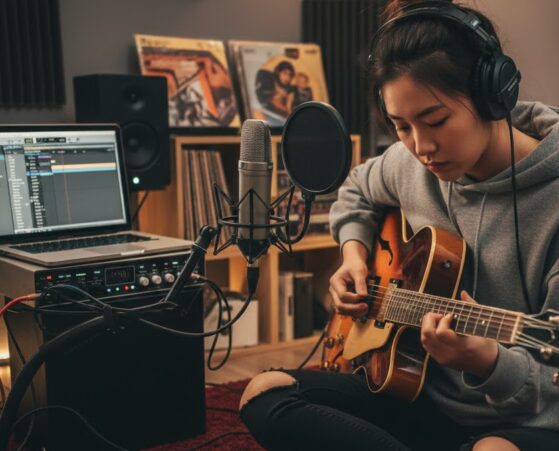
Experimenting With Style and Dynamics to Discover Your Signature Guitar Tone
Your hands are your most important tools. Pick attack, finger placement, vibrato, slides, and bends all dramatically shape your tone. Legendary players like Jimi Hendrix and John Mayer crafted iconic sounds through technique rather than gear.
Right-hand dynamics change everything: picking near the bridge gives a sharper, brighter sound, while picking near the neck adds warmth. Left-hand techniques, from slides to micro-bends, allow notes to sing with personality. By mastering these nuances, you create a tone that is truly yours, regardless of your setup.
Tone isn’t just about the instrument or effects; it’s also about how you use them. Experiment with different musical styles, alternate tunings, or varied dynamics. A clean fingerstyle passage followed by a distorted riff can reveal new aspects of your tone. Even small tweaks, like picking slightly harder or softening your touch, can make your playing feel fresh and more personal.
Embracing experimentation encourages creativity and helps you move beyond imitation. Your signature guitar tone evolves naturally as you push boundaries and adapt your style. Each experiment, no matter how small, adds a layer to your personal sound and brings you closer to a tone that feels like an extension of yourself.

Conclusion | Your Signature Guitar Tone Is in Your Hands
Finding your signature guitar tone doesn’t require expensive gear. It’s shaped by your playing, your technique, your listening skills, and your willingness to experiment. By understanding your instrument, refining your hands, and exploring both style and dynamics, your unique sound emerges naturally.
Remember: legendary tones weren’t purchased—they were developed. Your tone is waiting to be discovered, and it starts with curiosity, practice, and imagination. Through Guitar Lessons Online at The Mystic Keys, you can unlock this journey, exploring the full potential of your playing and discovering a sound that is unmistakably yours.
For more information and exciting resources about learning music, visit our website at The Mystic Keys. For more music content and exciting offers follow us on
Facebook, Instagram, YouTube, LinkedIn, Twitter, Pinterest, and Threads.