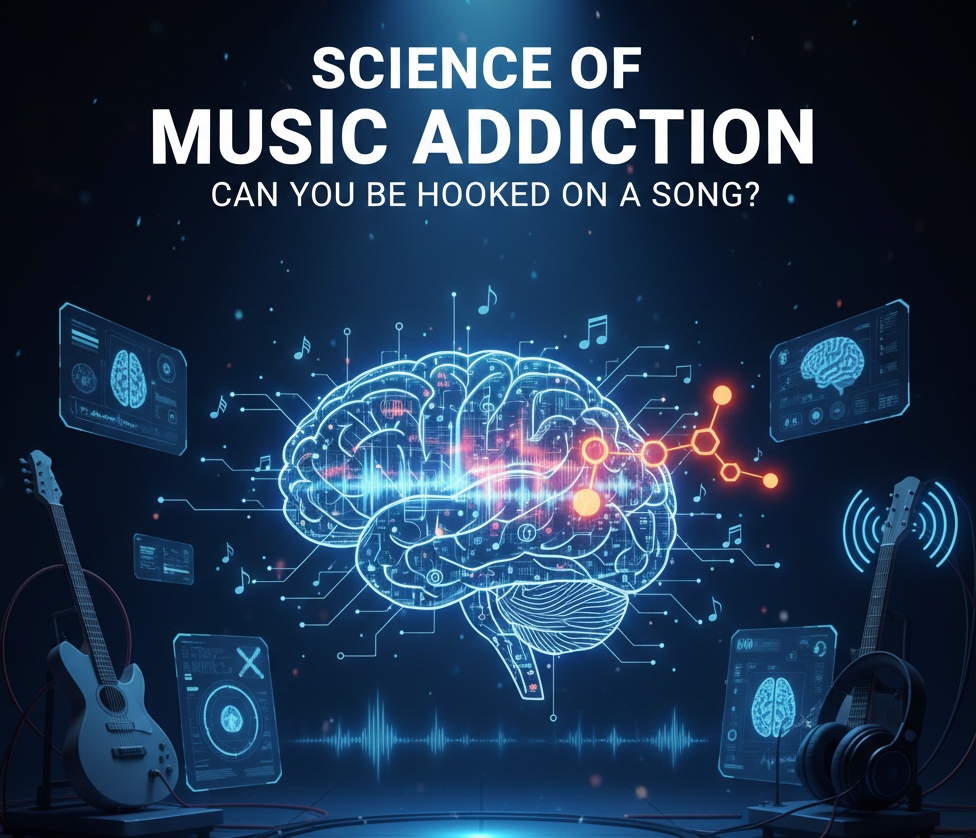
Science of Music Addiction | Can You Be Hooked on a Song?
Science of Music Addiction | Can You Be Hooked on a Song?
You press play once, then immediately hit replay. Before you realize it, the song takes over your entire day—looping through your thoughts while you work, travel, or lie awake at night. According to the Science of Music, this isn’t just casual listening; it’s your brain responding to patterns, rhythm, and anticipation. You’re no longer simply enjoying the sound—the music is actively pulling you back, almost compelling you to listen again.
This intense connection with certain songs goes far beyond personal taste or a passing mood. Beneath the surface, the Science of Music reveals how sound engages emotion, memory, and the brain’s reward systems at the same time. What feels like a harmless obsession is actually a powerful neurological response. So when a song feels impossible to let go of, it isn’t an exaggeration—it’s neuroscience at work.

Understanding Music Addiction Through the Science of Music
When we talk about addiction, we often think of substances and chemical dependence. Music, of course, doesn’t fit that mold. Yet psychologists recognize something called behavioral reinforcement, where certain activities become deeply rewarding and habit-forming without involving drugs or alcohol.
The science of music helps explain why listening can feel so compulsive. Music stimulates multiple areas of the brain simultaneously—those responsible for hearing, movement, emotion, and memory. Few other stimuli manage this level of total engagement. Over time, the brain begins to associate specific songs with pleasure or relief, reinforcing the urge to return to them again and again.
This isn’t weakness or lack of self-control; it’s a natural response to a stimulus designed—intentionally or not—to captivate the human brain.

The Science of Music and the Dopamine Loop
At the core of music’s irresistible pull lies dopamine, the brain’s primary “reward” chemical. Dopamine is often misunderstood as a pleasure molecule, but it’s more accurately a motivation signal. It pushes us to seek experiences we’ve enjoyed before.
The science of music shows that dopamine release doesn’t just happen when a song reaches its emotional peak. It begins before the peak, as the brain predicts what’s coming next. That buildup—the anticipation of a chorus, a beat drop, or a familiar lyric—is often just as satisfying as the moment itself.
This prediction-and-reward loop explains why you crave a song even when it isn’t playing. Each replay strengthens the neural pathway, making the urge feel automatic. In this way, music mirrors the reward cycles seen in other habit-forming behaviors—only in a far gentler, more emotionally rich form.

Why the Science of Music Explains Catchy Songs
Not all songs become obsessions, and the science of music helps clarify why some tracks latch onto our minds more stubbornly than others. Catchy songs tend to balance familiarity and novelty. They’re predictable enough for the brain to follow easily, yet surprising enough to remain interesting.
Repetition plays a major role here. Repeated melodies and lyrics make songs easier to remember, while rhythmic consistency encourages mental and even physical synchronization. Meanwhile, small variations—like a sudden pause or shift in melody—keep the brain alert and engaged.
Emotion seals the deal. When a song becomes linked to a personal memory or feeling, the brain encodes it more deeply. Listening to it again doesn’t just recreate the sound; it recreates the emotional state attached to it. That emotional shortcut is often what transforms casual enjoyment into something that feels like attachment.

Earworms and Obsessive Replays
If you’ve ever had a song looping endlessly in your head, you’ve experienced an earworm. According to the science of music cognition, earworms occur because the brain treats music as an incomplete pattern it wants to resolve.
Songs with simple structures, repeated phrases, and steady tempos are especially prone to this. The brain keeps replaying the tune in an attempt to “finish” it, even when no actual sound is present. Ironically, trying to force the song out of your head often makes it return more strongly.
This internal replay can drive people to listen to the song repeatedly, not just for pleasure but for mental relief. In this way, earworms blur the line between passive enjoyment and active compulsion, making the experience of being “hooked” feel very real.

Is Music Addiction Harmful According to the Science of Music?
From a scientific standpoint, being attached to music is rarely harmful. In fact, the science of music consistently highlights its benefits—stress reduction, emotional regulation, improved focus, and even pain management. For many people, replaying a favorite song is a form of self-soothing.
Problems only arise when music becomes a form of avoidance rather than expression. If someone relies on a song to escape emotions they’re unwilling to confront, the issue isn’t the music itself but what it’s being used for. Even then, music often acts as a bridge, helping people process feelings gradually rather than all at once.
Understanding this context reframes music addiction as something far more nuanced than a simple loss of control.

Can You Break Free from a Song—If You Want To?
Interestingly, the science of music suggests that the best way to reduce a song’s hold isn’t to avoid it completely. Listening to the track in full—without skipping or replaying favorite moments—can give the brain a sense of closure.
Introducing new musical styles or switching to instrumental music can also disrupt repetitive auditory patterns. Most importantly, reflecting on why a song resonates—what memory or emotion it carries—often weakens its grip. Awareness transforms compulsion into choice.

So, Can You Really Be Hooked on a Song?
The science of music shows that while songs may not cause addiction in a clinical sense, they do create powerful, habit-forming bonds. Music actively engages dopamine-driven reward loops, taps into emotional memory, and feeds the brain’s deep love for patterns—pulling listeners back again and again.
Rather than something to fight, this pull reveals music’s extraordinary influence on the human mind. Being hooked on a song isn’t a weakness; it’s proof that sound can shape emotion, memory, and motivation with remarkable precision. As platforms like The Mystic Keys explore, music doesn’t just entertain—it connects, heals, and resonates on a deeply personal level.
Sometimes, pressing replay isn’t indulgence at all. It’s simply your brain reaching for a feeling it already knows—and wants to feel once more.
For more information and exciting resources about learning music, visit our website at The Mystic Keys. For more music content and exciting offers follow us on
Facebook, Instagram, YouTube, LinkedIn, Twitter, Pinterest, and Threads.