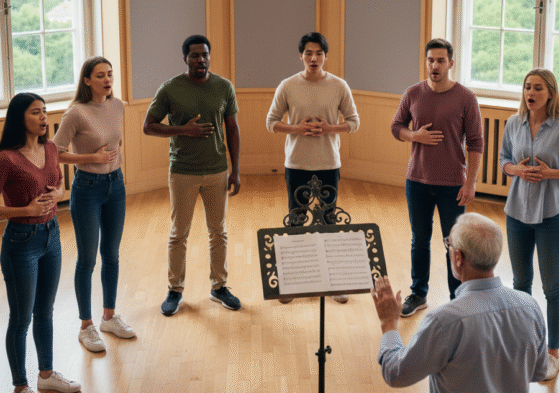
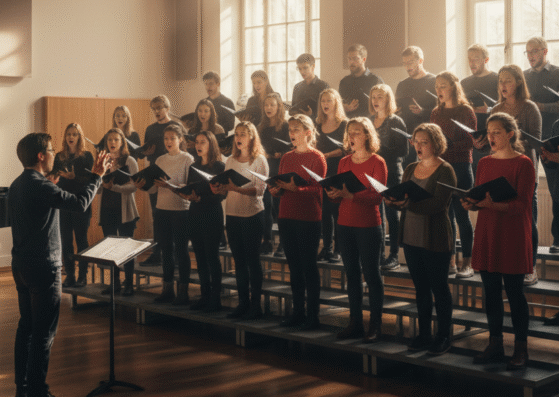
Every choir rehearsal begins long before the first note of a song is sung. It begins with preparation—of the body, the breath, and the voice. Because the voice is a living instrument, it cannot be switched on instantly. Vocal warm-ups serve as the bridge between silence and singing, helping choir members move into sound safely, confidently, and cohesively.
In a choral setting, warm-ups are especially important. They ensure that individual voices blend into a unified whole, allowing the choir to sing with clarity, balance, and expressive depth. When done correctly, vocal warm-ups don’t just protect the voice—they elevate the entire ensemble.
Why Vocal Warm-Ups Matter in a Choir Setting
In a choir, individual voices must function as one unified sound. This requires more than good pitch; it demands vocal flexibility, shared resonance, and healthy technique. Warm-ups help align these elements across all singers.
When a choir warms up together, it creates a shared physical and musical awareness. Breathing synchronizes, vowels unify, and tension begins to release. As a result, singers feel more connected—not just to their own voices, but to the ensemble as a whole. Over time, consistent warm-ups also build vocal stamina, making long rehearsals and performances far more sustainable.
Preparing the Body Before the Voice
Before a single note is sung, the body must be ready. Singing involves far more than the vocal cords; posture, alignment, and muscle freedom all play vital roles.
Gentle physical movements such as rolling the shoulders, loosening the neck, or stretching the spine help release unnecessary tension. When the body is aligned and relaxed, breath flows more easily and the voice responds with greater freedom. This physical preparation acts as a bridge between silence and sound,ensuring the voice is supported rather than forced.
Vocal Warm-Ups That Build Breath Awareness and Support
Once the body feels awake, attention naturally shifts to the breath. Breath is the foundation of all singing, especially in a choir where sustained phrases and unified cut-offs depend on controlled airflow.
Simple breathing exercises—such as slow inhalations followed by controlled exhales on a hiss or hum—train singers to manage breath efficiently. These exercises encourage diaphragmatic breathing rather than shallow chest breathing, allowing for better tone production and longer phrases. Over time, breath-focused warm-ups help choir members sing with greater ease and consistency, regardless of vocal range.
Gentle Vocal Activation Through Resonance
Once singers establish their breath, they awaken their voices. They should progress gradually through this phase, allowing the vocal cords to coordinate smoothly.
Exercises like humming or lip trills introduce sound in a relaxed, low-impact way. These resonant sounds naturally promote healthy placement and minimize tension in the throat and jaw. As singers explore comfortable pitch ranges, they make their voices more flexible and responsive. In a choir, this step also sharpens listening skills, helping members match pitch and blend tones early in the rehearsal.
Vocal Warm-Ups for Vowel Unification and Blend
A strong choir defines itself through consistent vowels. Even perfectly accurate pitches lose focus when singers shape vowels differently across sections. Vocal warm-ups that emphasize vowels help singers create a unified, cohesive choral sound.
When choir members sing sustained vowels or simple melodic patterns, they actively adjust mouth shape, resonance, and tone color together. These exercises train singers to hear how their individual voices contribute to the ensemble, improving blend, clarity, and expressiveness throughout the group.
Expanding Range with Care
After the voice is fully engaged, range extension can begin—but always with caution. This phase should feel like a natural expansion rather than a push.
Gradual scale patterns that move upward and downward help stretch the voice safely. Choir members learn to navigate their registers smoothly, reducing breaks or strain. Importantly, these exercises should never be competitive. Each singer works within their own comfortable range while contributing to the collective sound, ensuring vocal health and confidence across the ensemble.
Articulation and Text Readiness
Since rehearsals often focus on lyrics and expression, warm-ups actively prepare singers for clear articulation. Choir members move their lips, tongue, and jaw freely to shape consonants accurately.
Simple diction exercises that repeat consonant-vowel combinations energize the facial muscles. These exercises improve clarity and inject a sense of playfulness and alertness into the rehearsal. When singers warm up their articulation properly, they focus on musicality instead of struggling with the text later.
Bringing It All Together
A well-structured vocal warm-up actively shapes the focus and energy of the entire rehearsal or performance, not just individual voices. As choir members progress from physical alignment to breath, sound, resonance, and articulation, they engage their voices deliberately and enter the music fully prepared. This intentional sequence helps singers release tension, sharpen their listening skills, and respond more freely to the conductor’s guidance.
Over time, these warm-ups evolve into familiar rituals that build trust, strengthen ensemble unity, and enhance vocal confidence. They encourage consistency across rehearsals and create a shared sense of purpose among singers. Above all, they remind choir members to care for their voices and affirm that great choral singing begins long before the first piece is performed.
Final Thoughts
Vocal warm-ups are not optional extras; they form the foundation of healthy and effective choral singing. When choirs commit to consistent, thoughtful warm-up routines—like those emphasized at The Mystic Keys—they protect their voices while enhancing blend, balance, and overall sound quality. These practices turn rehearsals into focused, engaging, and musically fulfilling experiences.
Every choir member, regardless of age, experience, or vocal range, gains from taking the time to warm up properly. When singers prepare their voices together, they build strength, confidence, and unity. A choir that warms up as one does more than sing better—it sings healthier, stronger, and with greater beauty and purpose.
For more information and exciting resources about learning music, visit our website at The Mystic Keys. For more music content and exciting offers follow us on
Top 10 Iconic Guitarists and What You Can Learn from Them
The history of modern music has been shaped by iconic guitarists whose sound, technique, and creativity changed the way the instrument is played and perceived. Studying iconic guitarists is not about imitation alone. It is about understanding how their musical choices, discipline, and innovation can inform your own guitar journey.
From expressive blues phrasing to groundbreaking rock techniques, iconic guitarists offer timeless lessons that apply to players at every level. By analyzing their approach, guitarists can improve tone, timing, creativity, and musical confidence.
Why Studying Iconic Guitarists Matters for Guitar Players
Learning from iconic guitarists provides more than inspiration. It offers practical insights into tone shaping, musical storytelling, and long-term artistic growth.
Key benefits include:
Understanding how technique serves expression
Learning the importance of tone and touch
Developing musical identity
Improving phrasing and dynamics
Gaining historical perspective on guitar styles
Each guitarist represents a unique approach that can strengthen your own playing.
Jimi Hendrix and the Power of Sonic Experimentation
Jimi Hendrix redefined what the electric guitar could do. His fearless experimentation with feedback, effects, and unconventional chord voicings expanded the instrument’s expressive range.
What you can learn:
Use effects as creative tools, not distractions
Explore chord embellishments within lead playing
Develop control over feedback and sustain
Focus on emotional impact rather than technical perfection
Hendrix’s playing teaches guitarists to think beyond traditional boundaries.
Eric Clapton and Expressive Blues Phrasing
Eric Clapton’s influence lies in his ability to make simple notes deeply expressive. His phrasing emphasizes feel, space, and melodic clarity.
What you can learn:
Prioritize phrasing over speed
Use bends and vibrato with intention
Leave space between phrases
Focus on tone consistency
Clapton demonstrates that emotional depth often outweighs technical complexity.
Jimmy Page and Creative Song-Oriented Guitar Playing
Jimmy Page combined technical skill with compositional brilliance. His guitar parts always served the song, whether through riffs, textures, or solos.
What you can learn:
Think compositionally when playing guitar
Use alternate tunings for inspiration
Layer guitar parts creatively
Balance rhythm and lead roles
Page’s approach shows how guitarists can contribute meaningfully to overall musical structure.
B.B. King and the Art of Musical Conversation
B.B. King’s guitar playing mirrored human speech. His phrasing, vibrato, and note choice conveyed emotion with remarkable clarity.
What you can learn:
Treat guitar phrases like sentences
Develop a distinctive vibrato
Focus on note choice rather than note count
Communicate emotion through simplicity
His style reminds guitarists that expression is the heart of music.
Carlos Santana and Melodic Sustain
Carlos Santana is known for his singing sustain and lyrical phrasing. His playing blends blues, Latin rhythms, and rock influences seamlessly.
What you can learn:
Aim for melodic continuity
Develop sustain through touch and tone
Use scales musically rather than mechanically
Let melodies evolve naturally
Santana’s approach encourages guitarists to focus on melody over technical display.
Eddie Van Halen and Technical Innovation
Eddie Van Halen revolutionized guitar technique through tapping, harmonics, and rhythmic precision. His innovations reshaped rock guitar playing.
What you can learn:
Explore new techniques responsibly
Combine rhythm and lead playing
Practice precision and timing
Use technical skills musically
Van Halen proves that innovation comes from curiosity and disciplined practice.
David Gilmour and Emotional Storytelling
David Gilmour’s solos are masterclasses in emotional storytelling. His phrasing emphasizes tone, dynamics, and melodic development.
What you can learn:
Build solos with a clear emotional arc
Use bends and vibrato expressively
Control dynamics carefully
Focus on tone shaping
Gilmour’s style shows how fewer notes can say more.
Slash and Memorable Guitar Riffs
Slash is known for creating instantly recognizable riffs and solos that blend blues and rock influences.
What you can learn:
Craft memorable riffs
Balance aggression with melody
Develop a signature tone
Use pentatonic scales creatively
Slash demonstrates how strong musical identity enhances recognition.
Mark Knopfler and Fingerstyle Precision
Mark Knopfler’s fingerstyle technique sets him apart from traditional pick players. His clean articulation and rhythmic control are central to his sound.
What you can learn:
Explore fingerstyle techniques
Improve right-hand control
Focus on articulation and clarity
Blend rhythm and melody fluidly
Knopfler’s playing emphasizes finesse over force.
John Mayer and Modern Blues Evolution
John Mayer bridges traditional blues with modern pop and rock sensibilities. His playing reflects deep musical knowledge and contemporary relevance.
What you can learn:
Blend traditional and modern influences
Develop dynamic control
Focus on clean tone articulation
Balance technique with songwriting
Mayer’s career highlights the importance of adaptability.
Understanding these shared traits helps guitarists refine their own approach.
How to Apply These Lessons to Your Own Guitar Practice
Studying iconic guitarists is most effective when applied intentionally.
Practical steps include:
Learning solos by ear
Analyzing phrasing and dynamics
Practicing slow, controlled expression
Experimenting with tone settings
Recording and reviewing your playing
Application transforms inspiration into progress.
Avoiding Imitation While Learning from Iconic Guitarists
While learning from legendary players is valuable, developing your own voice is essential.
Balance imitation by:
Combining influences
Adapting techniques to your style
Focusing on musical goals
Allowing personal expression to evolve naturally
Your identity emerges through informed exploration.
The Role of Education in Understanding Guitar Legends
Formal learning helps guitarists understand why iconic guitarists sound the way they do. Theory, technique, and ear training provide context that accelerates growth.
Structured guidance ensures lessons from legends are applied correctly and effectively.
Conclusion
Iconic guitarists have shaped music history through creativity, discipline, and emotional expression. By studying their techniques, phrasing, and musical mindset, guitarists can gain valuable insights that elevate both skill and artistry. Learning from these legends is not about copying their sound, but about understanding the principles that made them timeless.
For guitarists seeking structured growth while developing personal style, Guitar Lessons Online can provide the foundation needed to apply these lessons with confidence and clarity.
For more information and exciting resources about learning music, visit our website at The Mystic Keys. For more music content and exciting offers follow us on
DIY Guitar Customization: How to Modify Your Guitar at Home
Every guitarist eventually reaches a moment where their instrument feels familiar but limited. While buying a new guitar is one option, many players discover that thoughtful DIY guitar customization can dramatically improve tone, comfort, and personal connection to their instrument. Customizing a guitar at home allows musicians to shape their sound, refine playability, and develop a deeper understanding of how their instrument works.
DIY guitar customization is not about transforming your guitar into something unrecognizable. Instead, it is about making small, intentional modifications that enhance your playing experience while preserving the character of the instrument. With the right approach, patience, and knowledge, home guitar modifications can be safe, rewarding, and musically transformative.
Understanding DIY Guitar Customization Before You Begin
Before making any changes, it is important to understand what DIY guitar customization truly involves. Customization should always serve a musical purpose rather than being driven purely by aesthetics or experimentation.
Key principles to keep in mind include:
Modifying only what you understand
Starting with reversible changes
Prioritizing playability and tone
Respecting the guitar’s construction
A thoughtful approach ensures that modifications improve the instrument rather than introduce new problems.
Why Guitarists Choose DIY Guitar Customization
Many players assume customization is only for professionals, but beginners and intermediate players often benefit the most. DIY guitar customization allows players to adapt their instrument to their evolving technique and musical style.
Common reasons guitarists customize include:
Improving tuning stability
Enhancing tonal clarity
Increasing playing comfort
Personalizing the instrument’s feel
Learning how guitars function
Customization creates a stronger bond between the musician and the instrument, leading to more expressive playing.
Setting Realistic Expectations for Home Guitar Modifications
DIY guitar customization is not about instant perfection. Every modification requires careful testing and adjustment. Results may be subtle at first, but small improvements compound over time.
It is important to:
Accept gradual improvement
Test changes thoroughly
Avoid multiple modifications at once
Keep original parts when possible
Patience is one of the most valuable tools in guitar customization.
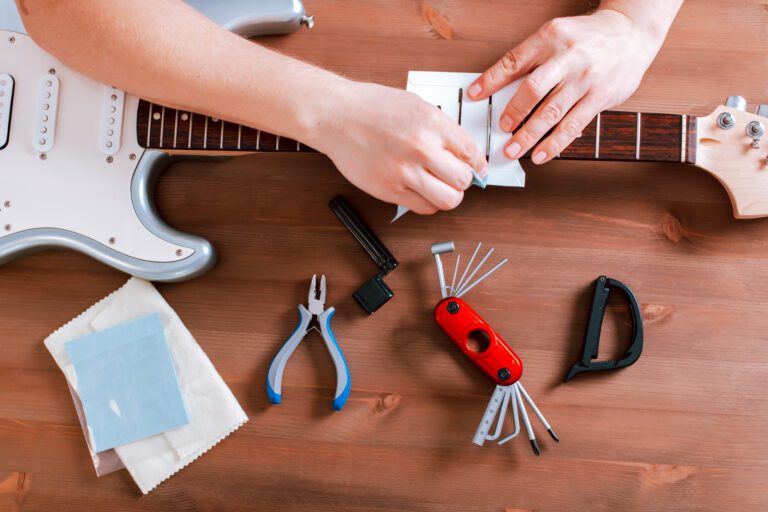
Basic Tools Needed for DIY Guitar Customization
Before beginning any guitar modification, assembling basic tools ensures safety and accuracy. You do not need advanced equipment to perform effective DIY guitar customization.
Essential tools include:
Screwdrivers in various sizes
String winder and wire cutters
Allen keys
Electronic tuner
Clean cloths
Contact cleaner for electronics
Using proper tools reduces the risk of damaging components.
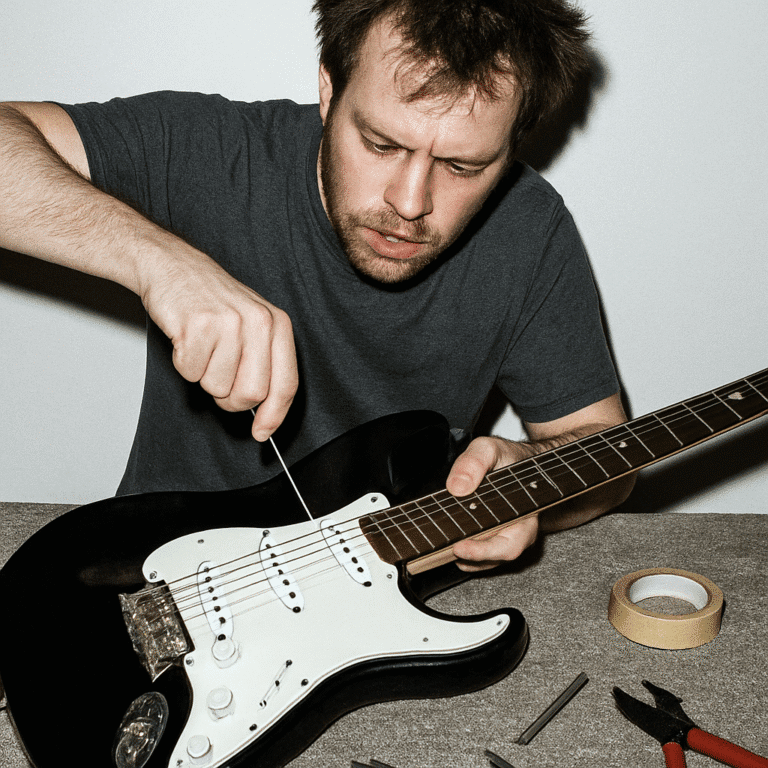
DIY Guitar Customization Through String Changes
One of the simplest yet most impactful modifications is changing strings. Many players underestimate how much strings influence tone and playability.
String customization allows you to:
Adjust string tension
Enhance brightness or warmth
Improve bending comfort
Match strings to musical style
Experimenting with string gauge and material is a safe entry point into DIY guitar customization.
Adjusting Guitar Action for Better Playability
Action refers to the height of the strings above the fretboard. Proper action makes playing easier while reducing unwanted fret buzz.
When adjusting action at home:
Make small changes gradually
Use manufacturer guidelines as reference
Test across the entire fretboard
Stop if resistance feels excessive
Correct action setup improves comfort and reduces hand fatigue.
Pickup Height Adjustment as a Tone Upgrade
Pickup height dramatically affects tone output and clarity. This modification is fully reversible and ideal for home customization.
Benefits of adjusting pickup height include:
Improved balance between strings
Enhanced sustain
Clearer articulation
Reduced muddiness
Listening carefully after each adjustment is essential to achieving the desired sound.
DIY Guitar Customization Through Nut Maintenance
The nut plays a crucial role in tuning stability and tone. Poorly maintained nuts cause tuning issues and string binding.
Simple nut-related improvements include:
Cleaning string slots
Applying graphite lubrication
Checking slot depth carefully
Major nut reshaping should be left to professionals, but maintenance is safe for home customization.
Upgrading Guitar Hardware at Home
Hardware upgrades can significantly improve reliability. While more advanced than basic adjustments, certain hardware changes are manageable with care.
Common DIY hardware upgrades include:
Replacing tuning machines
Changing control knobs
Installing strap locks
These modifications enhance stability and performance without altering the guitar’s core structure.
Electronics Customization for Better Sound Control
DIY guitar customization often includes electronics upgrades for players seeking tonal versatility.
This personal alignment supports long-term musical growth.
DIY Guitar Customization for Different Skill Levels
Customization evolves as skill develops. Beginners benefit from comfort adjustments, while advanced players refine tone and responsiveness.
Beginners often focus on:
Action setup
String selection
Tuning stability
Advanced players explore:
Pickup balancing
Electronics upgrades
Hardware precision
Each stage benefits from thoughtful modification.
The Role of Learning in Responsible Customization
Understanding music theory, technique, and instrument mechanics supports better customization decisions. Knowledge reduces risk and improves outcomes.
Learning guitar holistically ensures that customization enhances musicianship rather than compensates for weak fundamentals.
Conclusion
DIY guitar customization offers guitarists a powerful way to improve playability, tone, and personal connection with their instrument. By making informed, gradual, and purposeful modifications, players can transform their guitar into a more responsive and inspiring musical partner. When done responsibly, customization enhances both technical growth and creative expression.
For guitarists looking to strengthen fundamentals alongside practical instrument knowledge, Guitar Lessons Online can provide structured guidance that supports confident playing and long-term musical development.
For more information and exciting resources about learning music, visit our website at The Mystic Keys. For more music content and exciting offers follow us on
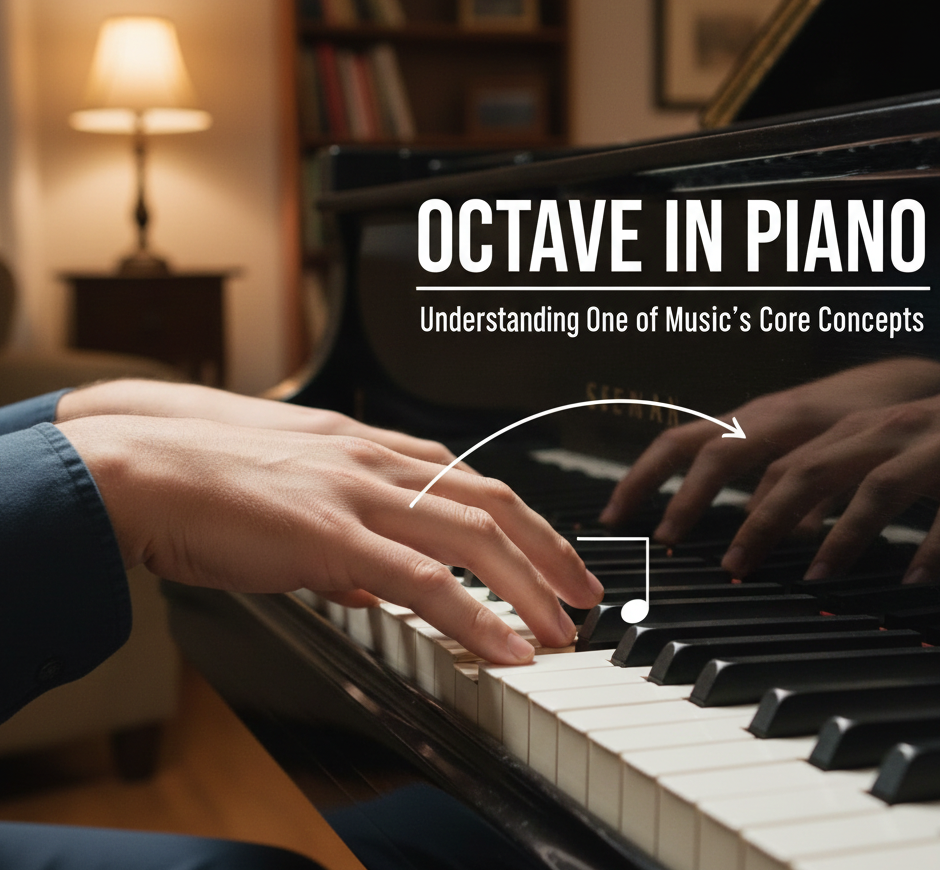
Octave in Piano | Understanding One of Music’s Core Concepts
Music often feels magical, but behind that magic lies a beautifully ordered system. One of the most important building blocks of this system—especially for pianists—is the octave. Whether you are just beginning your piano journey or revisiting fundamentals with fresh curiosity, understanding octaves will deepen how you hear, see, and play music. In this blog, we will explore what an octave is, how it appears on the piano, why it sounds the way it does, and how pianists use octaves musically and technically.
Understanding the Meaning of an Octave in Piano
An octave is the distance between one musical note and the next note with the same name, either higher or lower in pitch. For example, moving from one C to the next C above it is called an octave.
The word octave comes from the Latin octavus, meaning “eighth.”This refers to the higher note being the eighth when counting musical letters, including both the starting and ending note. More than the number, however, an octave is important because of how it sounds—notes an octave apart feel naturally connected, like the same note in different pitch ranges.
This similarity is not a coincidence. Notes an octave apart vibrate at frequencies that are exactly double or half of each other. Because of this, the human ear hears them as closely related, making octaves a fundamental part of musical structure across instruments and cultures.
Octave in Piano | Understanding the Keyboard Layout
The piano is one of the clearest instruments for understanding octaves. Its repeating pattern of white and black keys makes octaves easy to recognize once you know what to observe.
Each octave on the piano has 12 keys—seven white and five black. Together, these keys include all the notes used in Western music before the pattern repeats. A group of two black keys followed by three black keys is a clear sign of this octave structure.
If you begin on any note, such as C, and move up to the next C, you complete one octave. This repeating layout helps pianists move across the keyboard with confidence, identify intervals quickly, and understand the instrument’s layout more clearly.
Why an Octave in Piano Sounds the Same but Higher or Lower
One fascinating aspect of octaves is that, despite being higher or lower in pitch, they retain a strong sense of identity. A C played low on the keyboard and a C played high on the keyboard sound different in brightness and depth, yet they unmistakably feel like the same note.
This happens because of the mathematical relationship between their sound waves. When one note vibrates at twice the frequency of another, the ear naturally groups them together. In practical terms, this means octavesblend easily, sound stable,and feel resolved to the listener.
Because of this natural harmony, composers and performers frequently use octaves to reinforce melodies, create power, or add richness without introducing tension.
How Many Octaves Are There on a Piano?
A standard full-size piano has 88 keys, which span a little over seven octaves. The lowest note is A, and the highest note is C, meaning the instrument does not start and end exactly on the same letter name.
These octaves cover a wide range of sound—from deep, resonant bass notes to bright, bell-like treble tones. This vast range is one reason the piano is so versatile. It can carry melody, harmony, rhythm, and bass all at once, often using different octaves simultaneously.
Understanding where you are on this octave spectrum helps with reading music, controlling tone, and shaping musical expression.
Octave in Piano Playing Technique
Beyond theory, octaves play a major role in piano technique. Pianists frequently encounter passages where the same note is played simultaneously in two different octaves, often using the thumb and little finger of one hand.
Playing octaves requires a balance of strength, flexibility, and relaxation. While octaves can sound powerful and dramatic, they should never feel forced. Learning to move the hand smoothly across octave patterns is an essential skill, especially in advanced repertoire.
Over time, octave practice improves hand coordination and builds confidence across the keyboard, allowing pianists to tackle larger, more expressive musical gestures.
Musical Uses of Octaves
Octaves are not just technical tools; they are expressive devices. Composers use them in many ways to shape musical character. A melody doubled in octaves can sound bold and heroic, while soft octave passages can feel warm and expansive.
In accompaniment, octaves in the left hand often provide a strong harmonic foundation. In the right hand, octave melodies can project clearly over complex harmonies. Across styles—from classical and jazz to film music and pop—octaves help music sound fuller and more confident.
Their versatility makes them a favorite choice for emphasizing important musical moments.
Learning to Recognize and Use Octaves
For beginners, recognizing octaves starts with visual awareness. Noticing repeating key patterns and matching note names across the keyboard builds familiarity quickly. With time, the ear also learns to recognize the distinct sound of octaves, both when played together and when heard melodically.
As this understanding deepens, octaves stop feeling like a theoretical concept and start becoming a natural part of musical thinking. Pianists begin to sense where notes belong, how melodies can shift registers, and how sound changes across the keyboard.
Conclusion | Why Octaves Matter in Piano Music
An octave is more than the distance between two notes. It is a core principle that shapes how music is heard, organized, and performed. On the piano, octaves give structure to the keyboard, strengthen melodies, and add depth to musical expression—an idea strongly emphasized at The Mystic Keys through its Piano Lessons Online.
When pianists understand octaves, the keyboard begins to feel familiar and logical. Musical patterns become easier to recognize and play with confidence. From early lessons to advanced pieces, octaves quietly guide both the hands and the ears.
This understanding improves finger coordination and listening skills. It also helps pianists move smoothly across the keyboard. With consistent practice and guided learning, octaves become a natural part of expressive piano playing.
For more information and exciting resources about learning music, visit our website at The Mystic Keys. For more music content and exciting offers follow us on
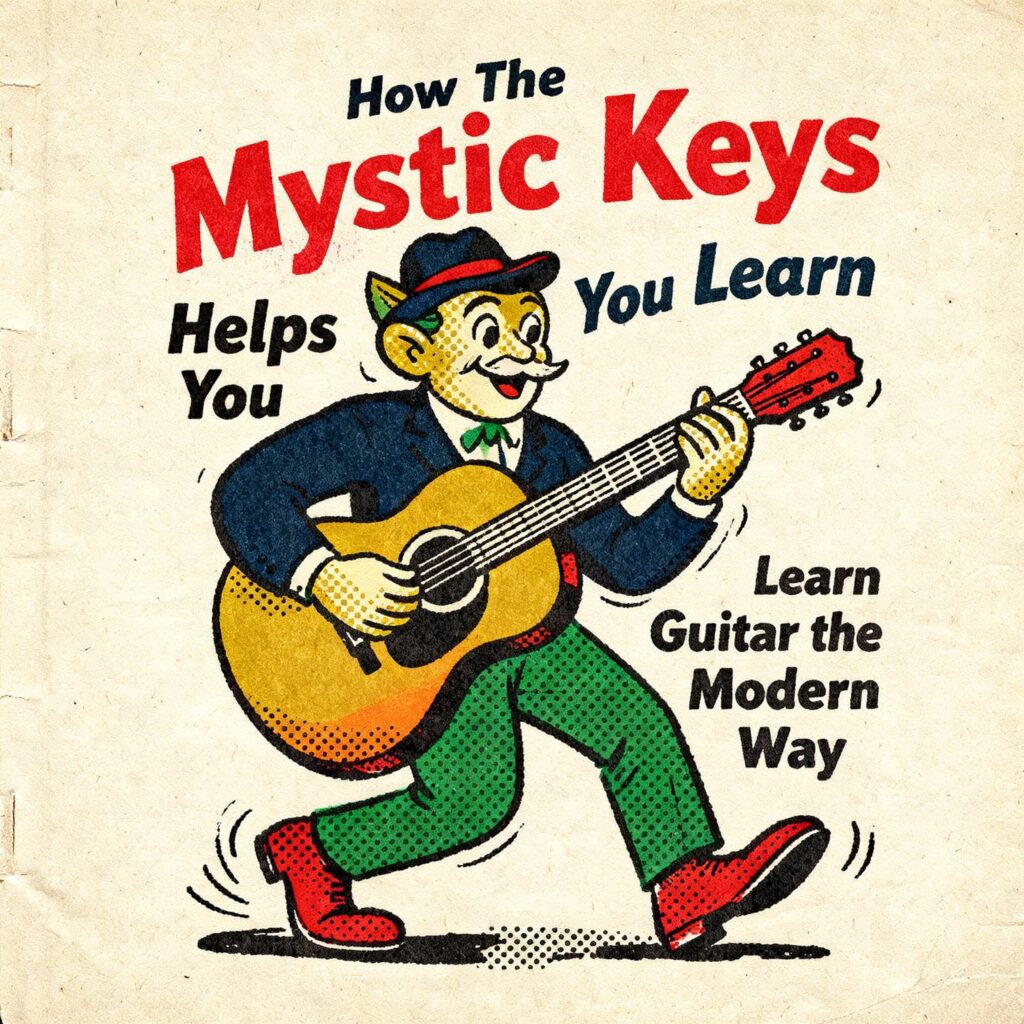
How The Mystic Keys Helps You Learn Guitar the Modern Way
Learning guitar today looks very different from how it did a decade ago. Traditional learning methods often relied on rigid schedules, printed books, and limited access to skilled instructors. In contrast, modern learners seek flexibility, clarity, and progress that fits into their real lives. This shift has led many aspiring musicians to look for platforms that help them learn guitar the modern way without compromising musical depth or discipline.
The Mystic Keys stands at the center of this evolution. By combining structured musical training with modern learning tools, it provides guitar students with an approach that is practical, accessible, and aligned with today’s learning habits. This blog explores how The Mystic Keys helps students learn guitar the modern way while still preserving strong musical foundations.
The Changing Landscape of Guitar Learning
The way people consume information has changed dramatically, and music education is no exception. Students today are more informed, more independent, and more selective about how they invest their time and effort.
Modern guitar learners value:
Flexible learning schedules
Clear, step-by-step guidance
Practical application over memorization
Visual and repeatable instruction
Freedom to learn at their own pace
The Mystic Keys recognizes these needs and designs its guitar programs to reflect how musicians actually learn in the digital age.
Learning Guitar the Modern Way Starts with Structure
One common misconception about modern learning is that flexibility means a lack of structure. In reality, effective modern learning requires even stronger organization to avoid confusion and inconsistency.
The Mystic Keys helps students learn guitar the modern way by offering:
Clear learning pathways from beginner to advanced levels
Logical progression of techniques
Purpose-driven practice routines
Skill-based lesson organization
Instead of overwhelming students with random lessons, each concept builds naturally on the previous one, ensuring steady growth and confidence.
Why Traditional Guitar Learning Often Feels Limiting
Many students begin their guitar journey through traditional methods and quickly feel stuck. This is not due to a lack of talent, but rather outdated teaching approaches that no longer match how students learn best.
Common limitations include:
Fixed class timings that disrupt consistency
One-size-fits-all lesson pacing
Limited revision opportunities
Heavy reliance on theory without application
Lack of engagement outside the lesson hour
Learning guitar the modern way means removing these barriers and allowing students to stay connected to music beyond a classroom environment.
How The Mystic Keys Uses Modern Teaching Philosophy
The Mystic Keys follows a student-centered learning philosophy. This means lessons are designed around how learners absorb, practice, and apply information rather than how teachers traditionally deliver it.
Key principles include:
Learning by doing, not just watching
Encouraging active listening and self-correction
Building musical awareness alongside technique
Developing confidence through repetition and clarity
This approach allows students to grow into independent musicians rather than dependent learners.
Visual Learning That Enhances Guitar Technique
One of the strongest advantages of modern guitar education is visual learning. Seeing finger placement, hand posture, and movement clearly helps students avoid common mistakes.
The Mystic Keys supports this by:
Demonstrating techniques from clear angles
Breaking down complex movements into simple steps
Allowing students to replay lessons as needed
Encouraging slow, mindful practice
This visual clarity is a key reason students feel more confident when they learn guitar the modern way.
Self-Paced Learning Without Losing Direction
Flexibility is valuable only when paired with guidance. Without direction, students may lose motivation or practice inefficiently.
The Mystic Keys balances flexibility and discipline by:
Offering guided lesson sequences
Providing practice recommendations
Encouraging goal-based learning
Supporting consistent progress tracking
Students remain in control of their time while still moving forward with purpose.
Developing Strong Guitar Foundations the Modern Way
Modern guitar learning does not mean skipping fundamentals. In fact, it places even greater emphasis on mastering the basics correctly.
The Mystic Keys focuses on:
Proper posture and hand positioning
Clean fretting and picking techniques
Timing, rhythm, and coordination
Musical listening skills
By building a strong technical foundation, students avoid long-term habits that limit growth later.
Technique Meets Musical Expression
Many traditional systems separate technique from creativity. Modern guitar education blends both from the beginning.
This adaptability ensures students stay connected to their instrument even during busy periods.
Encouraging Independent Musical Thinking
Modern guitarists are expected to think, listen, and adapt rather than simply copy.
The Mystic Keys promotes independent learning by:
Encouraging self-evaluation
Teaching students how to identify mistakes
Developing listening awareness
Helping learners understand why techniques work
This empowers students to grow beyond lessons and apply skills creatively.
Modern Guitar Learning Is About Confidence
Confidence plays a critical role in musical growth. Many learners struggle not because they lack ability, but because they doubt themselves.
The Mystic Keys builds confidence through:
Clear explanations that reduce confusion
Gradual difficulty progression
Reinforcement of small achievements
Supportive learning environment
When students understand what they are doing and why, confidence follows naturally.
Learning Guitar the Modern Way Through Consistency
Consistency is more important than intensity. Modern learning focuses on sustainable habits rather than short bursts of effort.
Students are guided to:
Practice regularly in manageable sessions
Focus on quality rather than speed
Build discipline without burnout
Stay motivated through visible progress
This long-term mindset leads to deeper musical growth.
How Technology Enhances Guitar Education
Technology, when used thoughtfully, enhances learning rather than replacing musical discipline.
The Mystic Keys integrates technology to:
Improve accessibility
Support revision and reinforcement
Encourage interactive learning
Provide consistent guidance
Rather than distracting from music, technology supports clarity and engagement.
Preparing Guitarists for Real Musical Situations
Modern guitarists often play in bands, worship teams, recordings, or live settings. Learning should reflect real musical demands.
The Mystic Keys prepares students by:
Teaching rhythm accuracy
Developing timing awareness
Encouraging ensemble sensitivity
Emphasizing musical responsibility
This practical focus helps learners transition from practice to performance with confidence.
Why Modern Guitar Learning Is More Sustainable
Sustainability in music education means learning in a way that supports long-term growth rather than quick results.
The Mystic Keys supports sustainability through:
Balanced practice expectations
Clear learning milestones
Encouragement over pressure
Respect for individual learning pace
Students remain engaged without feeling overwhelmed.
Bridging Tradition and Innovation
While the approach is modern, musical values remain rooted in tradition. The Mystic Keys respects classical foundations while adapting delivery methods to modern learners.
This balance ensures:
Musical depth is preserved
Technique remains accurate
Creativity is encouraged
Learning feels relevant
Modern learning does not replace tradition; it refines how tradition is taught.
Who Benefits Most from Learning Guitar the Modern Way
This approach is ideal for:
Beginners seeking clarity
Self-motivated learners
Busy professionals
Students returning to guitar after a break
Musicians wanting structured flexibility
By meeting learners where they are, The Mystic Keys creates meaningful progress for diverse students.
Long-Term Growth Beyond Basic Guitar Skills
Learning guitar the modern way is not just about chords and scales. It is about developing musical identity, discipline, and expression.
Students gradually build:
Musical awareness
Technical reliability
Creative confidence
Lifelong learning habits
This depth ensures guitar learning remains fulfilling over time.
Conclusion
Learning guitar today requires an approach that respects both music and modern lifestyles. The Mystic Keys helps students learn guitar the modern way by combining structure, flexibility, clarity, and musical depth. Through guided lessons, visual learning, and thoughtful progression, students develop strong foundations while staying motivated and consistent.
For those ready to grow as confident, independent guitarists, Guitar Lessons Online at The Mystic Keys offer a practical and meaningful path toward long-term musical success.
For more information and exciting resources about learning music, visit our website at The Mystic Keys. For more music content and exciting offers follow us on
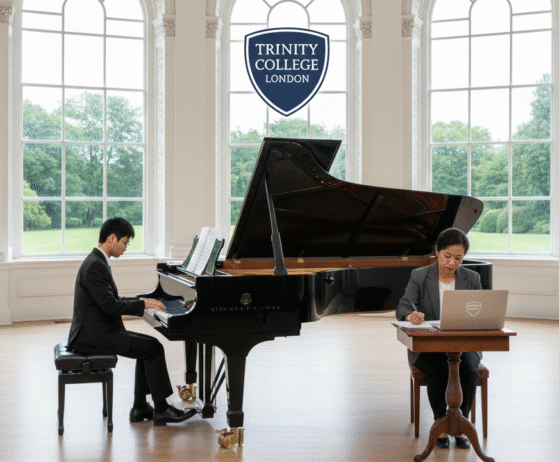
Trinity Assessment | Understanding the True Level of Difficulty
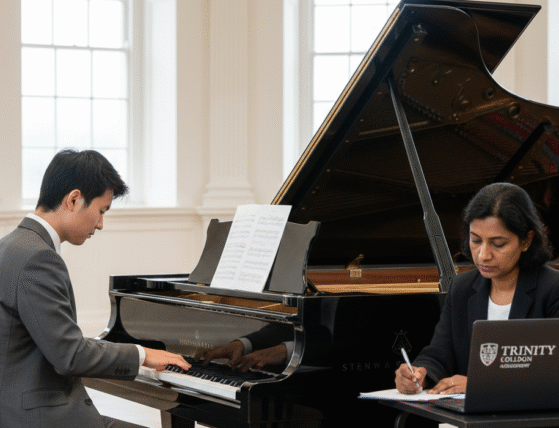
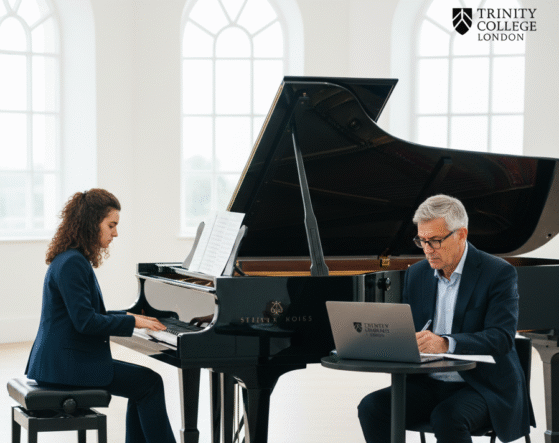
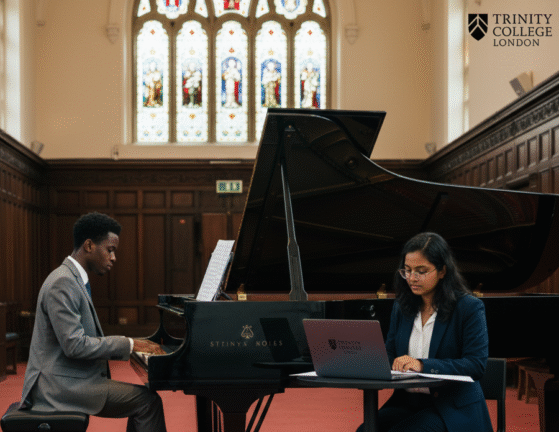
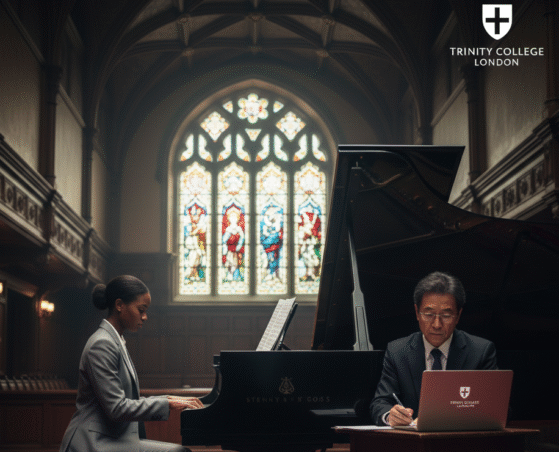
Music exams can intimidate, especially when you try to understand what each level expects of you. The Trinity Assessment, a globally recognized music examination system, evaluates your technical skill, musical understanding, and expressive ability. It pushes you to master not just the notes, but also timing, phrasing, and musical expression. Every grade introduces new challenges, requiring focused practice and a deep connection with your instrument. By approaching each stage thoughtfully, you can transform anxiety into confidence and growth.
In this blog, we explore the nuances of the Trinity Assessment and reveal what makes it both challenging and rewarding for musicians of all ages. From sight-reading and improvisation to performance and theory, every component tests different aspects of your musicianship. Understanding the expectations at each level helps you prepare effectively and progress steadily. Whether you are a beginner or an advanced student, the Trinity Assessment provides a clear roadmap for improving your skills and achieving musical excellence.
What Is the Trinity Assessment?
The Trinity Assessment is more than just a test—it’s a comprehensive evaluation of your musical journey. Unlike other exams that focus solely on technical ability, Trinity emphasizes a balanced approach: performance, musicianship, and understanding of theory. Each grade is carefully structured to progress in complexity, preparing students not just to play notes correctly but to perform with confidence and musicality.
Transitioning from one grade to the next is not just about learning harder pieces; it’s about developing a deeper connection with music. The assessment challenges students to interpret music, express emotion, and demonstrate control over rhythm and tone. This holistic approach is what often surprises newcomers who underestimate the true difficulty of the exam.
The Gradual Rise in Difficulty
One of the most misunderstood aspects of the Trinity Assessment is the gradual increase in difficulty between grades. Many assume that the difference between Grade 1 and Grade 5 is minimal, but each step introduces more complex techniques, advanced rhythms, and nuanced expression.
For example, early grades may focus on fundamental scales, simple pieces, and basic sight-reading. By mid-level grades, students encounter more challenging fingerings, varied articulations, and intricate time signatures. The higher grades demand a combination of technical mastery and expressive interpretation, making it clear that success is measured not just by hitting the right notes but by bringing the music to life.
This gradual rise ensures that musicians are constantly challenged without being overwhelmed, striking a balance between skill development and motivation.
Trinity Assessment| Performance vs Musicianship
A unique aspect of the Trinity Assessment is its dual focus: performance and musicianship. While performing a prepared piece accurately is important, examiners place equal emphasis on how well students understand music theory, improvisation, and sight-reading.
In practice, this means that a technically perfect performance may not score as highly as one that demonstrates musical awareness. Students are encouraged to explore dynamics, phrasing, and stylistic nuances, showing a deep comprehension of the pieces they perform. This is where the difficulty of the Trinity Assessment often becomes evident—success requires not just practice but genuine musical insight.
Transitioning smoothly between these areas—technical skill, musicality, and theoretical knowledge—can feel daunting at first. However, the holistic nature of Trinity ensures that students emerge as well-rounded musicians rather than simply skilled performers.
Understanding the True Challenge
So, what makes the Trinity Assessment truly difficult? It challenges students not just with complex music but by demanding the integration of skill, expression, and mental preparedness. Each grade requires students to concentrate deeply, build confidence, and internalize pieces rather than rely solely on memorization.
The performance setting can further amplify the challenge. Even experienced musicians often find the live, one-on-one evaluation nerve-wracking. This experience helps students develop resilience and stage presence—skills that prove invaluable in any musical career.
Difficulty also varies from student to student. What challenges one learner may feel natural to another. Trinity designs its assessments with this in mind, providing a clear roadmap for incremental growth while encouraging personal expression at every level.
Preparing for Success in Trinity Assessment
Understanding the level of difficulty comes first; students build confidence through thorough preparation. They can acclimate to both technical and expressive demands by following structured practice routines, receiving consistent guidance from teachers, and performing in mock exams.
Mindset also plays a crucial role. Students who recognize the Trinity Assessment as a learning journey rather than just a test experience less performance anxiety. Each grade gives them a new opportunity to improve, explore, and enjoy music in a structured yet expressive way.
Finally, students transform perceived difficulty into actionable insights by embracing feedback from examiners instead of fearing it. This approach allows them to grow at a pace that suits their abilities.
Conclusion
At The Mystic Keys, we guide students through the Trinity Assessment, a comprehensive music evaluation. It challenges students to combine technical skill, musicality, and theoretical knowledge. By practicing steadily and approaching it holistically, students master each step with confidence.
The Trinity Assessment is more than an exam—it’s a journey to becoming an expressive, skilled, and resilient musician.Knowing its true difficulty helps teachers and students tackle it with clarity and purpose.
Our structured approach ensures students grow in technique, rhythm, and musical understanding. We focus on building confidence, creativity, and stage presence. With consistent guidance and practice, every student can rise to the challenge and enjoy the art of music fully.
For more information and exciting resources about learning music, visit our website at The Mystic Keys. For more music content and exciting offers follow us on